


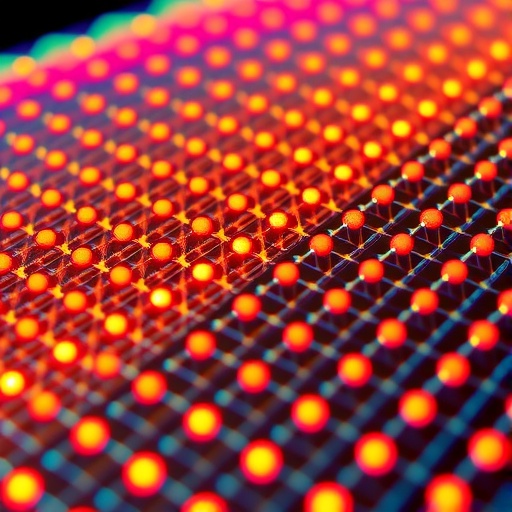
Quantum dot superlattices have long been heralded as a promising frontier for revolutionizing optoelectronic devices, particularly in the realm of display technologies. Their highly ordered structures offer collective properties that dramatically differ from traditional disordered solid films, promising enhanced performance. Despite their tremendous potential, integrating these materials into high-resolution, pixelated display systems has remained a formidable challenge. This obstacle primarily stems from the difficulty in producing thin films that are both structurally coherent and spatially defined at the nanoscale. However, a groundbreaking study from Zhang, C., Zeng, Q., Li, H., and colleagues, published in Nature (2026), now charts a new course toward overcoming these barriers.
At the heart of this advancement is a scalable method for fabricating pixelated perovskite quantum dot (PeQD) superlattice thin-film arrays that exhibit in-plane long-range order with precise vertical confinement and spatial patterning. The researchers achieved this feat by carefully engineering rhombic dodecahedral-shaped CsPbBr₃ nanocrystals. Unlike conventional spherical nanocrystals, these uniquely shaped quantum dots, when terminated robustly by a ligand-fluoride co-stabilization protocol, facilitate exceptional packing order. This surface chemistry approach confers stability while promoting self-assembly into hexagonally close-packed superlattice films, a critical characteristic for the desired optoelectronic properties.
One of the pivotal innovations enabling the perfect alignment and patterning of these nanocrystals involves capillary liquid-bridge confined assembly techniques. By harnessing the subtle dynamics of liquid interfaces confined between substrates, the team precisely controlled the deposition and organization of nanocrystals into uniform superlattice films with nanoscale positional accuracy. This method effectively overcomes previous limitations in spatial resolution for pixelated quantum dot arrays, marking a significant leap forward in nanoscale patterning capabilities with broad implications for next-generation device fabrication.
The resulting PeQD superlattice films showcase a remarkable reduction in energetic disorder—a key factor that limits the efficiency and stability of quantum dot devices. Furthermore, the enhanced electronic coupling within these films facilitates more efficient charge transport and recombination processes, fostering improved emission properties. These collective advances translate into superior performance metrics when integrated into functional light-emitting diodes (LEDs).
The constructed LEDs demonstrated an external quantum efficiency (EQE) reaching an impressive 30.9%. Moreover, these devices achieved luminance levels as high as 117,144 cd m⁻²—figures that outpace many existing PeQD-based systems. Even more striking is the pixel density achievable through this method, reaching up to 5,080 pixels per inch (PPI), which aligns with the demands for ultra-high-resolution display technologies, including applications in augmented reality, virtual reality, and advanced mobile devices.
Notably, the operational stability addressed one of the most challenging aspects of perovskite-based emitters. The devices exhibited an extrapolated operational half-lifetime (T₅₀) of 12,411 hours at a luminance of 100 cd m⁻². This longevity represents a more than 1,000-fold increase compared to previously reported pixelated PeQD LEDs, signaling a substantial breakthrough for commercial viability. Stability improvements are largely attributed to the ligand-fluoride surface passivation, which plays a crucial role in mitigating non-radiative recombination pathways and environmental degradation.
Taking an additional step towards practical applications, the research team successfully integrated the patterned PeQD superlattice films directly onto a commercial thin-film transistor (TFT) backplane. This integration resulted in the creation of a 1.85-inch active-matrix display capable of full greyscale control and real-time video playback. The demonstration conclusively proves the feasibility of incorporating these advanced nanomaterials into existing device architectures, a necessary step for technological adoption.
The implications of this work extend far beyond simple performance improvements. By establishing colloidal quantum dot superlattices as a viable materials platform for high-resolution, stable, and efficient perovskite displays, this study opens up avenues for the development of next-generation optoelectronic devices that can outperform conventional OLEDs and LCDs both in resolution and energy efficiency. Such devices could offer unprecedented color purity, brightness, and energy consumption profiles suitable for future consumer electronics.
Furthermore, the methodology presents a potentially scalable approach adaptable to various quantum dot compositions and device configurations, thus broadening its impact across different material systems and application fields. This versatility is paramount as the display industry continually seeks materials capable of pushing the envelope in terms of pixel density and device longevity without compromising manufacturability.
Technically, the ligand-fluoride co-stabilization technique not only enhances the chemical robustness of the CsPbBr₃ nanocrystals but also modifies their surface energetics to favor tighter packing and reduced trap states. This fundamental insight into surface chemistry manipulation provides a new toolkit for tuning nanocrystal interactions and superlattice formation, which could inspire further innovations in nanomaterial assembly.
Moreover, the investigation into liquid-bridge confined assembly underscores the importance of fluid dynamics and interfacial phenomena in nanomanufacturing. This precision assembly method could be generalized to other colloidal systems requiring high degrees of order and spatial control, suggesting wide-ranging utilities that transcend quantum dot research alone.
In essence, Zhang et al.’s work stands as a landmark achievement in marrying nanoscale materials engineering with device-level performance, answering long-standing challenges in the practical realization of quantum dot superlattice displays. The combination of improved optoelectronic characteristics, device stability, and integration with conventional electronics lays a strong foundation for future explorations aimed at commercializing quantum dot–based display technologies.
As the display industry faces mounting pressure to deliver higher resolution, better color accuracy, and longer-lasting devices, the innovations presented in this study could catalyze a shift towards quantum dot superlattices as the new standard for emissive displays. With this path clearly illuminated, forthcoming research will likely focus on scalable manufacturing techniques and the exploration of other perovskite compositions to further enhance device capabilities and environmental stability.
Given the intense research interest in perovskite materials and quantum dot technologies, the breakthrough achieved by Zhang and colleagues may well represent the dawn of a new era in optoelectronic devices, combining the best features of nanoscale materials science with the demands of practical, high-performance applications.
Cite Scienmag News
Denise Maddox. (April 16, 2026). Quantum-Dot Superlattice Enables Pixelated LEDs. Scienmag. https://scienmag.com/quantum-dot-superlattice-enables-pixelated-leds/
Denise Maddox. "Quantum-Dot Superlattice Enables Pixelated LEDs." Scienmag, 16 April 2026, https://scienmag.com/quantum-dot-superlattice-enables-pixelated-leds/. Accessed 4 September 2026.
Denise Maddox. "Quantum-Dot Superlattice Enables Pixelated LEDs." Scienmag. April 16, 2026. https://scienmag.com/quantum-dot-superlattice-enables-pixelated-leds/


