


Learning a second language is becoming increasingly popular worldwide, with millions of people turning to digital tools and mobile applications to pick up a new language at their own pace. But what makes some more popular or effective than others?
Many successful language-learning apps are built around a simple idea of making learners guess a word based on a picture, even before they learn the answer. This design isn’t just for fun, but a strategy that draws on decades of cognitive psychology which suggests that attempting an answer first and then seeing the correct one strengthens memory.
Now, a new study by NUS provides formal experimental evidence confirming why this works. The research shows that word-picture guessing exercises with immediate feedback can significantly improve adults’ ability to recall new vocabulary in a second language.
“Millions of people learn new languages through apps that rely heavily on word-picture guessing tasks, but the scientific evidence for how much those activities actually help learners remember new vocabulary has been limited,” said Assistant Professor Steven Pan from the Department of Psychology, NUS Faculty of Arts and Social Sciences. “Our study shows that attempting an answer first, even if you may not have learnt the word yet, and then seeing the correct response boosts memory and supports lasting learning.”
So why does guessing help? “When you try to answer before knowing the correct response, your brain actively searches memory and engages more deeply with the material. Seeing the correct answer immediately afterwards strengthens memory by helping the brain encode and retain the information more effectively than passive study alone,” explains Asst Prof Pan.
The ‘pretesting’ effect in action
In learning science, this ‘guessing-then-feedback’ approach is known as pretesting. Learners attempt an answer before they have fully learned the material and then receive instant feedback on whether they got it right or wrong, and which is the correct answer. Even if the initial guess is wrong, the process primes the brain to encode the correct answer more effectively, making later recall stronger than passive study alone.
Although prior research has shown that an initial attempt can strengthen later memory, most studies have focused on purely verbal materials (e.g., word pairs or text). It has therefore remained unclear whether the same benefit extends to the word-picture matching tasks that are central to many digital language-learning platforms.
How the study was conducted
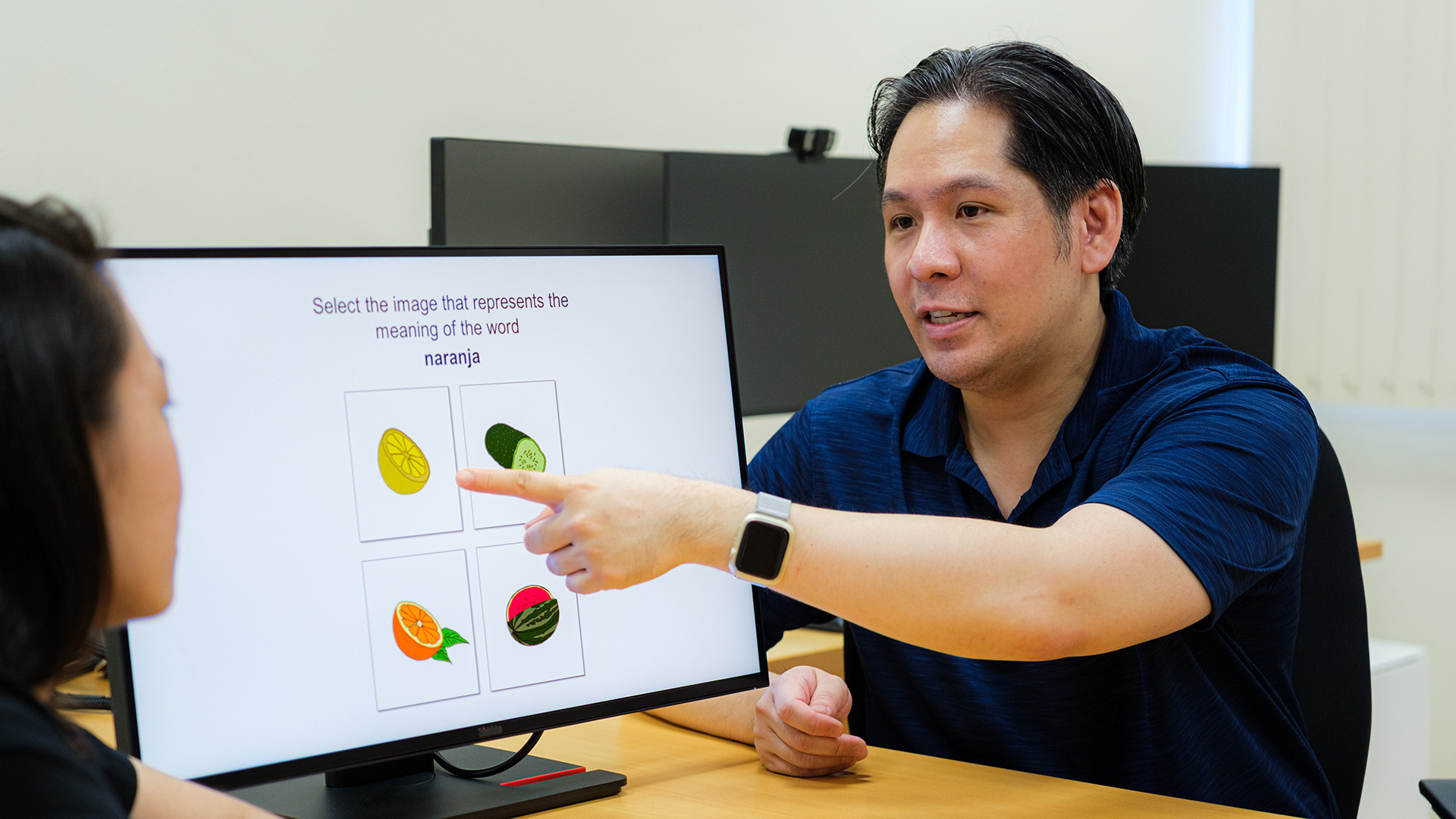
Asst Prof Steven Pan and NUS Department of Psychology Master’s student Ms Tabitha Chua designed four controlled experiments, across which a total of 341 adults who had no prior knowledge of Spanish participated. They were asked to learn Spanish nouns using two different learning methods:
- Guessing-with-feedback (pretesting), where participants made a multiple-choice guess before being told the correct word-picture pairing; and
- Study-only (reading), where participants viewed the word-picture pairs without guessing.
The experiments also varied the exercise format, or the direction in which information was presented, both of which are common in language apps:
- Word→image, where participants saw a Spanish word and chose the matching picture; and
- Image→word, where participants saw a picture and chose the correct Spanish word.
Memory was then assessed through cued recall (producing the answer from memory) and multiple-choice recognition tests.

Overall, the results showed that participants who guessed first, i.e. learned using the guessing-with-feedback method, consistently recalled words more accurately, whether they were presented with the word or image first.
“Second language learners often hesitate to guess until they feel confident, but the study’s results suggest that early attempts, even without full knowledge, can help learners engage more actively with words,” said Asst Prof Pan.
“For anyone using apps or self-study tools, choosing exercises that encourage trying first and learning from feedback is a simple way to strengthen vocabulary recall over time,” he added.
The findings of the study were published in the journal Cognitive Research: Principles and Implications on 6 March 2026. The team hopes the work will guide the design of evidence-based learning activities in both digital language platforms and classroom practice.
Cite Scienmag News
Courtney Benton. (April 15, 2026). NUS Study Reveals That Guessing Before Learning Enhances Memory in Language Acquisition. Scienmag. https://scienmag.com/nus-study-reveals-that-guessing-before-learning-enhances-memory-in-language-acquisition/
Courtney Benton. "NUS Study Reveals That Guessing Before Learning Enhances Memory in Language Acquisition." Scienmag, 15 April 2026, https://scienmag.com/nus-study-reveals-that-guessing-before-learning-enhances-memory-in-language-acquisition/. Accessed 3 September 2026.
Courtney Benton. "NUS Study Reveals That Guessing Before Learning Enhances Memory in Language Acquisition." Scienmag. April 15, 2026. https://scienmag.com/nus-study-reveals-that-guessing-before-learning-enhances-memory-in-language-acquisition/

