


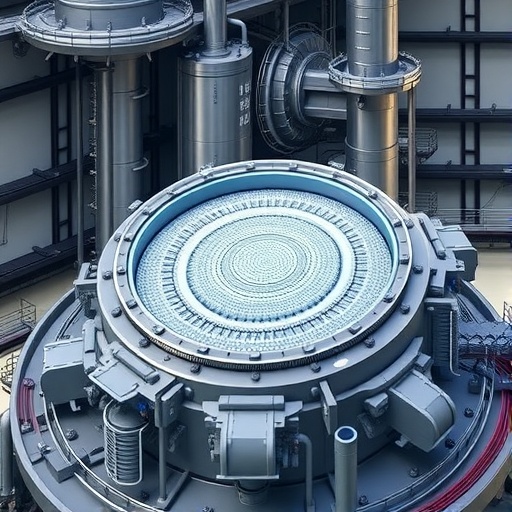
A groundbreaking advancement in catalytic reaction engineering has emerged with the development of the diameter-transformed fluidized bed (DTFB) reactor, a pioneering design that promises to revolutionize industrial catalytic processes. This innovative reactor concept, meticulously elaborated in a recent study published in the journal Engineering, represents a significant leap forward in addressing the intricate demands of automotive gasoline upgrading and multifaceted heterogeneous catalytic reactions, combining theoretical sophistication with practical industrial solutions.
At the heart of the DTFB reactor lies a profound understanding of the interplay between thermodynamics and kinetics in fluid catalytic cracking (FCC) reactions. Conventional reactors have struggled to reconcile the contrasting requirements of endothermic cracking—ideally conducted at high temperatures with short contact times—and exothermic isomerization and hydrogen transfer reactions, which favor low temperatures and prolonged contact. The DTFB ingeniously resolves this challenge by incorporating a diameter-variation strategy within a single reactor vessel, effectively partitioning distinct reaction zones that foster tailored reaction environments. This design not only enhances reaction specificity but also circumvents the operational complexities and inefficiencies inherent in linking multiple separate fluidized beds, such as intermediate retention and catalyst attrition.
Integral to the successful implementation of the DTFB design is the ability to accurately predict and control flow regime transitions within the reactor’s varying diameter sections. The research team has introduced a novel computational framework centered around a two-way coupled energy minimization multi-scale (EMMS) drag model combined with multi-scale computational fluid dynamics (CFD) techniques. This hybrid modeling approach captures both global operational dynamics and local hydrodynamic phenomena, enabling simulations that are robust against mesh discretization and sensitive to key design parameters. Critically, it elucidates the conditions that lead to choking—a detrimental flow instability particularly prevalent in expanded diameter zones—and quantifies how geometric factors like expansion ratio and bed height impact system stability.
To fully harness the DTFB’s catalytic potential, the study presents an integrative simulation framework pairing the EMMS drag supermodel with artificial neural networks (ANN), facilitating comprehensive reactive simulations of interconnected FCC reactor-regenerator systems. This full-loop modeling approach enables dynamic analysis of unit coupling, providing insights into operational steadiness and avenues for preemptive identification and mitigation of instabilities. This computational prowess represents a major stride toward combining reaction engineering with process control at unprecedented resolution.
Realizing the DTFB’s industrial promise also demanded parallel advancements in hardware and control strategies. Specialized distributor technologies, including mushroom-headed and concave distributor designs, have been developed to steer stable flow regime transitions and substantially reduce catalyst attrition rates. Moreover, the design integrates flexible control systems that precisely regulate temperature profiles, particle density, and gas-solid contact duration within each segmented reaction zone. Collectively, these engineering measures ensure that the DTFB reactor operates reliably at scale while delivering optimized catalytic performance.
Industrial application of the DTFB technology is already manifesting impressive achievements across multiple sectors. The study highlights eight fully commercialized processes that leverage the DTFB platform, with an additional one scheduled for implementation by 2026. These applications span from petroleum hydrocarbon catalytic cracking to olefin-to-light olefin conversion and methanol-to-light olefins (MTO) synthesis, demonstrating the design’s versatility. Notably, retrofitting FCC units with DTFB technology has yielded measurable benefits such as reduced dry gas and coke production, increased liquid product yields, and significant energy savings. These improvements have underpinned China’s progressive gasoline quality upgrades from National I through National VI emission standards, with the DTFB-based fuels commanding over 70% of the domestic catalytic cracking gasoline market share and affirming its international licensing footprint.
The DTFB reactor not only transforms process economics but also fundamentally alters the paradigm of catalytic reaction engineering by overcoming the long-standing trade-off between conversion efficiency and selectivity. By precisely tailoring reaction environments in a single fluidized bed, the platform achieves selective control that was previously unattainable without employing multiple reactors or stages, thereby reducing operational complexity and enhancing overall process sustainability.
Looking forward, the study charts an ambitious research trajectory aimed at deepening the integration of catalytic performance with flow dynamics. Future investigations are expected to delve into decoding the mechanisms governing reaction-flow regime matching, fostering a more nuanced co-design of catalysts and reactors through multi-scale kinetic modeling. Furthermore, the incorporation of artificial intelligence promises to accelerate industrial model development and innovation cycles, extending the DTFB’s impact beyond current applications to new frontiers of catalytic reaction engineering.
This landmark work embodies a convergence of fundamental science, cutting-edge modeling, and pragmatic engineering that is poised to redefine catalytic reactor technology. The DTFB reactor exemplifies how transformative innovation in reactor geometry and flow control can overcome entrenched limitations and unlock new operational and environmental efficiencies for large-scale chemical manufacturing.
The research, led by Youhao Xu and Bona Lu with collaborators from Sinopec and the Chinese Academy of Sciences’ Institute of Process Engineering, stands as a testament to the power of multidisciplinary collaboration in advancing sustainable industrial technologies. Their full open-access paper, titled “Diameter-Transformed Fluidized Bed-Based Catalytic Reaction Engineering and Industrial Application,” provides an expansive technical exposition of the concept, models, and industrial results, offering a foundational reference for academics and practitioners alike.
As the energy and chemical industries increasingly pursue decarbonization and resource optimization, innovations like the DTFB reactor illustrate the critical role of catalytic reaction engineering in achieving these goals. The combination of theoretical insight, computational rigor, and successful industrial deployment marks the DTFB as a pivotal development with broad implications for cleaner fuel production and more efficient petrochemical processes worldwide.
Cite Scienmag News
Bethany Barker. (April 15, 2026). Diameter-Transformed Fluidized Bed Advances Catalytic Reaction Engineering and Industrial Scale-Up. Scienmag. https://scienmag.com/diameter-transformed-fluidized-bed-advances-catalytic-reaction-engineering-and-industrial-scale-up/
Bethany Barker. "Diameter-Transformed Fluidized Bed Advances Catalytic Reaction Engineering and Industrial Scale-Up." Scienmag, 15 April 2026, https://scienmag.com/diameter-transformed-fluidized-bed-advances-catalytic-reaction-engineering-and-industrial-scale-up/. Accessed 4 September 2026.
Bethany Barker. "Diameter-Transformed Fluidized Bed Advances Catalytic Reaction Engineering and Industrial Scale-Up." Scienmag. April 15, 2026. https://scienmag.com/diameter-transformed-fluidized-bed-advances-catalytic-reaction-engineering-and-industrial-scale-up/


