


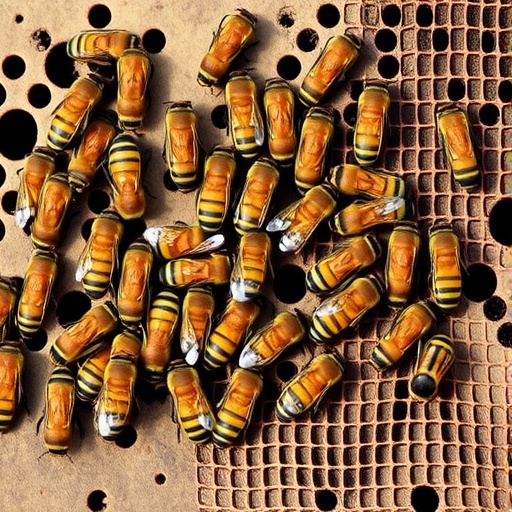
ITHACA, N.Y. — In a remarkable discovery that highlights the hidden biodiversity in overlooked urban spaces, researchers at Cornell University have identified one of the largest and oldest known aggregations of solitary, ground-nesting bees within the confines of East Lawn Cemetery in Ithaca, New York. The discovery was sparked by a simple but impactful chance observation when Rachel Fordyce, a technician in Cornell’s entomology lab, brought a jar full of bees found in the cemetery to her supervisor, Professor Bryan Danforth. These bees were identified as Andrena regularis, a species pivotal to both ecological balance and agriculture due to their pollination services.
This species, commonly referred to as the regular mining bee, is solitary and nests underneath the ground, exhibiting behaviors crucial for the reproduction of many plants, including commercially valuable crops such as apples. The Ithaca cemetery, covering a modest 1.5-acre plot, has been shown to harbor an estimated population of about 5.5 million individual A. regularis bees. This astonishing population density remarkably surpasses the scale of honeybee colonies, paralleling the pollination power of more than 200 managed hives, and exceeds the human population of Manhattan by over threefold. Such a massive congregation was previously undocumented for this species.
Researchers used innovative emergence traps—small, tent-like mesh enclosures placed on the ground—to capture and quantify bees exiting their subterranean nests. These traps funnel emerging insects into collection jars, enabling scientists to measure population density, emergence timing, and to study interspecies interactions with unprecedented precision. During the study period from late March to mid-May 2023, the team documented 3,251 individual insects comprising 16 species, with A. regularis overwhelmingly dominant. The traps demonstrated distinct emergence patterns, with males appearing first to maximize mating opportunities once females emerged days later.
The bees’ underground lifecycle is fascinating. After eggs are laid in brood cells provisioned with pollen and nectar, larvae develop entirely below the surface until they mature into adults that overwinter underground. This adult overwintering strategy is relatively rare in bees and aligns their emergence with early spring blooms, especially apple blossoms. Cornell Orchards, situated roughly a third of a mile from the cemetery, provides this critical floral resource, further supporting the thriving population. The sandy soils of the cemetery offer an optimal nesting environment, contributing to the aggregation’s longevity and size.
One particularly intriguing aspect revealed by the research is the presence of brood parasitism by nomad or “cuckoo” bees (Nomada imbricata). These parasitic bees wait for the regular mining bees to provision brood cells before infiltrating and laying their own eggs inside. Their larvae consume the host bee larvae, usurping the nutritional stores meant for the original offspring. This dynamic underscores complex ecological interactions within this dense bee community and adds depth to our understanding of host-parasite relationships in solitary bees.
Historical analysis indicates that these bee aggregations have been established at East Lawn Cemetery for over a century, with records dating back to the early 1900s. The cemetery’s establishment in 1878 and its minimal disturbance practice over the years have inadvertently created a biodiversity refuge, confirming theories that such green spaces can serve as vital refuges for rare and valuable species. These findings resonate with global conservation concerns as urban expansion threatens critical habitats for pollinators.
The peaceful environment of cemeteries, characterized by limited pesticide use and undisturbed ground, appears to offer an ideal haven for ground-nesting bees, which make up approximately 75% of all bee species. Despite their ecological importance, solitary ground nesters remain greatly understudied, highlighting a significant gap in entomological research and conservation efforts. This Cornell study closes some of that gap, using pioneering techniques to illuminate aspects of these bees’ emergence, sex ratios, and population dynamics.
The implications of this work extend beyond academic curiosity. Wild pollinators like Andrena regularis play essential roles in maintaining the health of ecosystems and agricultural productivity, particularly for fruit crops integral to New York’s economy such as apples. Protecting their nesting grounds ensures the sustainability of these ecosystem services. Professor Danforth stresses the urgency of conserving these sites, warning that urban development could erase millions of essential pollinators overnight.
To broaden the impact and collect global data on such bees, the research team launched an international citizen science project where individuals can report sightings and aggregations of ground-nesting bees in their own locales. This initiative not only raises awareness but equips communities with the tools to participate actively in pollinator conservation efforts, directly linking scientific discovery with public engagement.
The study, a collaboration of postdoctoral researchers, graduate and undergraduate students, and lab staff, was supported by the Cornell Atkinson Center for Sustainability along with the National Science Foundation and the Federal Capacity Funds program. It stands as a model for integrating field biology, novel sampling methodologies, and citizen science to address pressing environmental challenges.
This groundbreaking research not only redefines our understanding of pollinator population ecology but also elevates cemeteries—spaces traditionally seen only as somber landscapes—into critical hubs of biodiversity conservation. It invites a reevaluation of urban planning and land management practices to recognize and protect such inadvertent sanctuaries.
News Publication Date: April 13, 2026
Web References: DOI link
References: Hoge, S., Danforth, B., Kueneman, J., Odanaka, K., Fordyce, R., & Dobler, C. (2026). Emergence dynamics and host-parasite associations in a large aggregation of Andrena regularis. Apidologie.
Cite Scienmag News
Margaret Porter. (April 13, 2026). Cornell Researchers Record One of the Largest Ground-Nesting Bee Populations Ever Documented. Scienmag. https://scienmag.com/cornell-researchers-record-one-of-the-largest-ground-nesting-bee-populations-ever-documented/
Margaret Porter. "Cornell Researchers Record One of the Largest Ground-Nesting Bee Populations Ever Documented." Scienmag, 13 April 2026, https://scienmag.com/cornell-researchers-record-one-of-the-largest-ground-nesting-bee-populations-ever-documented/. Accessed 3 September 2026.
Margaret Porter. "Cornell Researchers Record One of the Largest Ground-Nesting Bee Populations Ever Documented." Scienmag. April 13, 2026. https://scienmag.com/cornell-researchers-record-one-of-the-largest-ground-nesting-bee-populations-ever-documented/


