


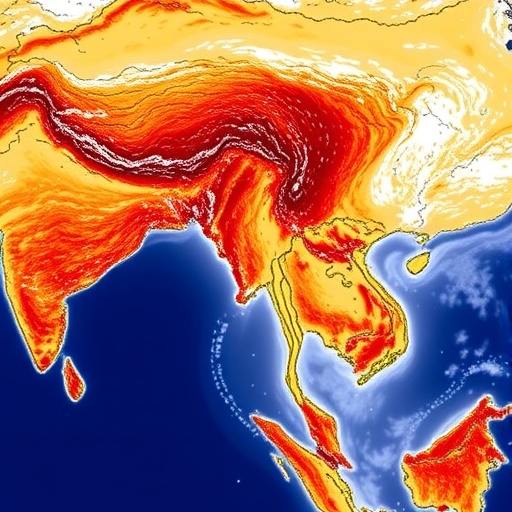
For decades, prevailing scientific consensus held that land-atmosphere interactions were fundamentally significant in arid and semi-arid environments, primarily because dry soils directly influence the surface flux of heat and moisture. These processes were understood to play a pivotal role in regulating local and regional climate variability. Conversely, the wet, humid Asian monsoon regions—with their copious and often persistent rainfall—were traditionally regarded as systems dominated overwhelmingly by large-scale atmospheric circulation patterns. The influence of land surface characteristics, it was thought, was negligible, effectively drowned out by the magnitude of moisture delivery from monsoonal winds and prevailing synoptic-scale phenomena.
However, recent research is upending this long-standing paradigm. A comprehensive review published in the journal Advances in Atmospheric Sciences critically reassesses the influence of land surfaces on precipitation dynamics in the humid monsoon realms of Asia. Spearheaded by Dr. Hiroshi G. Takahashi of Tokyo Metropolitan University, the study integrates two decades’ worth of cutting-edge satellite observations and state-of-the-art convection-permitting climate model simulations. This meticulous synthesis reveals that, contrary to prior assumptions, nuanced but substantial land-atmosphere coupling exerts a decisive impact on monsoon precipitation characteristics—especially concerning the timing and intensity of rainfall events.
In the classical “dryland paradigm,” empirical evidence has long demonstrated a straightforward relationship: wetter soils enhance surface evaporation, which in turn augments local moisture availability and convective precipitation. Yet, this straightforward causality does not translate cleanly to humid monsoon environments. Instead, the review elucidates a more intricate framework in which diurnal variability and boundary layer dynamics play critical roles. During daylight hours, increased soil moisture tends to suppress the growth of the boundary layer, thereby inhibiting the vertical development of convective plumes and consequently reducing rainfall intensity. Conversely, at night, land surface conditions influence nocturnal circulations and precipitation patterns, particularly in monsoon regions known for dominant overnight rainfall episodes such as the Indo-Gangetic Plain, the Khorat Plateau, and parts of central China.
These insights challenge the simplistic notion that greater evaporation invariably begets more rain in wet monsoon regions. The reality is far more complex, involving a delicate interplay between soil moisture, surface energy partitioning, atmospheric stability, and mesoscale circulations. This nuanced understanding carries wide-reaching implications for regional hydrology, ecosystem services, and the resilience of socio-economic systems dependent on monsoon rainfall patterns.
A critical enabler of this research revolution is the advent of high-resolution satellite radar systems such as NASA’s Tropical Rainfall Measuring Mission (TRMM) and the Global Precipitation Measurement (GPM) mission. These satellite platforms provide unprecedented detail on the spatiotemporal structure of precipitation, capturing the diurnal cycle and episodic variability with remarkable fidelity. This observational rigor has been pivotal in detecting how anthropogenic land-use changes, including urbanization and agricultural expansion, are modifying local microclimates and influencing precipitation timing and intensity at scales previously unresolvable.
Equally transformative is the emergence of convection-permitting climate models (CPCMs) operated at kilometer-scale resolution. Unlike conventional global climate models, which rely heavily on parameterized convection schemes to approximate sub-grid rainfall processes, CPCMs explicitly resolve convective dynamics, facilitating more realistic simulation of precipitation and its sensitivity to land surface heterogeneities. Dr. Takahashi emphasizes that this leap in modeling methodology transcends mere technical refinement; it closes a fundamental knowledge gap about land-atmosphere interactions by removing oversimplified assumptions and artificial constraints.
The comprehensive review underscores that many past modeling errors and uncertainties were not simply numerical artifacts but symptoms of an incomplete grasp of the coupling mechanisms governing the land-moisture-precipitation nexus in humid monsoonal zones. By integrating high-resolution observational data with convection-resolving simulation frameworks, researchers are now unraveling mechanisms by which soil moisture and surface energy fluxes modulate convective initiation, nocturnal low-level jets, boundary-layer humidity profiles, and ultimately, precipitation patterns.
Looking toward the future, the study urges intensified observational campaigns focused on boundary-layer vapor dynamics and enhanced soil moisture monitoring, especially through dedicated field experiments such as AsiaPEX (Asian Precipitation Experiment). These initiatives aim to bridge persistent data gaps and refine process-level understanding, thereby enabling improved precipitation forecasting under the growing challenges of global warming and rapid land-use transformation.
The review concludes with a compelling call to action for the scientific community: comprehensive integration of satellite-derived datasets, high-fidelity modeling approaches, and field-based observations is essential for advancing predictive capabilities of Asian monsoon rainfall. As climate change alters monsoon dynamics and land cover patterns, teasing apart the multifaceted feedback loops between terrestrial surfaces and atmospheric moisture transport assumes critical importance for the preparedness and sustainability of billions reliant on monsoon-driven water resources.
This paradigm shift redefines conceptual frameworks within atmospheric sciences and heralds a new era in monsoon research — one in which intricate land-atmosphere dialogues underpinning precipitation variability are finally brought into clear focus. The implications extend beyond academic curiosity, informing policy decisions, agricultural planning, disaster risk management, and climate adaptation strategies across one of the world’s most populous and climate-sensitive regions.
Cite Scienmag News
Russell Cooper. (April 13, 2026). How Land Surfaces Influence Rainfall Patterns in Humid Asian Monsoon Regions. Scienmag. https://scienmag.com/how-land-surfaces-influence-rainfall-patterns-in-humid-asian-monsoon-regions/
Russell Cooper. "How Land Surfaces Influence Rainfall Patterns in Humid Asian Monsoon Regions." Scienmag, 13 April 2026, https://scienmag.com/how-land-surfaces-influence-rainfall-patterns-in-humid-asian-monsoon-regions/. Accessed 3 September 2026.
Russell Cooper. "How Land Surfaces Influence Rainfall Patterns in Humid Asian Monsoon Regions." Scienmag. April 13, 2026. https://scienmag.com/how-land-surfaces-influence-rainfall-patterns-in-humid-asian-monsoon-regions/


