


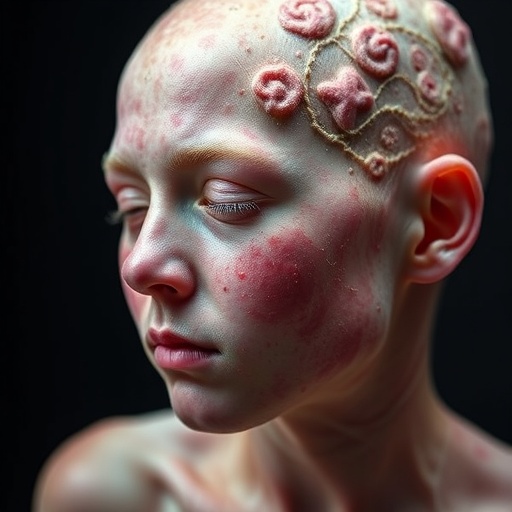
Imagine enduring a skin disorder so agonizing that affected individuals find themselves crawling through their homes, desperate to avoid the excruciating pain caused by walking on thickened, hardened calluses. This harrowing reality is faced daily by those afflicted with pachyonychia congenita (PC), a rare but debilitating genetic condition. PC arises from mutations in any one of five keratin genes and manifests as painful skin lesions predominantly on the soles of the feet, accompanied by characteristic nail thickening. Despite its rarity, the burden of PC profoundly diminishes quality of life, with sufferers often immobilized by the intense discomfort.
In groundbreaking research led by the University of Michigan and spearheaded by the laboratory of Pierre Coulombe, Ph.D., new insights have emerged elucidating the role of keratin 16 (K16), a protein central to the pathology of PC and similar dermatoses. This study unravels intricate molecular pathways that connect the dysregulation of K16 to abnormal immune responses within diseased skin, advancing our understanding of PC mechanistically for the first time. The investigation encompasses sophisticated experimental models, including genetically engineered mice and primary skin biopsies obtained from PC patients, uniting clinical and basic science in a synergistic approach.
As Erez Cohen, Ph.D., a key investigator in Coulombe’s lab and the study’s lead author, elaborates, “The skin’s reaction to wounding and stress comprises a precise choreography of molecular signals designed to restore tissue integrity. Our question was what transpires when this response spirals out of control.” This query strikes at the heart of PC and similar inflammatory skin diseases such as psoriasis, where an aberrantly heightened tissue stress response intersects with the immune system’s regulatory networks.
PC shares molecular fingerprints with prevalent conditions like psoriasis and atopic dermatitis (eczema), notably in the upregulation of stress-responsive keratins including K16 and an improperly modulated immune reaction. These keratin proteins, encoded by the mutated genes in PC, are pivotal players in the skin’s adaptive response to environmental and physiological stressors. Yet, prior to this study, the precise functions held by keratins like K16 in the pathogenesis and perpetuation of these disorders remained largely elusive, reflecting a critical gap in dermatological knowledge.
To dissect this complexity, Cohen, Coulombe, and colleagues embarked on a meticulous quest to decode cellular mechanisms governed by K16. Mining patient-derived data revealed a surprising linkage between K16 and the type I interferon (IFN) pathway, a molecular cascade best recognized for its role in antiviral immunity. Type I IFNs act as potent cytokines initiating and amplifying immune defenses, but their hyperactivation can provoke detrimental inflammation. The research team hypothesized that K16 might interface with this pathway, either restraining or exacerbating inflammatory circuits.
Employing a viral mimic—double-stranded RNA molecules that simulate pathogen presence—the researchers modeled immune activation in keratinocytes, the predominant cell type in the skin’s outermost layer. Investigations compared normal keratinocytes with those lacking K16 or harboring mutated K16 variants derived from PC patients. The results were striking: the absence or malfunction of K16 precipitated an exaggerated type I interferon response, magnifying inflammatory signaling beyond typical physiological levels. This finding spotlights K16 not merely as a structural cytoskeletal component but as a critical modulator dampening immune overactivation during stress.
Fundamental to the skin’s ability to heal is the resolution phase following inflammation, wherein activated cells revert to baseline function. This study overturns prior assumptions by demonstrating that K16 functions partly as a molecular “brake,” curbing inflammatory signaling as tissue repair progresses. Loss of this regulatory role, as occurs in PC-associated mutations, fosters persistent inflammation, driving chronic lesions and symptomology. Thus, K16’s dual identity emerges—both a scaffold protein and a key immunomodulatory agent maintaining skin homeostasis.
Excitingly, this mechanistic insight ushers in therapeutic possibilities hitherto unimaginable for PC, a condition currently bereft of effective treatments. The research team leveraged a transgenic mouse model of PC developed in Coulombe’s laboratory, administering topical formulations of ruxolitinib—a FDA-approved Janus kinase (JAK) inhibitor known to suppress type I interferon signaling. Application of ruxolitinib cream attenuated skin lesions and inflammation in the mice, providing compelling preclinical proof-of-concept for a novel targeted therapy that could dramatically improve patient outcomes.
The translational potential extends beyond PC alone, as keratin-associated dysregulation of interferon responses may underpin pathogenesis in multiple keratinopathic and inflammatory skin diseases. Supported by funding from the National Institutes of Health and the National Psoriasis Foundation, this research epitomizes the bench-to-bedside continuum, forging pathways from molecular discovery to clinical intervention. Cohen underscores the importance of foundational science in uncovering therapeutic targets: “Only by unraveling disease mechanisms at the protein and cellular level can we hope to develop precision treatments that truly meet patient needs.”
Pierre Coulombe reflects on the broader impact of studying rare disorders such as pachyonychia congenita, emphasizing their value in illuminating normal tissue biology and disease mechanisms. “Rare diseases often point us toward fundamental biological insights that are broadly relevant but overlooked due to low prevalence,” he states. Highlighting the collaborative nature of this work, Coulombe also praises the Pachyonychia Congenita Project (www.pachyonychia.org), a patient-driven advocacy organization that has been instrumental in facilitating access to critical patient samples and fostering partnerships among patients, clinicians, and scientists.
This pioneering investigation not only clarifies the enigmatic role of keratin 16 in skin inflammation and repair but also delivers hope to those afflicted by rare yet devastating dermatological conditions. By revealing K16 as a linchpin in restraining type I interferon-driven hyperinflammation, it opens new arenas for targeted immune modulation. Future clinical trials of JAK inhibitors and related agents may finally equip clinicians with viable therapies for PC and related keratin-associated skin disorders, transforming patient care and quality of life.
The study, published in Science Translational Medicine, represents a major advance in dermatological research, merging molecular genetics, immunology, and clinical science. Beyond the immediate findings, it exemplifies the power of integrating patient-derived data with sophisticated animal models to dissect complex disease pathways. As investigations continue, the field moves closer to unraveling the full spectrum of keratin functions and their implications for multiple skin pathologies.
With these discoveries, the scientific and medical communities are poised at the cusp of a new era wherein chronic skin diseases, once viewed as untreatable, might be managed or even cured through precise modulation of keratin-mediated immune pathways. The legacy of this work extends beyond pachyonychia congenita, enriching our holistic understanding of tissue stress responses and immune regulation across dermatology and immunology.
Web References:
Science Translational Medicine DOI Link
Pachyonychia Congenita Project
References:
Cohen Erez et al., “Keratin 16 inhibits type I interferon responses in differentiating keratinocytes of stressed and diseased skin,” Science Translational Medicine, 2024.
Cite Scienmag News
Juliet Wilcox. (April 13, 2026). New Research Uncovers Possible Cause of Debilitating Skin Condition and Reveals Promising Treatment Ahead. Scienmag. https://scienmag.com/new-research-uncovers-possible-cause-of-debilitating-skin-condition-and-reveals-promising-treatment-ahead/
Juliet Wilcox. "New Research Uncovers Possible Cause of Debilitating Skin Condition and Reveals Promising Treatment Ahead." Scienmag, 13 April 2026, https://scienmag.com/new-research-uncovers-possible-cause-of-debilitating-skin-condition-and-reveals-promising-treatment-ahead/. Accessed 3 September 2026.
Juliet Wilcox. "New Research Uncovers Possible Cause of Debilitating Skin Condition and Reveals Promising Treatment Ahead." Scienmag. April 13, 2026. https://scienmag.com/new-research-uncovers-possible-cause-of-debilitating-skin-condition-and-reveals-promising-treatment-ahead/


