


In an era where global agricultural supply chains face mounting scrutiny over their environmental footprint, a groundbreaking study offers a transformative approach to ensuring sustainable commodity trade. Recent innovations in high-resolution tracing technologies have now been applied to soybeans, a crop notoriously linked to deforestation, enabling unprecedented transparency in supply chains. This development could redefine how companies and consumers verify the origins of agricultural products, holding them accountable for environmental stewardship in real time.
Soybeans rank among the world’s most extensively traded commodities, with production concentrated in regions that are hotspots for deforestation, including the Amazon and Cerrado biomes. The expansion of soybean cultivation has historically been a major driver of forest loss, contributing to biodiversity decline and increased greenhouse gas emissions. Tracking the progression of these supply chains to verify that soybeans are sourced from deforestation-free areas has long been a challenge due to the complexity and opacity of agricultural markets spanning multiple countries and intermediaries.
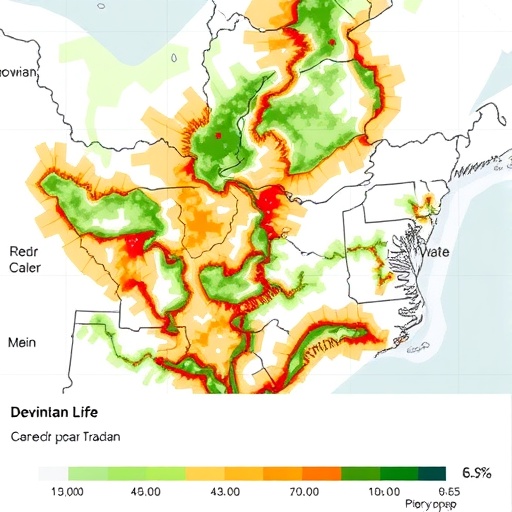
The latest research introduces an advanced methodology capable of tracing soybean shipments with unparalleled spatial resolution. By integrating satellite imagery, geospatial analytics, and detailed supply chain records, the system creates high-definition maps that pinpoint exact fields of origin. Unlike traditional verification protocols that rely heavily on company reporting and coarse geographic indicators, this approach offers objective, data-driven evidence of production locations and land use history, shining a light on the entire journey from farm to exporter.
At the core of this innovative tracing framework is the fusion of remote sensing technologies and machine learning algorithms. These technologies collectively analyze spectral signatures to distinguish soybean fields from surrounding natural vegetation and other crops. The system leverages multispectral satellite data with frequent revisits and fine spatial granularity, allowing identification of plant phenology and field boundaries. This dynamic temporal information improves accuracy, enabling differentiation between newly deforested sites and long-term agricultural areas, which is crucial for distinguishing legal cultivation from illicit land clearing.
This research goes beyond surface-level mapping by incorporating historical deforestation data and land tenure records. With these integrated layers, the tracing tool can verify whether soybeans originate in areas legally cleared prior to conservation regulations or in recently deforested zones—information vital for enforcement of legality standards. Furthermore, cross-validation with transport and export documentation strengthens the integrity of the tracing results, effectively preventing fraudulent reporting and concealment of origins within complex supply chains.
The implications of applying such precise tracing extend far beyond monitoring. For buyers committed to sustainability, the ability to validate deforestation-free sourcing offers a powerful instrument to ensure compliance with corporate environmental commitments and regulatory frameworks. It provides tangible evidence to support “zero deforestation” pledges and enables supply chain partners to identify and engage with producers adhering to best practices. This heightened transparency can foster responsible investment and consumer confidence, while disincentivizing land conversion and degradation.
Equally impactful is the potential for governments and regulatory bodies to adopt these technologies for enforcement and certification. By offering a verifiable standard for deforestation monitoring linked directly to shipment batches, authorities can streamline audits and reduce reliance on informal or retrospective assessments. This could enhance governance effectiveness in regions where illegal clearance is a pervasive challenge, stimulating compliance through improved traceability and accountability.
This technology also aligns with emerging international frameworks aimed at mitigating climate change impacts associated with agriculture-driven deforestation. By linking supply chain data with carbon accounting and ecosystem service valuation, policymakers and companies can better quantify and manage the climate benefits of sustainable sourcing. This integration paves the way for verified carbon credits and incentive programs tied to conservation, promoting economic models that couple profitability with planetary health.
Despite its transformative promise, scaling this high-resolution tracing approach across global supply chains comes with challenges. The approach requires substantial computational resources to process and analyze large volumes of satellite and logistical data continuously. Additionally, achieving full transparency depends on cooperation among diverse stakeholders—farmers, traders, governments, and certification bodies—to share information and uphold data integrity. Privacy concerns and commercial sensitivities must also be navigated carefully to ensure ethical use and broad acceptance.
Nevertheless, pilot applications in major soybean-producing regions have demonstrated impressive efficacy, detecting deforestation signals linked to supply chain movements with accuracy exceeding existing methodologies. These case studies highlight the tool’s adaptability across different landscapes and cropping systems, reinforcing its potential as a universal solution for sustainable agricultural commodity tracing.
Looking ahead, further enhancements under development aim to incorporate real-time monitoring capabilities, enabling near-instant detection of deforestation events and production anomalies. Coupled with blockchain-based transaction records, this could facilitate automatic alerts and responsive interventions, enabling supply chain actors to act swiftly on environmental risks. Such advancements would mark a paradigm shift from reactive to proactive environmental governance.
The study underscores the critical role of interdisciplinary collaboration in addressing complex sustainability challenges. By bringing together expertise in remote sensing, agronomy, data science, and supply chain management, the researchers have crafted a holistic system that bridges technological innovation and policy relevance. This fusion manifests as a powerful tool for enforcing environmental responsibility in the agricultural sector.
Ultimately, the high-resolution soybean tracing framework represents a beacon of hope in global efforts to decouple agricultural commodity production from deforestation. As markets and consumers increasingly demand deforestation-free products, technologies offering verifiable traceability will be central to transforming supply chains and safeguarding natural ecosystems. This study exemplifies how cutting-edge science can empower decisive action against one of the most pressing environmental crises of our time.
By enabling continuous, granular, and transparent tracking of soybean origins, this work lays the foundation for scalable models applicable to diverse commodities and geographies beyond soy. As these tools gain traction, they promise to catalyze a new era of accountability and sustainability across global food systems, inspiring collective responsibility toward a more resilient and eco-conscious future.
In conclusion, harnessing the power of satellite imagery combined with sophisticated data analytics to trace soybean supply chains exemplifies a major leap forward in environmental oversight. This innovation offers not only a pathway to eliminate deforestation from one of the world’s most critical agricultural commodities but also sets a precedent for similar breakthroughs in supply chain transparency. Stakeholders at every level stand to benefit from adopting these technologies, as they represent a vital asset in the quest to reconcile food security with planetary conservation imperatives.
Cite Scienmag News
Violet Maxwell. (April 13, 2026). High-Resolution Soybean Tracing Enables Deforestation-Free Supply. Scienmag. https://scienmag.com/high-resolution-soybean-tracing-enables-deforestation-free-supply/
Violet Maxwell. "High-Resolution Soybean Tracing Enables Deforestation-Free Supply." Scienmag, 13 April 2026, https://scienmag.com/high-resolution-soybean-tracing-enables-deforestation-free-supply/. Accessed 3 September 2026.
Violet Maxwell. "High-Resolution Soybean Tracing Enables Deforestation-Free Supply." Scienmag. April 13, 2026. https://scienmag.com/high-resolution-soybean-tracing-enables-deforestation-free-supply/


