


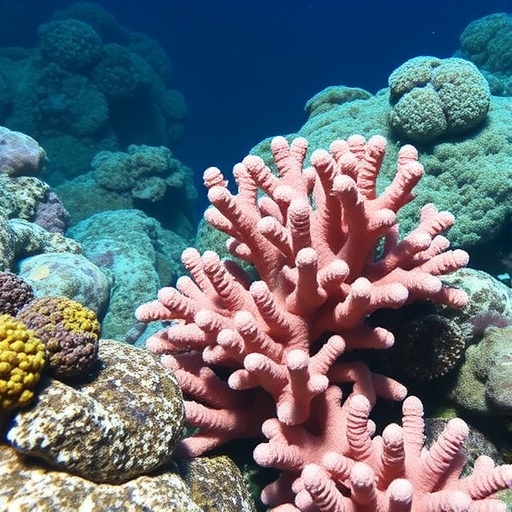
Emerging research is shedding unprecedented light on the intricate dietary webs of coral reef ecosystems—thanks to an unlikely but groundbreaking proxy: crustose coralline algae. Recent findings reveal that the biomineral-bound nitrogen isotopes within these calcifying organisms provide a reliable baseline for reconstructing coral trophic strategies. This insight promises to revolutionize our understanding of coral nutrition, shedding light on ecological dynamics previously concealed by conventional methodologies.
Coral reefs are complex, multifaceted systems where corals themselves engage in a remarkable diversity of feeding strategies. These range from autotrophic nutrition through symbiotic algae to heterotrophic feeding on plankton and dissolved organic matter. Despite decades of research, quantifying and disentangling these trophic pathways has remained challenging due to methodological constraints and the dynamic, often opaque environments in which corals reside.
Enter crustose coralline algae (CCA), a sessile group of calcifying red algae known for their critical role in reef cementation and stability. Traditionally valued for their ecological engineering capabilities, CCA have now stepped into the spotlight as robust isotopic archives. Their skeletal biominerals incorporate nitrogen isotopes in a manner that reflects ambient nutrient sources and cycle dynamics, essentially encoding environmental and biological information within their calcium carbonate frameworks.
The innovation lies in analyzing the nitrogen isotopic composition bound within the algal biominerals themselves, rather than the more labile organic matter. This approach circumvents the usual issues surrounding sample degradation and diagenesis, offering a more stable and temporally integrated isotopic signal. By leveraging this stable archive, researchers can establish isotopic baselines that anchor interpretations of coral feeding regimes with unparalleled precision.
Delving deeper, isotopic nitrogen exists primarily as two stable isotopes: ^14N and ^15N. The ratio of these isotopes (expressed as δ^15N) reveals critical information about nutrient sources and trophic level positioning. In coral reef systems, δ^15N signatures vary with local biogeochemical processes, the presence of nitrogen-fixing organisms, and the relative contribution of dissolved versus particulate N sources. By capturing these δ^15N signatures in CCA biominerals, scientists gain a window into the baseline nitrogen pool fueling the ecosystem.
This research team systematically collected CCA samples from diverse reef sites, spanning gradients of nutrient availability and anthropogenic impact. Through meticulous isotopic analyses, they demonstrated that the δ^15N values in CCA biominerals consistently reflected the baseline nitrogen isotopic composition of reef waters. This baseline provides a critical reference point when assessing the isotopic signatures of corals themselves, enabling a more accurate reconstruction of their trophic strategies.
In practical terms, this means that previously ambiguous variations in coral tissue nitrogen isotopes can now be contextualized against a reliable environmental baseline. Corals exhibiting elevated δ^15N compared to the baseline likely engage more heavily in heterotrophy, supplementing their nutrition by consuming plankton or organic particles. Conversely, closer δ^15N alignment with CCA-derived baselines suggests a dominant reliance on autotrophic nutrition through symbiosis with photosynthetic algae.
Moreover, the study’s findings extend beyond static snapshots. Because CCA grow incrementally, their biomineral nitrogen isotopic record can chronicle temporal changes in nutrient dynamics. This opens the door to reconstructing historical shifts in coral trophic behavior in response to environmental disturbances such as eutrophication, climate change-driven bleaching events, or shifts in reef food web structure.
The method represents a significant advance over prior isotopic approaches that focused solely on coral tissue or dissolved nutrient pools, both of which are liable to rapid turnover and intricate metabolic fractionations. CCA biominerals, by contrast, integrate isotopic signals over months to years, offering a robust archive that smooths out short-term fluctuations and enhances interpretative clarity.
In addition to trophic reconstruction, this isotopic baseline can inform models of reef resilience. Understanding how corals modulate their feeding strategies in the face of stress—such as increased sedimentation or reduced symbiont photosynthesis—can yield crucial insights into their adaptive capacity. The ability to benchmark these strategies with a stable nitrogen isotopic reference anchors ecological interpretations in concrete geochemical data.
Another exciting implication is the potential to apply this methodology across coral reefs globally. Given the widespread distribution of CCA and their integral role in reef ecosystems, biomineral nitrogen isotope analysis holds promise as a standardized tool for comparative reef ecology. This universality could unify disparate field studies under a common isotopic framework, enhancing cross-site syntheses and meta-analyses.
The study also underscores the intricate biogeochemical coupling within reef systems. CCA not only record nitrogen isotope information but are themselves influenced by nutrient cycling processes mediated by microbial communities, symbionts, and reef metabolism. This positions them as both bioarchives and active participants in the nitrogen dynamics central to coral reef functioning.
Technical challenges remain, such as fully elucidating the mechanisms of nitrogen incorporation into CCA biominerals and addressing potential diagenetic influences in fossil or subfossil samples. However, advances in microanalytical techniques and isotopic imaging are rapidly enhancing resolution and interpretive power, promising ever more detailed reconstructions of reef trophic and environmental histories.
In a broader ecological and conservation context, this research shines a light on the subtleties of coral nutrition that underpin reef health. By clarifying how corals partition energy sources and adapt their trophic strategies, managers and scientists can better predict responses to environmental change and strategize targeted interventions.
This innovative use of crustose coralline algae biomineral nitrogen isotopes marks a paradigm shift in coral reef trophic ecology. It transforms a seemingly inert carbonate skeleton into a dynamic geochemical record, illuminating the nuanced nutritional networks sustaining coral reefs. As this method gains traction, it is poised to become a cornerstone for future coral reef research, conservation, and management efforts worldwide.
In essence, the intertwining of biology, chemistry, and geology within this approach captures the multifaceted nature of coral reefs. By unlocking the isotopic stories held within calcium carbonate, researchers reveal the otherwise invisible feeding strategies that maintain coral vitality, ecosystem productivity, and the resilience of one of Earth’s most biodiverse habitats.
As global coral reefs face mounting pressures from climate change, pollution, and overexploitation, innovative tools such as this are critical. They enable a more informed stewardship by revealing how fundamental processes like nutrition adapt and evolve in changing ocean environments. The biomineral chemistry of crustose coralline algae thus emerges not only as a scientific breakthrough but as a beacon of hope for coral reef futures.
Cite Scienmag News
Daisy Hatcher. (April 10, 2026). Crustose Coralline Algae Isotopes Reveal Coral Diets. Scienmag. https://scienmag.com/crustose-coralline-algae-isotopes-reveal-coral-diets/
Daisy Hatcher. "Crustose Coralline Algae Isotopes Reveal Coral Diets." Scienmag, 10 April 2026, https://scienmag.com/crustose-coralline-algae-isotopes-reveal-coral-diets/. Accessed 3 September 2026.
Daisy Hatcher. "Crustose Coralline Algae Isotopes Reveal Coral Diets." Scienmag. April 10, 2026. https://scienmag.com/crustose-coralline-algae-isotopes-reveal-coral-diets/


