


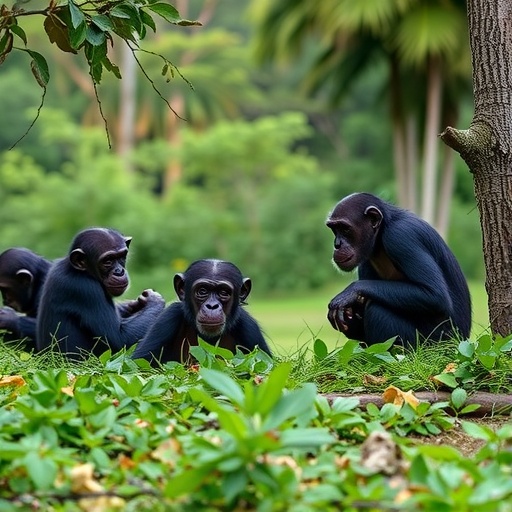
In a groundbreaking discovery that reshapes our understanding of chimpanzee social dynamics, researchers have documented an unprecedented permanent split within the largest wild chimpanzee community ever recorded. The Ngogo chimpanzees of Kibale National Park, Uganda—a population extensively studied over nearly thirty years—have divided into two discrete groups, setting off a chain of violent confrontations that challenge long-held assumptions about primate social behavior. This study, recently published in the journal Science, emerges from collaborative efforts between The University of Texas at Austin and multiple international research institutions and offers profound insights into the evolutionary roots of social fragmentation and conflict.
For over two decades, the Ngogo chimpanzee community exhibited a complex, fluid social structure known as fission-fusion dynamics. This system allows individuals to move freely between different social subunits or “clusters,” maintaining expansive social bonds and generalized group cohesion. Within this dynamic framework, clusters coexisted in overlapping territories, with individuals frequently interacting across subgroup boundaries. This flexible structure is integral to chimpanzee social strategies, promoting resource sharing, cooperation, and reduced intra-community aggression. However, this longstanding social harmony was disrupted around 2015, when researchers observed a growing polarization manifesting as avoidance behaviors between the cluster groupings, specifically between the Western and Central subdivisions.
The emergence of this schism coincided with a critical shift in the male dominance hierarchy, signaling a reorganization of social power within the community. Researchers attribute this transformation in part to the loss of several mature adult males who may have served as vital social connectors bridging the subgroups. These males likely played pivotal roles in mediating interactions and sustaining community cohesion, and their absence left a structural vacuum exacerbating inter-cluster divisions. By 2018, what began as social distancing crystallized into a permanent fission: two distinct chimpanzee groups, defined by exclusive territorial ranges and identities, diverged from what was once a single, cohesive society.
This division incited a series of lethal intergroup conflicts previously undocumented at such a scale and longevity among wild chimpanzees. Between 2018 and 2024, systematic observations and high-confidence inferences confirmed at least seven attacks targeting adult males and seventeen directed at infants from the opposing group, predominantly initiated by members of the Western faction against their former community peers in the Central group. The brutal nature of these aggressions underscores a radical transformation in social relationships—individuals who once cooperated and shared complex social bonds now engage in fatal hostility driven by newly forged group allegiances.
Aaron Sandel, an associate professor of anthropology at UT Austin and the study’s lead author, emphasizes the significance of these findings in understanding social identity and conflict. He notes, “The new group identities are overriding cooperative relationships that had existed for years.” This revelation highlights how emergent social constructs can fundamentally reshape behavioral repertoires, even in species lacking language or formalized cultural markers of identity. Such findings carry profound implications for reconceptualizing the driving forces behind group conflict, suggesting that primate species, including humans, may harbor innate predispositions toward factionalism and aggression grounded in relational dynamics.
Permanent fissions of this nature are extraordinary among chimpanzees, where fission-fusion societies typically prevent lasting group splits. Genetic analyses estimate these events to occur roughly once every 500 years, underlining their rarity and the exceptional nature of the Ngogo population’s division. The sole previously documented case occurred in the 1970s within the Gombe chimpanzee community in Tanzania during Jane Goodall’s pioneering research. However, that event remains contentious due to food provisioning by researchers possibly influencing social behaviors. In contrast, the Ngogo chimpanzees have never been provisioned, enhancing the ecological validity and significance of these new findings, which are grounded in the longest continuous observation effort by John Mitani and a dedicated multinational team.
Intriguingly, these observations confront prevailing hypotheses asserting that human warfare, including civil wars, primarily arises from cultural constructs such as ethnicity, religion, or ideology. Instead, this study positions relational mechanisms—social bonds and group cohesion—as fundamental forces capable of driving polarization and lethal conflict independently. Sandel cautions against simplistically labeling the phenomenon as a “civil war,” yet he underscores its relevance to human societies by illustrating that deep social schisms can emerge absent complex cultural identifiers or language, indicating evolutionary continuity in the roots of factional violence.
The implications of this research extend beyond primatology, offering a framework to explore the origins of human intergroup violence and reconciliation. If relational dynamics alone incite conflict in chimpanzee societies, cultural elements in human contexts might merely amplify or overlay more basic psychological and social processes. This perspective provides a hopeful avenue for mitigating human conflicts, emphasizing interpersonal daily acts of reconciliation and social repair as potential catalysts for peace-building.
Furthermore, the Ngogo case study enriches our grasp of primate social ecology, territoriality, and conflict. The newly delineated Western and Central chimpanzee groups demonstrate territorial exclusivity that contrasts with previously fluid boundaries. This territoriality, coupled with permanent social identity formation, resembles early stages of social speciation, underscoring how environmental pressures and demographic shifts can rapidly reorganize societal structures within long-lived primate populations.
Sandel’s research team meticulously combined behavioral observation, ecological monitoring, and genetic analysis to construct this comprehensive picture of social fission and violence. The painstaking longitudinal study draws on decades of continuous fieldwork, deploying a multidisciplinary approach that integrates ethology, anthropology, and evolutionary biology. These findings compel reconsideration of primate social models and underscore the necessity of sustained field studies to capture rare, transformative events in wild animal populations.
In a broader evolutionary context, the Ngogo findings challenge anthropocentric assumptions about the uniqueness of human social conflict. The lethal aggression between formerly cohesive chimpanzee subgroups, in the absence of symbolic communication or culturally derived identities, suggests that the evolutionary lineage shared with humans possesses inherent propensities for social schism and violence. Understanding these predispositions may illuminate the underpinnings of complex human social phenomena and reinforce the importance of fostering cross-group social bonds.
Ultimately, this research punctuates the fragile balance of cooperation and competition inherent in primate societies. The split of the Ngogo chimpanzee community serves as both a poignant natural experiment and a mirror reflecting the deep evolutionary roots of social fragmentation. It invites scientific and public audiences alike to contemplate the intersections of identity, conflict, and reconciliation—not just in our closest animal relatives but within humanity itself.
News Publication Date: 9-Apr-2026
Web References: DOI: 10.1126/science.adz4944
Cite Scienmag News
Courtney Benton. (April 9, 2026). Rare Case of Division and Deadly Violence Observed in World’s Largest Known Chimpanzee Community. Scienmag. https://scienmag.com/rare-case-of-division-and-deadly-violence-observed-in-worlds-largest-known-chimpanzee-community/
Courtney Benton. "Rare Case of Division and Deadly Violence Observed in World’s Largest Known Chimpanzee Community." Scienmag, 9 April 2026, https://scienmag.com/rare-case-of-division-and-deadly-violence-observed-in-worlds-largest-known-chimpanzee-community/. Accessed 3 September 2026.
Courtney Benton. "Rare Case of Division and Deadly Violence Observed in World’s Largest Known Chimpanzee Community." Scienmag. April 9, 2026. https://scienmag.com/rare-case-of-division-and-deadly-violence-observed-in-worlds-largest-known-chimpanzee-community/


