


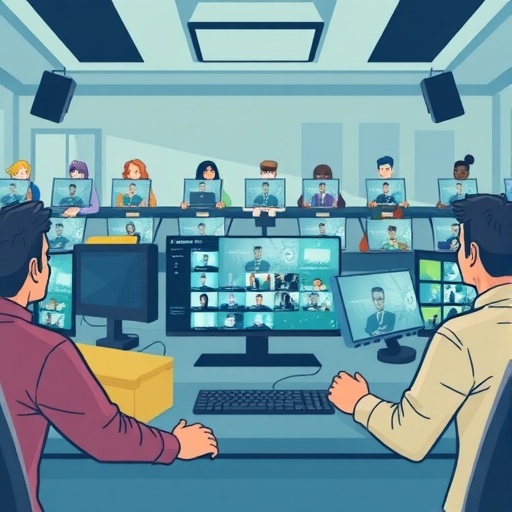
In the rapidly evolving digital landscape, livestreaming has emerged as a transformative medium reshaping how audiences engage with content and how creators connect with their followers. Amidst the dominance of prerecorded content on platforms like TikTok, a provocative question arises: Can the simple act of debuting a new single or product through a livestream forge a more profound and authentic bond between performer and audience or seller and consumer? Recent research conducted by scholars at the McCombs School of Business, University of Texas at Austin, suggests that the answer is a resounding yes.
The livestreaming industry has witnessed unprecedented growth, catalyzed in part by global social shifts during the COVID-19 pandemic. From an estimated valuation of $100 billion in 2024, projections indicate the market will soar to an astounding $345 billion by 2030. This meteoric rise is echoed by user engagement patterns, with approximately 30% of internet users globally tuning into livestreams on social media platforms at least once a week. These trends signify more than just a fleeting fascination—they point toward a fundamental change in how digital experiences are perceived and valued.
Adrian Ward, an associate professor of marketing at UT Austin, embarked on this inquiry after personally experiencing the magnetic pull of a livestreamed town hall meeting. Ward found himself engrossed not solely because of the speaker’s content but due to the “liveness” factor—the awareness that the event was unfolding in real time. This prompted a deeper investigation into what Ward and his colleagues term the “mere liveness effect,” positing that knowing something is live heightens viewers’ feelings of connection and presence.
To rigorously explore this phenomenon, Ward teamed up with researchers Alixandra Barasch from the University of Colorado Boulder and Nofar Duani from the University of Southern California. Their experimental approach consisted of five meticulously designed studies involving over 3,500 participants across different platforms and contexts. These experiments manipulated variables such as video format (live vs. prerecorded) and content type to parse out the psychological impact of real-time broadcasting.
One notable experiment invited participants to consume content on Twitch, a leading livestreaming platform, where they freely selected live or recorded videos to watch. Another involved watching live versus prerecorded performances by “Sunny and the Black Pack,” an R&B cover band, on YouTube Live. In a third experiment, the researchers engineered a bespoke streaming interface to present identical videos under the guise of either live or prerecorded content, isolating the effect of perceived liveness from other factors.
The results of these studies consistently highlighted the multifaceted advantages of livestreaming. Viewers who engaged with live content reported feeling more connected to the performers—an effect quantified as a 7 percentage point increase relative to prerecorded counterparts. Interestingly, this connection intensified when participants believed they were the sole audience members, underscoring the uniqueness and intimacy of shared live experiences even in isolation.
Beyond connection, enjoyment levels diverged significantly between formats. Participants reported deriving 5 percentage points greater pleasure from live streams compared to recorded videos. This elevated enjoyment extended to behavioral metrics as well; viewers were more likely to remain engaged for longer durations and demonstrated an increased propensity to follow or subscribe to streamers providing live content. This “liveness lift” points to real-world implications for retention and audience growth strategies.
Fundamentally, these psychological effects are underpinned by a heightened sense of presence. Ward explains that live viewing engenders psychological transportation, collapsing the perceived distance between viewer and performer. The viewer’s knowledge that the event is happening “right now” dissolves the usual barriers that separate digital consumption from in-person experiences, fostering a feeling of shared temporal and spatial immersion.
However, certain conditions can modulate the strength of this liveness effect. The research indicates that the ability to see a performer’s face is critical. When viewers only saw abstracted components—such as a musician’s hands without facial visibility—the connection diminished despite identical performances. Thus, visual cues and personal presence are integral to maximizing the potential of live interactions.
The research has profound implications for various stakeholders in the digital content ecosystem. For marketers, it suggests that live product launches or promotional events could enhance consumer engagement and loyalty by fostering authentic, real-time interpersonal connections. For platform developers, embedding features that highlight the liveness of content—beyond mere timestamps or notifications—could boost user retention and platform stickiness.
Content creators, artists, and influencers stand to benefit as well. The findings suggest that real-time interaction goes beyond mere novelty, representing a substantive shift in how audiences perceive and value digital presence. Ward and his team are currently extending this research to explore whether the liveness effect translates into tangible business outcomes, such as enhanced brand trust or elevated sales figures.
Ultimately, the core insight emerging from this body of work is that livestreaming is not merely a distribution method but an experiential catalyst. The unique temporal alignment of performer and audience fosters a shared space that feels more genuine, immediate, and communal. It engages viewers on psychological and emotional levels distinct from traditional video consumption, deepening bonds in a digital age where social fulfillment increasingly hinges on virtual connections.
As digital ecosystems continue evolving, embracing the principles of liveness could redefine best practices for content delivery and audience engagement. Beyond entertainers and marketers, these insights beckon a reevaluation of how we conceive social presence, authenticity, and connection in the age of the internet. What emerges is a vision where livestreaming forms the backbone of richer, more immersive digital experiences that blur the lines between presence and absence, performer and spectator.
The work of Ward and colleagues heralds a new frontier in understanding human behavior in mediated environments, one where the temporal immediacy of digital content becomes a powerful lever for connection and engagement. As livestreaming cements its place at the core of the online economy, tapping into the “mere liveness effect” could become a strategic imperative for brands, creators, and technologists alike, ushering in a more vibrant and connected digital world.
News Publication Date: 26-Jan-2026
Web References:
- https://www.mccombs.utexas.edu/faculty-and-research/faculty-directory/profile/?username=aw33587
- https://www.teleprompter.com/blog/live-streaming-statistics
- https://journals.sagepub.com/doi/abs/10.1177/00222429261421488
References:
Ward, A., Barasch, A., & Duani, N. (2026). The Liveness Lift: Viewing Live Streams Creates Connection and Enhances Engagement in Amateur Music Performances. Journal of Marketing. DOI: 10.1177/002224292614214
Cite Scienmag News
Courtney Benton. (April 9, 2026). Science Magazine: Online Audiences Show Strong Preference for Livestreams Over Recorded Videos. Scienmag. https://scienmag.com/science-magazine-online-audiences-show-strong-preference-for-livestreams-over-recorded-videos/
Courtney Benton. "Science Magazine: Online Audiences Show Strong Preference for Livestreams Over Recorded Videos." Scienmag, 9 April 2026, https://scienmag.com/science-magazine-online-audiences-show-strong-preference-for-livestreams-over-recorded-videos/. Accessed 4 September 2026.
Courtney Benton. "Science Magazine: Online Audiences Show Strong Preference for Livestreams Over Recorded Videos." Scienmag. April 9, 2026. https://scienmag.com/science-magazine-online-audiences-show-strong-preference-for-livestreams-over-recorded-videos/


