


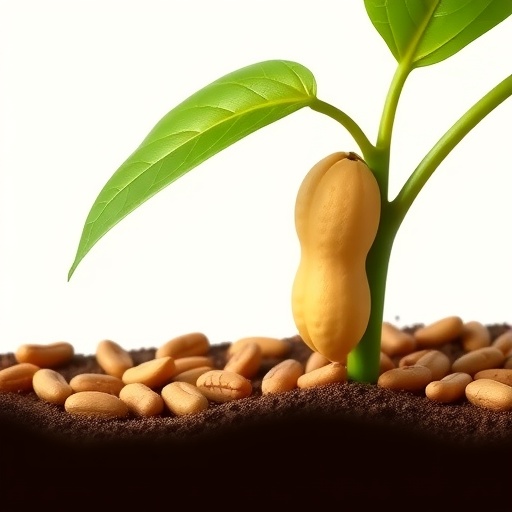
In a groundbreaking study recently published in The Crop Journal, researchers from Henan Agricultural University have elucidated a pivotal genetic mechanism governing early seed development in peanuts (Arachis hypogaea L.). Peanuts, a globally crucial oilseed crop, significantly contribute to the agricultural economy, with China responsible for over 35% of the world’s production. Despite their importance, peanut yields have long been hampered by a phenomenon known as embryo abortion, which drastically reduces seed set and results in the proliferation of empty pods. Until now, the molecular underpinnings of this developmental failure remained largely elusive.
The investigative team embarked on an intricate examination of a mutant peanut line characterized by a distinctive developmental anomaly—these plants produced pods containing only a single well-formed seed instead of the typical multi-seeded pods. This phenotype signaled an interruption in embryogenesis at an early developmental juncture. Professor Dongmei Yin, leading the study, highlighted that aberrations in embryonic development become evident as soon as seven days post-flowering, a critical window in seed formation. This temporal pinpointing enabled the team to conduct comparative analyses of gene expression profiles between normal seeds and embryos destined to abort.
Central to their discovery is the gene AhZAR1-4, which encodes a leucine-rich repeat receptor-like kinase (LRR-RLK). Such kinases are integral membrane proteins that function as molecular sentinels, perceiving and transducing extracellular signals essential for diverse developmental processes. In the mutant peanuts, a single nucleotide polymorphism—a cytosine to thymine substitution—introduces a premature stop codon in the AhZAR1-4 coding sequence. This truncation leads to the loss of both the transmembrane anchoring domain and the kinase’s catalytic core, rendering the protein nonfunctional and disturbing the signaling cascades necessary for proper embryo development.
Further mechanistic studies unveiled that AhZAR1-4 operates at a hormonal nexus, interfacing crucially with auxiliary signaling pathways mediated by auxin and brassinosteroids, two hormones known for their regulatory roles in plant growth and differentiation. Specifically, AhZAR1-4 directly interacts with AhIAA31, an auxin-responsive protein, and AhBSK2, a kinase implicated in brassinosteroid signaling. These interactions suggest that AhZAR1-4 orchestrates a complex signal integration hub facilitating early embryogenesis by coordinating hormonal crosstalk.
Expanding the scope of their investigation, the researchers demonstrated that AhZAR1-4 modulates downstream members of the mitogen-activated protein kinase (MAPK) cascade, including AhYDA and AhWOX8. These genes are conserved across angiosperms and are fundamental in establishing embryonic polarity, a crucial aspect of embryonic patterning and differentiation. The deregulation of these downstream effectors in the mutant line underscores the central role of AhZAR1-4 in embedding hormonal signals into developmental gene regulatory networks.
To validate the functional significance of AhZAR1-4, heterologous expression experiments were conducted in Arabidopsis thaliana, a model organism in plant biology. Transgenic Arabidopsis lines overexpressing the wild-type peanut AhZAR1-4 gene exhibited a remarkable rescue of seed abortion phenotypes when introduced into a ZAR1-deficient background. Furthermore, these transgenic lines displayed increased seed size compared to wild-type plants, providing compelling evidence that AhZAR1-4 not only restores but also enhances seed developmental parameters. Conversely, the mutant AhZAR1-4 allele failed to complement seed abortion defects, conclusively affirming that the loss of functional AhZAR1-4 is directly responsible for the defective embryogenesis in peanut.
This study redefines the genetic landscape of seed development in legumes, positioning AhZAR1-4 as the first identified gene in peanuts that integrates multiple hormonal cues and signaling pathways to regulate early embryonic development. The integration of auxin and brassinosteroid pathways through a receptor-like kinase underscores the sophisticated molecular orchestration underlying seed formation and viability.
The implications of this discovery are immense for agricultural biotechnology and molecular breeding. By targeting AhZAR1-4 and its associated signaling pathways, breeders can now envisage strategies to mitigate embryo abortion, thus improving seed set rates and ultimately enhancing peanut yield. This genetic insight opens avenues for precision breeding programs aiming to strengthen food security and economic stability in regions heavily dependent on peanut cultivation.
Professor Dongmei Yin emphasizes the transformative potential of these findings: “Our research uncovers a critical genetic determinant of early seed development in peanut. By manipulating AhZAR1-4, we move closer to unlocking higher productivity in peanut crops, which can profoundly impact global agriculture.”
The journey from identifying a single mutation to unraveling a complex hormonal integration network epitomizes the power of contemporary plant molecular biology. As the agriculture sector confronts growing challenges of climate change and population growth, such fundamental discoveries offer hope for sustainable intensification of crop yields.
In conclusion, this study from Henan Agricultural University not only advances scientific understanding of legume embryogenesis but also provides a tangible genetic target for breeding innovations. The identification and functional characterization of AhZAR1-4 stand as a testament to the synergy between molecular genetics and applied crop science, heralding a new era of yield improvement in peanut cultivation.
Web References: 10.1016/j.cj.2026.02.009
Cite Scienmag News
Drew Townsend. (April 9, 2026). Leucine-Rich Repeat Receptor-Like Kinase AhZAR1 Controls Early Seed Development in Peanut. Scienmag. https://scienmag.com/leucine-rich-repeat-receptor-like-kinase-ahzar1-controls-early-seed-development-in-peanut/
Drew Townsend. "Leucine-Rich Repeat Receptor-Like Kinase AhZAR1 Controls Early Seed Development in Peanut." Scienmag, 9 April 2026, https://scienmag.com/leucine-rich-repeat-receptor-like-kinase-ahzar1-controls-early-seed-development-in-peanut/. Accessed 4 September 2026.
Drew Townsend. "Leucine-Rich Repeat Receptor-Like Kinase AhZAR1 Controls Early Seed Development in Peanut." Scienmag. April 9, 2026. https://scienmag.com/leucine-rich-repeat-receptor-like-kinase-ahzar1-controls-early-seed-development-in-peanut/


