


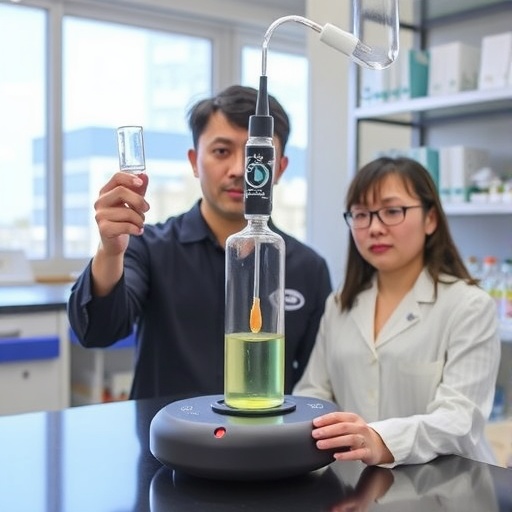
In a remarkable advancement addressing the pressing global challenge of carbon dioxide mitigation, a team of researchers at the Korea Advanced Institute of Science and Technology (KAIST) has unveiled a groundbreaking electrode technology that significantly enhances the electrochemical conversion of CO₂ into valuable chemical precursors. This innovative approach promises to accelerate the sustainable production of plastics and other chemicals, transforming CO₂ from an environmental liability into an industrial asset.
One of the perennial obstacles in electrochemical CO₂ reduction has been the issue of electrode flooding. Traditional electrodes frequently become saturated with electrolyte, which infiltrates the porous structure, blocking active catalytic sites and severely diminishing the overall efficiency and durability of the conversion process. This problem drastically limits the practical application of electrochemical CO₂ reduction technologies for large-scale chemical synthesis.
The KAIST research team, under the guidance of Professor Hyunjoon Song from the Department of Chemistry, has engineered a sophisticated three-layer electrode architecture that resolutely addresses the flooding dilemma without compromising electrical conductivity or catalytic activity. Central to this design is an overlaid network of ultrafine silver nanowires arranged in a spiderweb-like configuration, which operates as a multifunctional component within the electrode.
Unlike conventional electrodes that rely solely on hydrophobic layers to repel water, the new structure ingeniously integrates a hydrophobic substrate with a catalytic active layer topped by the silver nanowire network. This tri-layer assembly not only establishes a robust barrier against electrolyte penetration but also sustains efficient charge transport across the electrode, thereby preserving the reaction environment optimal for CO₂ reduction.
A pioneering discovery of this study lies in the dual functionality of the silver nanowires. These networks do not merely serve as highly conductive current collectors; they also actively engage in electrochemical catalysis. During the CO₂ reduction process, the silver nanowires facilitate the production of carbon monoxide (CO), an essential intermediary molecule which is shuttled to adjacent copper-based catalytic sites. There, CO undergoes further chemical transformations enhancing the synthesis of multi-carbon products such as ethylene.
This tandem catalytic mechanism—where silver nanowires and copper catalysts operate synergistically in sequence—marks a significant departure from conventional single-catalyst systems. It results in notably improved selectivity and efficiency in producing C₂+ hydrocarbons, compounds which are of high industrial importance given their application in plastic manufacturing and chemical feedstocks.
The performance metrics of this novel electrode are exceptional. Tests revealed selectivity rates of up to 79% towards C₂+ compounds in alkaline electrolytes and an unprecedented 86% selectivity under neutral electrolyte conditions. Such figures represent a new global benchmark in the field, highlighting the technology’s potential to redefine standards for electrochemical CO₂ conversion.
Moreover, the electrode demonstrated remarkable operational stability, sustaining high-performance levels beyond 50 continuous hours without noticeable degradation. This durability is critical given the rigorous demands of industrial-scale CO₂ processing, where long-term resilience of catalytic materials directly influences economic feasibility and environmental impact.
Importantly, Professor Song emphasized the broader implications of their research, noting that the ability of silver nanowires to function dually as conductors and active catalysts introduces a versatile design principle. This principle could be extended to tailor electrode architectures for the selective generation of a broader array of value-added chemicals, including ethanol and liquid fuels, thereby significantly expanding the scope of CO₂ utilization technologies.
These insights emanated from rigorous experimentation and detailed electrochemical analysis, with the research team’s findings published in the prestigious international journal Advanced Science on March 24, 2026. The published work delves deeper into the synthesis technique of the silver nanowire networks, the characterization of electrode morphology, and mechanistic studies of the tandem catalysis process.
This transformative research not only advances fundamental understanding in the realm of electrocatalysis but also heralds promising pathways for the development of sustainable carbon capture and utilization (CCU) strategies. By converting waste CO₂ into essential chemical building blocks more efficiently and reliably than ever before, the KAIST innovation sets a new paradigm in combating climate change while supporting the circular carbon economy.
The approach presented by the KAIST researchers has the potential to expedite the transition towards renewable energy-powered chemical manufacturing. Coupled with renewable electricity sources, such advanced electrodes can facilitate the production of crucial materials with minimal carbon footprint, reinforcing the global commitment to net-zero emissions and sustainable industrial practices.
As industries worldwide grapple with the dual imperatives of environmental stewardship and economic growth, technologies such as this electrode design may play an instrumental role in achieving scalable, green chemical production. The synergy between sophisticated nanomaterials engineering and catalyst chemistry demonstrated in this work exemplifies the cutting edge of clean energy innovation.
In sum, the KAIST-developed silver nanowire-enhanced electrode represents a milestone in electrochemical CO₂ reduction with its exceptional efficiency, selectivity, and stability. Its implications extend beyond academic interest, offering practical solutions to one of humanity’s most pressing environmental challenges while laying the groundwork for future advancements in sustainable materials science.
News Publication Date: April 6, 2026
Web References: http://dx.doi.org/10.1002/advs.75003
Keywords
Carbon dioxide conversion, electrocatalysis, silver nanowires, CO₂ reduction, ethylene production, tandem catalysis, gas diffusion electrodes, electrochemical efficiency, sustainable chemistry, catalyst design, plastic precursors, renewable energy integration
Cite Scienmag News
Bethany Barker. (April 7, 2026). KAIST Innovates Electrode Technology Attaining 86% Efficiency in Converting CO₂ into Plastic Precursors. Scienmag. https://scienmag.com/kaist-innovates-electrode-technology-attaining-86-efficiency-in-converting-co%e2%82%82-into-plastic-precursors/
Bethany Barker. "KAIST Innovates Electrode Technology Attaining 86% Efficiency in Converting CO₂ into Plastic Precursors." Scienmag, 7 April 2026, https://scienmag.com/kaist-innovates-electrode-technology-attaining-86-efficiency-in-converting-co%e2%82%82-into-plastic-precursors/. Accessed 3 September 2026.
Bethany Barker. "KAIST Innovates Electrode Technology Attaining 86% Efficiency in Converting CO₂ into Plastic Precursors." Scienmag. April 7, 2026. https://scienmag.com/kaist-innovates-electrode-technology-attaining-86-efficiency-in-converting-co%e2%82%82-into-plastic-precursors/


