


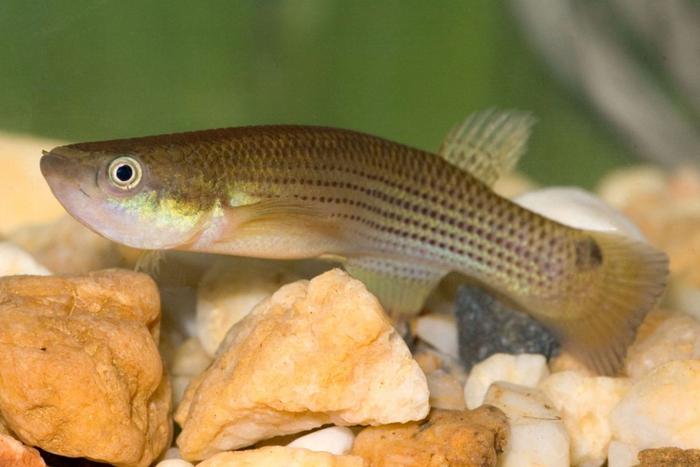
Some species of fish can evolve their egg-laying habits in response to predators in the area in order to survive, according to new research from The University of Texas at Arlington.

Credit: Photo credit UT Arlington
Some species of fish can evolve their egg-laying habits in response to predators in the area in order to survive, according to new research from The University of Texas at Arlington.
It has long been observed that organisms modify their traits, including reproductive patterns, in response to changes in their environment. This type of evolutionary plasticity has been observed in many types of animals in different habitats and with varying predators.
“We knew that fish who laid their eggs externally often adapted depending on the predators in the area, but we did not know how quickly species could change to these externals pressures,” said biology Professor Matthew Walsh, who recently published a paper on the topic in the prestigious Proceedings of the Royal Society B.
For his research, Dr. Walsh and biology lab technician Christopher Roden studied a small type of fish called the killifish that lives on the island of Trinidad in the Caribbean. Ranging in size from about 2 to 6 inches, the killifish are ideal for evolutionary studies because they are highly adaptable to their surroundings. Some types of killifish are even known to be amphibious, able to live on land to avoid predators.
The researchers tested the differences in egg-hatching plasticity among killifish living in sites with and without predators. They then examined the reproductive habits of those two populations by measuring the rates of hatching when eggs were laid submerged in water versus outside water on the surface of moist peat moss. The timing, hatching and offspring growth rates between the two groups of fish were then compared.
“Our study found striking differences in egg-hatching plasticity among killifish living in different habitats,” said Walsh. “This research provides new insights into how aquatic organisms adapt and evolve to changes in their environment. These findings may be particularly important in predicting how species are able to adapt to external pressures, such as those caused by climate change.”
Journal
Proceedings of the Royal Society B Biological Sciences
Method of Research
Observational study
Subject of Research
Animals
Article Title
Fish (eggs) out of water: evolutionary divergence in terrestrial embryonic plasticity in Trinidadian killifish
COI Statement
We declare we have no competing interests. This work was funded by the following grant from the UA National Science Foundation: NSF DEB 2236741.
Cite Scienmag News
Drew Townsend. (July 22, 2024). Fish adjust reproduction in response to predators. Scienmag. https://scienmag.com/fish-adjust-reproduction-in-response-to-predators/
Drew Townsend. "Fish adjust reproduction in response to predators." Scienmag, 22 July 2024, https://scienmag.com/fish-adjust-reproduction-in-response-to-predators/. Accessed 6 September 2026.
Drew Townsend. "Fish adjust reproduction in response to predators." Scienmag. July 22, 2024. https://scienmag.com/fish-adjust-reproduction-in-response-to-predators/

