


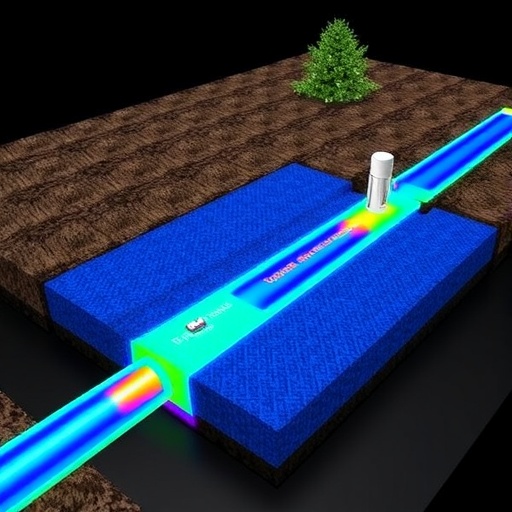
In a groundbreaking development in geotechnical monitoring, researchers have introduced a sophisticated intelligent monitoring pipe that leverages cutting-edge optical sensing technologies combined with advanced machine learning algorithms to capture and predict the three-dimensional soil settlement process in unprecedented detail. This innovative system offers a transformative approach to early warning systems for soil instability, which is a crucial factor in preventing catastrophic infrastructure failures, including pipeline displacements, structural cracks, and even building collapses.
Soil settlement, a phenomenon wherein soil compresses or shifts over time due to natural or anthropogenic causes, poses an omnipresent threat to the integrity of engineering structures such as bridges, buildings, pipelines, and slopes. Traditional soil monitoring techniques often fall short in providing comprehensive, real-time data, especially in three dimensions. To address these limitations, Dandan Sun and their colleagues at Shanxi University in China have engineered a robust device that embeds fiber optic technology within a simple PVC pipe structure, enhanced by 3D-printed protective components and temperature compensation mechanisms.
The core innovation lies in integrating Fiber Bragg Gratings (FBGs)—ultrafine structures inscribed within optical fibers that reflect specific wavelengths of light in response to mechanical strain—into the pipe sensor. This integration enables the detection of minute soil deformations caused by shifting earth masses. FBGs’ immunity to electromagnetic interference and resilience in harsh environmental conditions make them ideally suited for long-term deployment in soil environments. The researchers incorporated two orthogonally aligned five-point FBG arrays, intersecting at a 45-degree angle, supplemented with dedicated temperature compensation gratings, ensuring accurate strain measurement and accounting for environmental temperature variations.
To reconstruct the dynamic 3D soil movement, the team employed the mathematical Frenet-Serret frame, a powerful tool for describing the spatial behavior of curves. By mapping local fiber strain measurements onto this framework, the system can accurately rebuild the trajectory and morphology of soil settlement in three dimensions, revealing the intricate spatial patterns of subsidence in real time. This method overcomes the limitations of traditional sensors, which often provide only single-point, unidirectional, or static measurements.
Laboratory validation of this intelligent pipe system entailed rigorous testing, including indoor air setup trials demonstrating linearity between wavelength shift and induced strain, thereby confirming the precision and sensitivity of the FBG arrays. Subsequent soil burial experiments simulated complex subsidence scenarios using loess soil—a highly erodible, wind-deposited silt known for its instability—within controlled test chambers. By embedding the monitoring pipe and manipulating water content via drainage bags, the researchers could mimic the progressive stages of soil settlement, observing and recording the mechanical responses captured by the sensor’s FBG arrays.
Data harvested during these simulated test conditions were subjected to a suite of machine learning analyses, which markedly enhanced the system’s predictive capabilities. Among several algorithms tested, the Random Forest model emerged as the most effective at stage classification and volume prediction of soil settlement, achieving noteworthy accuracy with a classification precision of 95.65% and a relative prediction error limited to 4.02%. This synergy between optical sensing and artificial intelligence augments the monitoring pipe’s capability to not only detect but also anticipate hazardous soil behavior, enabling proactive engineering interventions.
The implications of this technological breakthrough extend well beyond laboratory confines. The intelligent monitoring pipe is poised to serve as a vital tool in urban environments, especially in older districts constructed atop soft or unstable soils, where traditional monitoring methods often fail to preempt risks effectively. By delivering real-time 3D settlement trajectories, this system facilitates early identification of structural foundation compromises, allowing for timely remedial actions before severe damage or failure occurs.
Furthermore, this technology holds promise for landslide detection and the ongoing assessment of critical infrastructure components, including bridge supports, railway embankments, and highway subgrades. Its operational resilience in harsh environmental contexts makes it suitable for monitoring complex geological settings, such as slope mining areas or expansive pipeline networks. The real-time monitoring capability, combined with predictive analytics, advances the frontier of geotechnical risk mitigation.
Looking ahead, the research team is focused on transitioning from controlled environments to field deployment across diverse geographies. Trials are planned within urban and rural foundations on China’s Loess Plateau, a terrain notorious for its geotechnical challenges, as well as in open-pit coal mine slopes and municipal pipeline corridors. Parallel efforts aim to refine the sensor by miniaturizing its components, enhancing integration, incorporating wireless communication for remote data transmission, and reducing manufacturing costs to facilitate widespread accessibility.
Additionally, to maximize operational utility, the researchers envision developing user-friendly software platforms designed for comprehensive visualization of 3D soil settlement evolution. These tools will include features for automatic early warnings based on real-time data analysis, stage-specific risk alerts, and long-term data archiving. Such software enhancements aim to make soil settlement monitoring intuitive and actionable for civil engineers, urban planners, and disaster management authorities.
This novel soil settlement monitoring pipe is poised to redefine how geotechnical hazards are understood and managed, offering a sophisticated fusion of photonic engineering and machine intelligence. Its capability to provide continuous, multidimensional insight into soil behavior marks a significant step toward safer infrastructure and smarter environmental risk management worldwide.
Web References:
- Optics Express Journal: https://opg.optica.org/oe/home.cfm
- DOI: http://dx.doi.org/10.1364/OE.589254
References:
L. Xie, M. Liu, J. Mao, H. Liu, Y. Yu, P. Chen, Z. Zhao, Y. Fu, D. Sun, J. Ma, “Fiber Bragg Grating-Integrated Soil Settlement Three-Dimensional Trajectory Pipe Sensor: Dynamic Soil Subsidence Evolution and Stage Prediction,” Opt. Express, 34, XXXX (2026).
Keywords
Soil settlement, Fiber Bragg Grating, 3D soil monitoring, optical fiber sensors, machine learning, geotechnical engineering, infrastructure safety, loess soil, dynamic soil subsidence, real-time monitoring, predictive analytics, civil engineering.
Cite Scienmag News
Denise Maddox. (April 7, 2026). Smart Sensor Pipeline Forecasts 3D Soil Settlement with Advanced Monitoring. Scienmag. https://scienmag.com/smart-sensor-pipeline-forecasts-3d-soil-settlement-with-advanced-monitoring/
Denise Maddox. "Smart Sensor Pipeline Forecasts 3D Soil Settlement with Advanced Monitoring." Scienmag, 7 April 2026, https://scienmag.com/smart-sensor-pipeline-forecasts-3d-soil-settlement-with-advanced-monitoring/. Accessed 3 September 2026.
Denise Maddox. "Smart Sensor Pipeline Forecasts 3D Soil Settlement with Advanced Monitoring." Scienmag. April 7, 2026. https://scienmag.com/smart-sensor-pipeline-forecasts-3d-soil-settlement-with-advanced-monitoring/


