


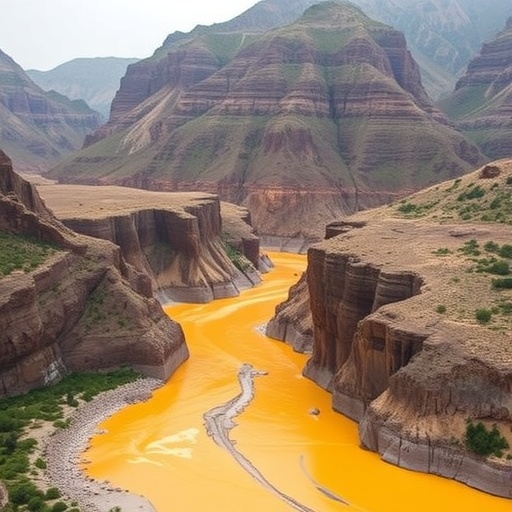
In the face of escalating environmental challenges, water resource management has emerged as one of the most pressing issues confronting both policymakers and scientists worldwide. The Yellow River Basin, known as the cradle of Chinese civilization, presents a particularly complex example of how natural resource conflicts pose serious threats to regional stability and sustainable development. Addressing these conflicts requires innovative approaches that align the complexity of socio-environmental systems with rigorous analytical tools. Recent advances reported by Y. Cao in a groundbreaking 2026 Scientific Reports article reveal a sophisticated integration of Pythagorean fuzzy numbers into the graph modeling framework, providing a novel pathway for resolving water resource disputes in this critically important region.
The Yellow River Basin’s water conflicts arise from multifaceted causes ranging from population pressure and industrial demand spikes to climate change-induced variability in water availability. Conventional methods, often relying on crisp, deterministic models, struggle to accommodate the pervasive uncertainty and imprecision inherent in such environmental systems. This has driven Cao’s research to explore the fertile mathematical ground established by Pythagorean fuzzy sets—an extension of classical fuzzy logic. Whereas traditional fuzzy sets consider the degree of membership alone, Pythagorean fuzzy numbers capture an additional dimension of non-membership values, thus offering enhanced expressive power to model uncertainty more realistically.
Graph models have long been utilized to represent the intricate interconnections and dependencies between different water users and stakeholders in river basins. They provide a structural visualization of water flows, usage priorities, and conflict hotspots, enabling planners to simulate scenarios and evaluate resolutions with network-based insights. Cao’s integration of Pythagorean fuzzy numbers into this framework introduces a refined mechanism for handling ambiguous or incomplete data regarding resource availability, user preferences, and policy interventions, allowing a more dynamic interpretation of the basin’s hydrological and human systems.
This innovative model begins by constructing a network where nodes represent individual water users—ranging from agricultural zones and industrial centers to urban municipalities—and edges denote the relationships and water exchanges among them. Each of these interactions is then characterized by Pythagorean fuzzy numbers defined by a triplet of membership, non-membership, and hesitation degrees, reflecting the uncertainty intrinsic to water resource claims and usage outcomes. By mathematically embedding this fuzzy information, Cao’s model improves robustness in decision support systems required during conflict mediation and resource allocation strategy design.
A key technical breakthrough of this approach lies in its capability to quantify the uncertainty and hesitation explicitly, controlling the influence of indeterminate information on system behavior. This allows water resource managers to analyze not only the most probable allocations but also the likelihood and risk associated with less certain scenarios. Consequently, the model aids in identifying stable allocation schemes that minimize conflicts while maintaining equitable and sustainable water distribution. In regions like the Yellow River Basin, this means supporting long-term water security and reducing detrimental competition among agricultural, industrial, and domestic sectors.
The research also showcases the adaptability of Pythagorean fuzzy graph models in accommodating evolving data streams, crucial for dynamic systems like river basins affected by rapid environmental shifts. By incorporating up-to-date hydrological measurements and stakeholder input, the model can be recalibrated regularly to reflect changes in water availability and user demands, thus serving as a real-time decision-making tool. Cao’s simulations illustrate how this adaptability enhances basin governance resilience under scenarios of climate change, urbanization, and regulatory reforms.
Importantly, the investigative team conducted a comprehensive case study in the Yellow River Basin, an area with chronic water shortages amplified by intense social-economic development. Field data and stakeholder consultations fed into the model, validating its ability to resolve competing demands with more nuanced trade-offs than existing linear programming or traditional fuzzy models. The case study demonstrated notable improvements in water utilization efficiency, reduction in stakeholder friction, and better alignment of water distribution with environmental sustainability goals.
This research paves the way for broader applications of fuzzy graph modeling techniques in complex environmental management challenges beyond river basins. It points towards a transformative paradigm where artificial intelligence and advanced mathematical theories merge to tackle uncertainty and conflict in resource-limited settings globally. By moving beyond rigid boundaries of Boolean logic, Cao’s framework empowers decision-makers to navigate ambiguity with greater confidence, incorporating both quantitative and qualitative factors into comprehensive water governance strategies.
The implications of this study extend to policy design as well. Governments and water management authorities in China and other arid regions could adopt these innovative models to enhance cooperation across provincial borders, integrate multiple water usage sectors, and implement adaptive management frameworks responsive to environmental variability. The incorporation of Pythagorean fuzzy numbers offers a mathematically sound yet practically viable way to reflect diverse stakeholder positions and incomplete information, fostering more inclusive and transparent multidisciplinary collaboration.
While the model presents significant progress, the authors acknowledge challenges in computational complexity and the need for high-quality data acquisition. Future work aims to enhance algorithmic efficiency and explore hybrid systems that combine fuzzy logic with machine learning techniques. Such efforts could elevate predictive accuracy, optimize resource allocation under multiple constraints, and further integrate socioeconomic dimensions into water conflict resolutions. Ongoing interdisciplinary partnerships between hydrologists, mathematicians, policymakers, and local communities remain essential to maximize real-world impacts.
In summation, Y. Cao’s integration of Pythagorean fuzzy numbers within graph-based water conflict resolution frameworks represents a monumental step forward in sustainable natural resource management. The ability to rigorously model uncertainty and stakeholder hesitation holds transformative potential for the Yellow River Basin and similarly challenged watersheds worldwide. This approach not only advances scientific understanding but also provides tangible tools enabling effective, equitable, and adaptive governance crucial for a rapidly changing planet.
As water scarcity intensifies and ecosystems become increasingly stressed, innovative solutions such as Cao’s hybrid fuzzy-graph methodology will be critical to harmonizing human and environmental needs. The cutting-edge research published in Scientific Reports underscores the importance of embracing complexity and ambiguity in environmental decision-making, ultimately charting a course toward resilient resource futures. By fostering greater harmony among competing demands amidst uncertainty, these advances offer hope for sustaining vital water systems that underpin human well-being and biodiversity alike.
Cao, Y. Integrating Pythagorean fuzzy numbers into the graph model to resolve water resource conflicts in the Yellow River Basin. Sci Rep (2026). https://doi.org/10.1038/s41598-026-47448-z
Cite Scienmag News
Denise Maddox. (April 7, 2026). Pythagorean Fuzzy Numbers Resolve Yellow River Conflicts. Scienmag. https://scienmag.com/pythagorean-fuzzy-numbers-resolve-yellow-river-conflicts/
Denise Maddox. "Pythagorean Fuzzy Numbers Resolve Yellow River Conflicts." Scienmag, 7 April 2026, https://scienmag.com/pythagorean-fuzzy-numbers-resolve-yellow-river-conflicts/. Accessed 4 September 2026.
Denise Maddox. "Pythagorean Fuzzy Numbers Resolve Yellow River Conflicts." Scienmag. April 7, 2026. https://scienmag.com/pythagorean-fuzzy-numbers-resolve-yellow-river-conflicts/


