


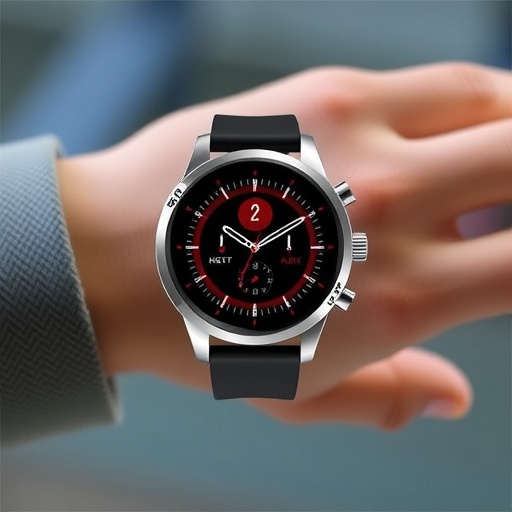
In an unprecedented advancement bridging wearable technology and artificial intelligence, researchers at Cornell University in collaboration with the Korea Advanced Institute of Science and Technology have developed a groundbreaking system known as WatchHand. This innovative platform transforms standard off-the-shelf smartwatches into sophisticated hand-tracking devices utilizing micro sonar technology. By harnessing the capabilities of built-in smartwatch speakers and microphones, WatchHand delivers continuous, real-time hand pose estimation without any auxiliary hardware, marking a significant leap forward in human-computer interaction technologies.
The crux of WatchHand’s technological revolution lies in its use of AI-powered acoustic sensing embedded directly into everyday smartwatches. Unlike previous wearables that demanded bulky external devices, WatchHand ingeniously exploits inaudible sound waves emitted from the smartwatch’s speaker. These micro sonar pulses ricochet off the user’s hand and return to the microphone, generating a dynamic echo profile. This profile is then processed by a sophisticated machine learning algorithm running locally on the device, enabling precise three-dimensional tracking of finger movements and wrist rotations at speeds sufficient for real-time applications.
This innovation dramatically redefines interaction paradigms for wearable devices. By leveraging sonar echoes rather than traditional cameras or inertial sensors, WatchHand offers a privacy-conscious method for hand pose detection that circumvents the energy intensity and data privacy pitfalls of vision-based systems. Importantly, all computation occurs locally on the smartwatch, ensuring personal data remains secure and never transmitted elsewhere. This local processing capability not only enhances user privacy but also improves responsiveness by minimizing latency typically introduced in cloud computing setups.
The potential applications of WatchHand are notably diverse and impactful. For individuals with limited mobility or speech impairments, this technology opens new avenues for assistive communication interfaces that could decipher nuanced hand gestures into actionable commands or speech synthesis. In the rapidly evolving domains of augmented reality (AR) and virtual reality (VR), WatchHand promises to serve as an intuitive, unobtrusive controller, facilitating seamless and natural interaction within immersive environments without the encumbrance of external devices or gloves. Furthermore, the capability to track finger movements accurately using just a smartwatch hints at the exciting prospect of invisible typing or gesture-based control schemes embedded in daily life.
In terms of technical robustness, WatchHand’s design was rigorously validated through comprehensive empirical studies involving 40 participants and amassing approximately 36 hours of gesture data. These trials spanned multiple smartwatch models, both left and right-hand usage, and environments with varying noise levels. The experimental outcomes affirm the system’s resilience in correctly interpreting a broad spectrum of hand poses even in acoustically challenging conditions, exhibiting remarkable fidelity in finger and wrist motion tracking. However, researchers concede there remain limitations, particularly in scenarios involving ambulatory motion where hand pose recognition accuracy subtly declines.
From an engineering perspective, the deployment of WatchHand required intricate calibration of the built-in speaker and microphone arrays to emit and capture audio signals beyond human hearing thresholds, ensuring seamless user experiences without auditory distractions. The finely tuned machine learning models were trained to decode subtle variations in echo profiles caused by diverse hand postures, orientations, and subtle finger articulations. This process necessitated careful balancing between model complexity and computational constraints imposed by smartwatch hardware, ultimately achieving efficient, real-time hand pose estimation capabilities within strict power and processing budgets.
WatchHand currently operates on Android-powered smartwatches due to software and hardware interface compatibilities, with plans to explore potential adaptations for other operating systems in future research. Its inherent flexibility suggests broad applicability across different smartwatch brands, signaling a widespread future adoption potential once integrated into consumer products. As this technology matures, it could supplant less practical prototype solutions prevalent in the market, democratizing access to advanced hand-tracking functionalities via everyday devices already familiar and worn by millions.
Beyond pure consumer applications, WatchHand embodies a paradigm shift in wearable sensory technologies, underscoring the transformative potential of micro sonar systems paired with AI. These insights extend into fields such as robotics, where compact, precise hand gesture recognition could integrate into human-robot collaboration frameworks, and healthcare, where continuous monitoring of hand activity could assist in rehabilitation therapies. By pioneering the first-ever AI-powered sonar hand-pose tracking without additional hardware, the research illuminates a promising path towards widespread, discreet, and powerful gesture sensing.
The intellectual foundations of WatchHand rest on sophisticated acoustic signal processing merged with state-of-the-art deep learning methodologies. The sonar pulses serve as active probes that illuminate the spatial configuration of the hand, while the AI models interpret these echo patterns to reconstruct the kinematic state of the hand joints. This approach departs from traditional passive sensor paradigms, embracing an active sensing strategy that enhances accuracy and robustness by leveraging the temporal dynamics captured in returned sonar signals.
Looking ahead, the team envisions refining WatchHand’s performance to overcome current challenges, including handling user movement and extending compatibility with diverse smartwatch platforms. Integration with emerging wearable ecosystems could enable complex multimodal interaction frameworks combining sonar with inertial and optical sensors, further enriching user experience. The architecture’s adaptability sets the stage for continuous innovation in human-centric computing interfaces that blend seamlessly with daily life while preserving privacy and convenience.
In conclusion, WatchHand propels the wearable technology landscape into a new dimension, where AI-driven micro sonar empowers smartwatches with nuanced hand-tracking abilities that were previously unexplored in consumer electronics. This synergistic fusion of acoustics, machine learning, and miniaturized hardware exemplifies the profound impact interdisciplinary research can have on enabling futuristic functionalities within existing devices. As continuous development and deployment efforts unfold, WatchHand is poised to redefine not only how we interact with technology but also how assistive and immersive experiences can be crafted around natural human gestures.
News Publication Date: April 2026
Web References:
Keywords
Wearable technology, AI, micro sonar, hand tracking, smartwatch, human-computer interaction, assistive technology, augmented reality, virtual reality, acoustic sensing, machine learning, privacy, human gestures
Cite Scienmag News
Bethany Barker. (April 6, 2026). Sonar-Enabled Stock Smartwatches Pave the Way for Breakthroughs in Hand-Tracking Technology. Scienmag. https://scienmag.com/sonar-enabled-stock-smartwatches-pave-the-way-for-breakthroughs-in-hand-tracking-technology/
Bethany Barker. "Sonar-Enabled Stock Smartwatches Pave the Way for Breakthroughs in Hand-Tracking Technology." Scienmag, 6 April 2026, https://scienmag.com/sonar-enabled-stock-smartwatches-pave-the-way-for-breakthroughs-in-hand-tracking-technology/. Accessed 3 September 2026.
Bethany Barker. "Sonar-Enabled Stock Smartwatches Pave the Way for Breakthroughs in Hand-Tracking Technology." Scienmag. April 6, 2026. https://scienmag.com/sonar-enabled-stock-smartwatches-pave-the-way-for-breakthroughs-in-hand-tracking-technology/


