


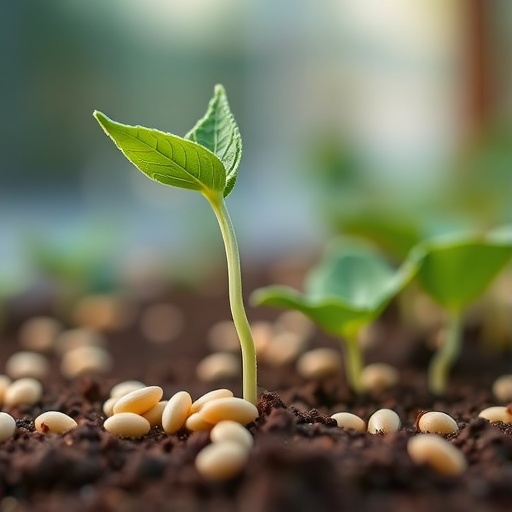
A groundbreaking study in soybean seed biology has identified a pivotal gene, GmJAZ8, that significantly influences seed germination speed through its intricate interplay with hormone signaling networks. This discovery, emerging from an extensive genome-wide association study (GWAS) combined with functional validation in Arabidopsis, marks a quantum leap in understanding the genetic and molecular determinants governing early seed development. The findings, published on March 16, 2026, illuminate a promising genetic target for breeding soybean varieties with enhanced germination performance, potentially revolutionizing agricultural efficiency and yield stability.
Seed germination is universally recognized as a critical phase in the plant life cycle, underpinning stand establishment and crop productivity. Soybean, a globally vital legume, presents unique challenges in seed vigor attributable to its high oil and protein content, factors that predispose seeds to rapid deterioration. Despite previous genetic studies pinpointing loci associated with germination traits, the molecular underpinnings directly controlling germination speed have remained elusive. The current investigation bridges this knowledge gap by providing a high-resolution genetic and transcriptomic characterization of soybean accessions with differential germination rates.
The researchers commenced with a comprehensive phenotypic screening of 277 diverse soybean accessions, meticulously quantifying germination at 36 and 48 hours post-imbibition. Utilizing a robust dataset exceeding 89 million high-confidence single nucleotide polymorphisms (SNPs), they deployed both general linear models (GLM) and mixed linear models (MLM) in GWAS to uncover genomic regions significantly associated with germination dynamics. A conspicuous cluster of 14 SNPs emerged within a 113.5-kilobase segment on chromosome 8, housing 15 annotated genes and delineating a precise locus of interest.
Correlating expression profiles through RNA sequencing and quantitative real-time PCR (qRT-PCR) analysis refined the candidate list, spotlighting Glyma.08G096500, subsequently designated GmJAZ8. Haplotype investigations further revealed natural promoter variations correlating with markedly reduced germination rates, underscoring allelic diversity’s functional impact in natural soybean populations. This integrative genomic approach laid a robust foundation for mechanistic interrogation via transgenic experimentation.
Functional validation entailed the overexpression of GmJAZ8 in Arabidopsis thaliana, a well-established model for dissecting gene function in plant developmental biology. Transgenic lines exhibiting heightened GmJAZ8 transcript abundance displayed significantly accelerated germination at 24 hours relative to wild-type controls, though all genotypes attained full germination by 48 hours. This acceleration pointed to a regulatory role of GmJAZ8 in modulating the biochemical and molecular processes controlling seed dormancy exit and growth initiation.
To elucidate the transcriptional reprogramming underpinning altered germination kinetics, the authors conducted comparative RNA-seq analyses of wild-type and GmJAZ8-overexpressing Arabidopsis at 0 and 24 hours post-imbibition (HAI). Results uncovered substantial differential gene expression at the immediate time point (0 HAI), notably in genes implicated in abscisic acid (ABA) and gibberellin (GA) hormone pathways. Specifically, there was a repression of AtNCED4, a key ABA biosynthetic enzyme, concomitant with upregulation of AtCYP707A2, mediating ABA catabolism. Concurrent activation of GA biosynthesis (AtGA20OX3) and downregulation of GA deactivation (AtGA2OX6) genes collectively signal a hormone milieu favoring germination progression.
Moreover, transcript levels of dormancy-associated regulators such as AtDOG1, AtABI5, and AtEM1 were reduced, suggesting that GmJAZ8 overexpression dampens dormancy signaling circuits. This hormonal rebalancing decreases the ABA/GA ratio, a known determinant of seed germination timing and vigor. Consequently, these molecular shifts orchestrated by GmJAZ8 facilitate a rapid physiological transition from seed quiescence to embryonic growth, highlighting the gene’s crucial role in harmonizing hormone signaling pathways.
The biological function of GmJAZ8 fits within the broader context of JAZ (Jasmonate ZIM-domain) proteins as integrative transcriptional regulators mediating crosstalk between jasmonate and other hormonal signals. This study enriches our understanding by positioning GmJAZ8 as a nexus modulator of seed germination hormone dynamics in soybean. By elucidating this mechanism, the research opens avenues for targeted manipulation of seed vigor traits through molecular breeding or biotechnological interventions aimed at enhancing field emergence and crop resilience.
Importantly, the translational potential of GmJAZ8 manipulation extends beyond model species. Given soybean’s economic significance as a protein and oil source worldwide, improving seed germination speed and uniformity can directly impact crop establishment success, reduce vulnerability to adverse environmental conditions, and ultimately stabilize yield outcomes. The integration of population genetic data with functional genomics ensures that the identified allelic variants of GmJAZ8 can be effectively harnessed within breeding programs to select for superior seed performance traits.
This investigation exemplifies the power of combining high-throughput genomics, precise phenotyping, and mechanistic interrogation to unravel complex agronomic traits. The elucidation of hormonal gene networks underlying germination paves the way for future research targeting other hormone-regulatory nodes and environmental interactions influencing seed biology. In this era of climatic challenges, genetic insights such as these are indispensable for developing climate-smart cultivars with optimized developmental timing.
In summary, the study conclusively establishes GmJAZ8 as a key regulator of soybean seed germination speed by modulating the transcription of critical genes in ABA and GA pathways. By lowering ABA biosynthesis, promoting ABA degradation, enhancing GA synthesis, and repressing dormancy genes, GmJAZ8 accelerates the germination process, potentially overcoming constraints imposed by seed deterioration. This discovery not only advances basic plant developmental biology but also provides a tangible target for practical applications aiming to enhance soybean production efficiency and seed quality under variable field conditions.
As global agriculture seeks to meet burgeoning food demands, advances in seed biology such as the functional characterization of GmJAZ8 represent vital progress. By unlocking the genetic basis of germination vigor, breeders and biotechnologists gain precise molecular handles to fine-tune seed behavior, contributing to sustainable intensification and improved crop security. The fusion of genomics and functional biology showcased in this work exemplifies the frontier of plant science for agricultural innovation.
The research was made possible through comprehensive interdisciplinary collaboration at Xianghu Laboratory, supported by targeted funding which underscores the importance of investment in plant genetic research. The open-access publishing of these findings in “Seed Biology” ensures broad dissemination, fostering accelerated scientific dialogue and application.
This groundbreaking research redefines the frontiers of seed biology, offering a beacon for future explorations into the complex genetic architectures that shape crop development and yield potential. With GmJAZ8 now firmly established as a pivotal genetic locus regulating soybean seed germination, the stage is set for a transformative impact on seed breeding strategies worldwide.
News Publication Date: 16 March 2026
References:
DOI: 10.48130/seedbio-0026-0003
Cite Scienmag News
Juliet Wilcox. (April 3, 2026). GmJAZ8 Accelerates Soybean Seed Germination. Scienmag. https://scienmag.com/gmjaz8-accelerates-soybean-seed-germination/
Juliet Wilcox. "GmJAZ8 Accelerates Soybean Seed Germination." Scienmag, 3 April 2026, https://scienmag.com/gmjaz8-accelerates-soybean-seed-germination/. Accessed 4 September 2026.
Juliet Wilcox. "GmJAZ8 Accelerates Soybean Seed Germination." Scienmag. April 3, 2026. https://scienmag.com/gmjaz8-accelerates-soybean-seed-germination/


