


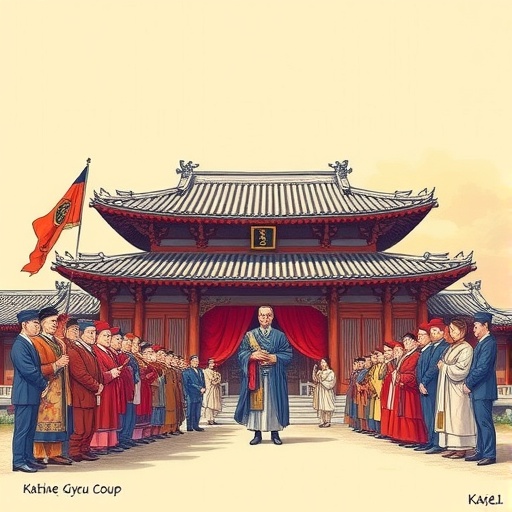
With the recent surge in popularity of the film The King’s Warden, public fascination has reignited around the tumultuous history of King Danjong and Prince Suyang, later King Sejo, and the pivotal Gyeyu Coup of 1453. While cinematic portrayals often dramatize political intrigue, the true pathways that led to the divergent fates of these historical figures are far more complex and entrenched in the broader bureaucratic machinery of the Joseon dynasty. An interdisciplinary research team from the Korea Advanced Institute of Science and Technology (KAIST) and scholars from Hong Kong have delved deep into the historical archives to quantitatively reconstruct and analyze the bureaucratic dynamics underpinning Joseon’s political landscape, utilizing sophisticated digital humanities approaches and complex systems analysis.
The collaborative research effort, led by Professor Juyoung M. Park of KAIST’s Graduate School of Culture Technology alongside Dr. Donghyeok Choi, an alumnus of KAIST now affiliated with Hong Kong Baptist University and the University of Hong Kong, leveraged two major historical datasets: the Annals of the Joseon Dynasty and the Mungwa Bangmok, the civil service examination records. Together, these datasets encompass a vast repository of official career trajectories, social networks, and political affiliations, enabling a systematic examination of over 14,600 officials’ careers spanning more than six centuries. This integrative analysis marries humanities scholarship with advanced computational techniques, generating fresh insights into the social stratification and power dynamics that defined Joseon’s ruling class.
Central to the team’s findings is the characterization of bureaucratic stability and decline through the lens of recruitment practices. The research reveals that in the earlier periods of Joseon, the gwageo civil service examination system functioned robustly as a meritocratic gateway, sustaining high degrees of mobility and fairness within governmental ranks. This effective meritocracy translated into a relatively stable bureaucratic institution that could weather political upheaval while maintaining systemic equilibrium. Contrastingly, the later Joseon period witnessed a progressive concentration of power within elite oligarchic families—most notably the Andong Gims and the Pungyang Jos—who, by leveraging political influence and social capital, eroded the competitive integrity of the gwageo system. This erosion precipitated increasing inequality, rigid stratification, and ultimately systemic fragility that contributed to national decline.
The researchers applied network science methodologies to dissect the complex affiliations around the 1453 Gyeyu Coup, mapping relationships among officials allied with King Danjong, Prince Suyang, and Prince Anpyeong. This revealed that loyalty to Sejo, who orchestrated the coup, was systematically rewarded with promotions and power, whereas those aligned with Anpyeong faced purges and persecution. These findings quantitatively substantiate historical narratives of factionalism, mapping political allegiances onto bureaucratic trajectories within the Joseon court.
Expanding beyond singular events, the team introduced a novel quantitative metric designated the “Total Success Index,” synthesizing multiple dimensions of bureaucratic career success—spanning rank attained and longevity of service. By longitudinally applying this index across centuries, the study unveiled nuanced trends: a moderate but persistent correlation between individual background variables (such as familial lineage and regional origin) and bureaucratic success during much of Joseon’s history, suggesting embedded social hierarchies yet a resilient degree of social mobility and fairness sustained across generations.
However, from the mid to late Joseon periods, the Total Success Index exhibited widening disparities reflective of social stratification driven largely by elite family dominance. The oligarchic capture of officialdom disturbed prior meritocratic equilibria, resulting in institutional decay underscored by nepotism and monopolization of power. This unraveling of administrative integrity signaled not just the demise of a civil service recruitment mechanism but also foreshadowed a broader systemic collapse, offering a compelling data-driven narrative of Joseon’s decline as a gradual process rather than a consequence of isolated incidents.
Professor Juyoung M. Park emphasized the significance of this computational historiography, stating, “Our study transcends the limitations of episodic historical analysis by interrogating the longitudinal structural transformations of a nation-state’s political system.” He further notes that understanding the interplay between individual agency and collective institutional dynamics provides not only a lens through which ancient bureaucracies can be understood but also yields vital lessons relevant to contemporary governance issues, particularly in talent recruitment and institutional fairness.
The integration of historical datasets with complex systems science represents a paradigm shift in the digital humanities field. By digitizing and computationally analyzing centuries-old archives, the researchers are pioneering methodologies that transform static historical records into dynamic models of socio-political evolution. This approach promises to illuminate hidden patterns, social networks, and power flows that traditional historiography might overlook, thereby enriching both academic scholarship and public understanding.
Looking ahead, the research team plans to harness artificial intelligence techniques to expand and refine the Joseon historical database further. This will facilitate deeper comparative analyses with bureaucratic systems across different historical regimes worldwide, as well as robust studies of international diplomatic interactions as documented in archival materials. Such ambitious expansions signal a burgeoning era where AI-enhanced humanities scholarship will bridge past and present, furnishing scholars and policymakers alike with transformative insights into governance, social justice, and institutional longevity.
Already published in the prestigious journal Physica A: Statistical Mechanics and Its Applications, the study entitled “Total Success Index and the Longitudinal Dynamics of Bureaucratic Stratification in Joseon Korea” (DOI: 10.1016/j.physa.2026.131353) encapsulates interdisciplinary rigor and innovative approaches to historical research. The meta-analytical methodology employed resonates with emerging trends to quantitatively decode social sciences phenomena, reaffirming the vitality and relevance of humanities scholarship underpinned by scientific inquiry.
Funded by the National Research Foundation of Korea alongside various academic and government research programs, this investigation stands at the forefront of a digital-humanities renaissance. It demonstrates how computational methodologies can unlock centuries-old data troves, revealing the subtle dynamics of political power, social stratification, and institutional decay that shaped the trajectory of one of East Asia’s most enduring dynasties.
In synthesizing historical archives with scientific modeling, this research not only contextualizes the Gyeyu Coup within the broader evolution of Joseon’s bureaucracy but also underscores the critical importance of transparent and equitable civil service systems for societal stability. By drawing parallels from the past, it poses timeless questions about governance, fairness, and the resilience of political institutions, making it a compelling and timely contribution to both historical and contemporary discourse.
News Publication Date:
9-Feb-2026
Web References:
https://shm.to/bYJ0SBo
References:
Park, Juyoung M., Choi, Donghyeok, et al. “Total Success Index and the Longitudinal Dynamics of Bureaucratic Stratification in Joseon Korea.” Physica A: Statistical Mechanics and Its Applications, vol. xxx, no. xx, 2026, DOI: 10.1016/j.physa.2026.131353.
Cite Scienmag News
Courtney Benton. (April 2, 2026). KAIST Unveils Power Structures Driving the Gyeyu Coup, Shedding Light on Joseon Bureaucratic Dynamics. Scienmag. https://scienmag.com/kaist-unveils-power-structures-driving-the-gyeyu-coup-shedding-light-on-joseon-bureaucratic-dynamics/
Courtney Benton. "KAIST Unveils Power Structures Driving the Gyeyu Coup, Shedding Light on Joseon Bureaucratic Dynamics." Scienmag, 2 April 2026, https://scienmag.com/kaist-unveils-power-structures-driving-the-gyeyu-coup-shedding-light-on-joseon-bureaucratic-dynamics/. Accessed 4 September 2026.
Courtney Benton. "KAIST Unveils Power Structures Driving the Gyeyu Coup, Shedding Light on Joseon Bureaucratic Dynamics." Scienmag. April 2, 2026. https://scienmag.com/kaist-unveils-power-structures-driving-the-gyeyu-coup-shedding-light-on-joseon-bureaucratic-dynamics/


