


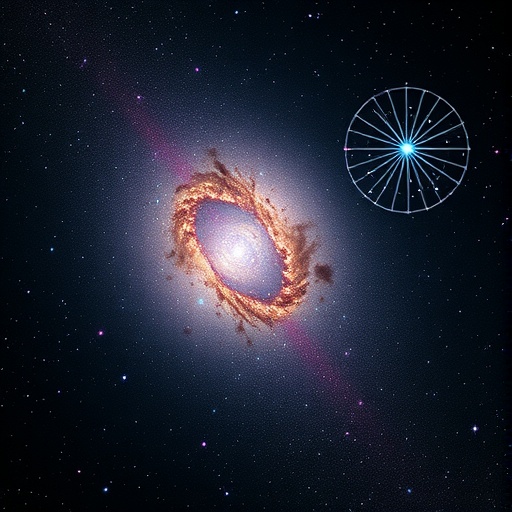
In a groundbreaking discovery that challenges long-held perceptions of galaxy formation, astronomers have identified an exceptionally compact quadruply lensed quasar, offering unprecedented insights into the assembly of stellar cores in elliptical galaxies. This quasar, lensed by a galaxy located at a redshift of 1.055, or about 5.5 billion years after the Big Bang, reveals a lensing galaxy with a surprisingly modest lensing mass of approximately 2 × 10^10 solar masses. The unique properties of this lensing system allow researchers to probe stellar populations in a regime of both mass and cosmic time previously unexplored, shedding new light on the nature of the initial mass function (IMF) in distant galactic bulges.
Gravitational lensing serves as a powerful astrophysical tool that magnifies and distorts the light from distant objects due to the presence of massive intervening structures. In this particular case, the lensing galaxy’s gravitational field bends the light of the background quasar into four distinct images. The intense compactness of the lens configuration—spanning a mere 0.2 arcseconds—suggests a remarkably dense central stellar distribution in the lens galaxy and offers a natural laboratory for weighing the galaxy’s stellar content in exquisite detail.
By employing sophisticated Bayesian statistical methods alongside standard scaling relations, astronomers have been able to constrain the central galactic IMF of the lensing galaxy with an unprecedented precision. These analyses reveal an IMF consistent with that of the Milky Way’s disk population, ruling out bottom-heavy IMFs that would imply an excess of low-mass stars. This finding is particularly striking because previous studies of massive elliptical galaxies generally favored a heavier IMF implying distinct star formation pathways or environmental influences.
Typically, bulges of elliptical galaxies formed early and fast, an assumption supported by heavy IMFs and high stellar densities. The current discovery disrupts this classical model, indicating that the core either experienced a much slower assembly or underwent early processes that fundamentally altered its stellar composition. This slower or altered buildup hints at a more complex evolutionary history where mergers, interactions, or feedback mechanisms may have reshaped or halted the inflow of low-mass stars, diversifying the star formation and assembly scenarios in high-redshift environments.
The compact lensing system provides a remarkable snapshot of galactic evolution 8 billion years ago, when the Universe was less than half its current age. Observations of such distant galaxies are typically hindered by their faintness and overwhelming confusion with surrounding objects. However, gravitational lensing dramatically enhances the effective resolution and signal-to-noise ratio, enabling astronomers to isolate and analyze stellar populations deep within galaxy cores that would otherwise remain invisible.
The mass estimation of around 2 × 10^10 solar masses for the lensing galaxy’s core is remarkably low compared to typical lensing galaxies, which often exceed several times 10^11 solar masses. This lower mass boundary allows for testing theoretical models of star formation and galaxy assembly in a mass regime that bridges dwarf galaxies and massive ellipticals. Such investigations are pivotal for refining our understanding of how central stellar populations in galaxies evolve over cosmic time.
Furthermore, the results imply that the initial conditions for star formation in early galaxies may have been more diverse than previously anticipated. The similarity of the IMF to that of the Milky Way suggests that some distant galaxy cores may form stars under conditions analogous to those in the local Universe, a revelation that reshapes expectations about galactic environments in the early cosmological epochs and the universality of star formation laws.
One of the most intriguing implications of this research relates to the apparent exclusion of bottom-heavy stellar IMFs in the lens galaxy’s core. Bottom-heavy IMFs—characterized by an overabundance of low-mass stars—have been a common interpretation to explain the observed dynamics and mass-to-light ratios in massive elliptical galaxies. The new data challenge this interpretation and propose that early-type galaxies might share IMF properties more akin to spiral galaxies like the Milky Way than previously thought.
This study also underscores the importance of high-resolution imaging and precise gravitational lens modeling. The quadruply lensed quasar configuration allowed researchers to dissect the lensing potential and distinguish the contributions of dark matter and luminous stars to the overall lensing mass. By isolating the stellar mass fraction, the team confidently inferred the underlying IMF, providing fresh constraints on the baryonic content of galaxy cores at high redshift.
The research team’s analysis points toward a dynamic evolutionary history for galaxy cores, where bulges and stellar-dominated central regions are not passive fossil relics from rapid, early formation events but active sites subject to a variety of processes influencing their mass assembly over billions of years. Such insights may necessitate revisions to galaxy formation simulations and theoretical frameworks that have assumed relatively static bulge formation post initial collapse.
Another critical aspect is the redshift of the lensing galaxy itself—at z = 1.055—allowing astronomers to peer approximately 8 billion years into the past. At this epoch, galaxies were undergoing substantial transformation, with star formation and mergers occurring at a high rate. The observed characteristics of this galaxy’s core, set against this bustling cosmic backdrop, offer vital clues regarding the timescale and mechanisms of bulge growth in regimes where direct observational data have been scarce.
In summary, the discovery of this highly compact quadruply lensed quasar system has opened a novel observational window on the stellar populations and mass assembly of elliptical galaxy cores at intermediate redshifts. The finding that these cores can host Milky-Way-like IMFs challenges pre-existing assumptions about the universality and variability of star formation in dense galactic environments. By extending our knowledge of stellar mass functions into new mass and temporal domains, this work paves the way for a deeper understanding of galaxy evolution across cosmic time.
These results, published by D’Amato, Mannucci, Sonnenfeld, and colleagues in Nature Astronomy, highlight the transformative power of gravitational lensing combined with meticulous statistical analysis in uncovering the mysteries of the universe’s early galactic structures. The work showcases how a single system, accurately modeled and characterized, can revolutionize our conceptual models of stellar populations and the lifecycle of galaxies.
Future observations, potentially leveraging next-generation telescopes and more extensive samples of compact lensing systems, could confirm whether this Milky-Way-like IMF property is common in early galaxy cores or truly an exception. Such studies will critically inform the debate on whether bulges universally form in rapid, intense bursts or through more moderated and possibly disruptive evolutionary paths, fundamentally refining our narrative of cosmic assembly.
Ultimately, this discovery exemplifies the power of gravitational lensing to transcend the limitations of direct observations, enabling the detailed study of galaxy cores at unprecedented distances and the testing of fundamental astrophysical theories on star formation, galactic structure, and cosmic evolution. It drives home the idea that the universe’s history is far more intricate and varied than canonical models once suggested, opening exciting avenues for exploration in extragalactic astronomy.
Cite Scienmag News
Grant Pearson. (April 2, 2026). Milky-Way Stars Revealed in Galaxy Core 8 Billion Years Ago. Scienmag. https://scienmag.com/milky-way-stars-revealed-in-galaxy-core-8-billion-years-ago/
Grant Pearson. "Milky-Way Stars Revealed in Galaxy Core 8 Billion Years Ago." Scienmag, 2 April 2026, https://scienmag.com/milky-way-stars-revealed-in-galaxy-core-8-billion-years-ago/. Accessed 5 September 2026.
Grant Pearson. "Milky-Way Stars Revealed in Galaxy Core 8 Billion Years Ago." Scienmag. April 2, 2026. https://scienmag.com/milky-way-stars-revealed-in-galaxy-core-8-billion-years-ago/


