


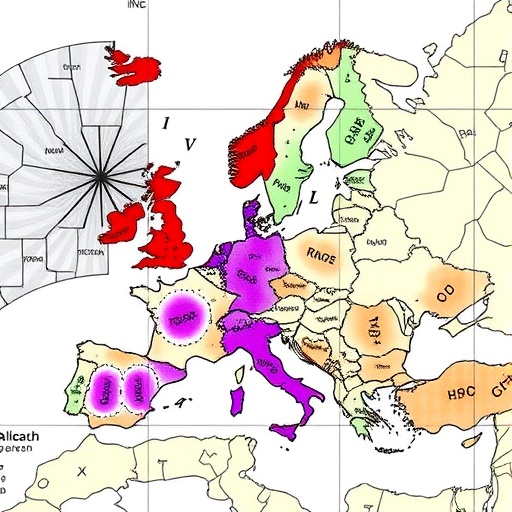
In a groundbreaking study published this April, researchers have unveiled intricate chemical exposome patterns among mothers and their children, highlighting the profound influence of urbanization on environmental chemical exposures throughout Europe. This extensive investigation, spanning five prominent birth cohorts across diverse urban settings, sheds new light on how urban life imprints unique chemical signatures on human health from the earliest stages of life. The findings emphasize the critical role of geographic and socio-environmental factors in shaping the complex tapestry of chemical exposures that individuals encounter daily.
The exposome, a burgeoning concept in environmental health sciences, represents the totality of chemical, biological, and physical exposures an individual experiences throughout their lifetime, starting from conception. This study delves specifically into the chemical exposome—the myriad substances people come into contact with through air, water, food, and consumer products. By meticulously analyzing chemical biomarkers in biological samples from mothers and children, the research team has distinguished distinct exposure patterns correlated with varying levels of urbanization, ranging from highly urbanized metropolitan centers to more rural environments.
The methodological rigor of the research stands out as a definitive strength. Employing advanced high-resolution mass spectrometry integrated with robust statistical modeling, the researchers could identify and quantify hundreds of chemicals, including both legacy pollutants and emerging contaminants, in biological matrices such as urine and blood. This untargeted approach enables a comprehensive chemical fingerprint of each participant, moving beyond traditional exposure assessments that often focus on a limited set of well-known toxicants. The granularity and breadth of data capture provide a powerful lens to decipher the complexities of daily chemical encounters in diverse environments.
One of the most compelling revelations from the study is the marked difference in exposome profiles contingent on urbanization intensity. Mothers and children residing in dense urban centers exhibited elevated levels of substances linked to traffic emissions, industrial activities, and consumer product usage, such as polycyclic aromatic hydrocarbons (PAHs), phthalates, and flame retardants. Conversely, rural populations showed higher internal levels of agricultural pesticides reflecting local land use. Importantly, the researchers highlighted certain persistent organic pollutants (POPs) that appear ubiquitously, underscoring the widespread and enduring nature of some chemical exposures irrespective of geographic context.
The dynamic interplay between environmental factors and biological responses also emerged vividly. The team correlated chemical exposome data with demographic, socioeconomic, and lifestyle information, thereby unveiling social determinants that modulate exposure burdens. For instance, dietary habits, housing characteristics, and occupation of the mothers had discernible effects on the internal chemical load. This nuanced understanding adds an important layer to public health considerations, suggesting that interventions to mitigate harmful exposures must be finely tailored, accounting for the diversity of exposure sources and individual susceptibilities.
Furthermore, the research offers critical insights into the transgenerational transfer of chemical burdens. By concurrently analyzing mother-child pairs, the study elucidates how prenatal and early postnatal windows represent highly vulnerable periods wherein chemical exposures can have lasting impacts on child development and health trajectories. The data underscore the potential for chemical insults during these formative stages to influence immune function, neurodevelopment, and metabolic outcomes, thereby laying the groundwork for chronic diseases later in life.
The study also innovates in its comparative international design. By incorporating birth cohorts from various European regions with distinct environmental regulations, industrial profiles, and cultural habits, the research provides a panoramic view of exposures across the continent. This diversity strengthens the generalizability of findings and highlights the imperative for harmonized European-wide policies aimed at reducing hazardous chemical exposures, particularly among sensitive populations such as pregnant women and young children.
From a technical perspective, the deployment of exposomics in epidemiological research exemplifies the cutting edge of environmental health studies. Integrating omics technologies, statistical clustering algorithms, and geographic information systems (GIS), the investigators constructed multidimensional exposure landscapes that capture temporal and spatial variability. This holistic methodology paves the way for future studies seeking to unravel the intricate pathways through which urbanization and modernization shape chemical exposures and resultant health risks.
The implications of this research resonate far beyond academic circles, calling for urgent attention from policymakers, urban planners, and public health officials. As urban populations continue to grow globally, understanding and managing chemical exposures in city environments emerges as a pivotal challenge. Strategies driven by scientific evidence, such as tightening regulations on vehicle emissions, promoting safer consumer products, and implementing green urban spaces, can substantially mitigate exposure burdens, safeguarding maternal and child health.
Moreover, the translation of exposome science into practical public health action requires enhanced biomonitoring infrastructure and data sharing initiatives. This study spotlights the value of cohort-based biomonitoring efforts capable of tracking evolving chemical landscapes and identifying emergent exposures that may escape conventional surveillance. It also stresses the necessity for community engagement and education to empower vulnerable populations with knowledge and resources to reduce avoidable chemical contacts.
Another dimension explored involves the potential cumulative and synergistic effects of multiple chemical exposures, which often co-occur in real-world settings. Traditional toxicological assessments, focusing on single substances, may underestimate risks posed by complex chemical mixtures. By characterizing exposome patterns comprehensively, the study provides a framework to better understand combined exposures and their implications for human health, fostering more realistic risk assessment paradigms.
Despite the immense progress, challenges remain in fully deciphering the exposome. Variability in analytical detection limits, temporal fluctuations in exposure, and the vast chemical diversity require continued methodological innovation and standardization. Likewise, establishing causal links between detected chemicals and specific health outcomes demands longitudinal data and integration with molecular and clinical endpoints.
The study’s pioneering approach exemplifies the transformative potential of exposome research to revolutionize environmental health sciences, offering predictive insights into how our rapidly changing environments impact human biology. By elucidating nuanced exposure patterns shaped by urbanization, it propels the field toward precision public health, where intervention strategies can be customized to distinct environmental contexts and population vulnerabilities.
As cities expand and lifestyles evolve, the chemical milieu enveloping populations will grow increasingly complex. This research stands as a clarion call to harness advanced scientific tools and cross-disciplinary collaboration to safeguard future generations from insidious chemical exposures. Only through such concerted efforts can we aspire to build healthier, more sustainable urban environments that nurture well-being from the earliest chapters of life onward.
In conclusion, the work by d’Errico, Moirano, Pizzi, and colleagues constitutes a seminal contribution to exposome science, demonstrating the profound influence of urbanization on maternal and childhood chemical exposures across Europe. Its rich dataset, methodological sophistication, and policy-relevant findings exemplify the future trajectory of environmental exposure assessment and public health intervention. As the research community delves deeper into the exposome frontier, studies like this will illuminate pathways to healthier societies amid the challenges and opportunities of the 21st century.
Cite Scienmag News
Ophelia Keating. (April 2, 2026). Chemical Exposome Patterns Vary by Urbanization in Europe. Scienmag. https://scienmag.com/chemical-exposome-patterns-vary-by-urbanization-in-europe/
Ophelia Keating. "Chemical Exposome Patterns Vary by Urbanization in Europe." Scienmag, 2 April 2026, https://scienmag.com/chemical-exposome-patterns-vary-by-urbanization-in-europe/. Accessed 4 September 2026.
Ophelia Keating. "Chemical Exposome Patterns Vary by Urbanization in Europe." Scienmag. April 2, 2026. https://scienmag.com/chemical-exposome-patterns-vary-by-urbanization-in-europe/


