


In the face of mounting water scarcity and extended drought conditions, the agricultural sector is under unprecedented pressure to optimize irrigation practices without compromising crop health. A trailblazing development from researchers at the University of California Riverside introduces a sophisticated robotic system designed to map soil moisture variability on an individual tree basis within citrus orchards. This novel approach heralds a significant leap forward in precision agriculture, particularly in water management, tackling one of the most critical challenges confronting dryland farming today.
Traditional irrigation strategies often rely on sparse soil moisture sensors embedded at fixed locations throughout orchards. These sensors, while technologically advanced, are prohibitively expensive and typically limited to just a few points within vast planting areas. Consequently, farmers must extrapolate water needs across large fields based on incomplete data, leading to potential overwatering or underwatering. This discrepancy stems from inherently heterogeneous soil properties, which can fluctuate drastically even over short distances, affecting water retention and availability for trees.
Soil texture plays a pivotal role in moisture dynamics. Fine-textured soils, with abundant tiny particles, possess a high surface area that retains water more effectively, whereas sandy soils exhibit rapid drainage due to larger grains and lower surface area. This variability results in neighboring trees experiencing vastly different water stress levels, which complicates irrigation scheduling and can lead to uneven crop health.
UC Riverside’s innovative system integrates mobile robotics with geospatial analysis to overcome these limitations. A robot autonomously navigates orchard rows, capturing measurements of soil apparent electrical conductivity (ECa). Electrical conductivity serves as an indirect but robust indicator of soil properties, influenced by moisture content, salt concentrations, and clay levels. By correlating these conductivity readings with direct moisture information from existing buried sensors, the team developed a sophisticated statistical model that extrapolates soil moisture content across the entire orchard with remarkable resolution.
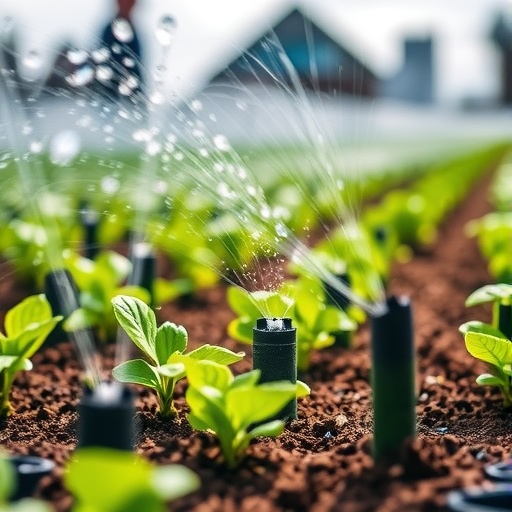
This method effectively generates detailed, tree-specific water availability maps, empowering growers to target irrigation with unprecedented accuracy. Rather than applying uniform water volumes via sprinklers, farmers can now identify drought-stressed trees and allocate water precisely where needed, thereby enhancing water-use efficiency. Such granularity not only conserves precious water resources but also protects trees from the detrimental effects of overwatering, such as oxygen depletion in root zones that can impair health and yield.
Beyond improving plant health, the system addresses critical regulatory and economic pressures confronting farmers. Increasing groundwater usage restrictions coupled with rising water costs necessitate innovative solutions that enable sustainable crop production under constrained inputs. The precise irrigation facilitated by this robotic mapping technology offers growers viable alternatives to orchard retirement, boosting the resiliency of the agricultural economy in arid regions.
Moreover, minimizing overwatering curtails the leaching of fertilizers and nutrients below the root zone, a significant source of groundwater pollution. By optimizing water application, the technology indirectly contributes to environmental protection efforts, reducing nutrient runoff and preserving water quality in surrounding ecosystems.
The genesis of this robotic mapping system dates back to 2019, born from a multidisciplinary collaboration between engineers and agricultural scientists at UCR’s Center for Agriculture, Food, and the Environment (CAFE). Elia Scudiero, the project’s lead and an associate professor specializing in precision agriculture, has long explored soil conductivity measurement technologies. Pairing these expertise areas with autonomous robotics fulfilled a longstanding vision of fundamentally enhancing field-scale soil monitoring.
A key innovation involves how the robot interfaces with buried moisture sensors without interfering with their readings—a technical breakthrough for which the team has filed a patent. Initial testing has been conducted at UCR’s Citrus Research Center & Agricultural Experiment Station, a controlled environment allowing rigorous validation of the system’s accuracy and operational reliability.
Looking forward, the research team aims to transition this technology from experimental plots to commercial farming operations. This progression will require engineering rugged, all-weather robots capable of handling diverse orchard configurations and crop types. Partnerships with private industry are anticipated to facilitate the commercialization and deployment of this precision irrigation platform at scale.
The advent of robotic soil conductivity mapping underscores a broader trend within precision agriculture, where converging technologies—including robotics, advanced sensors, and data science—are revolutionizing resource management. By enabling farmers to make data-driven decisions about irrigation, this technology promises to foster agricultural sustainability and productivity even in the face of severe environmental constraints.
Ultimately, this research represents a paradigm shift in how growers understand and manage water in their fields. The capacity to deliver “more crop per drop” epitomizes the potential impact of marrying cutting-edge robotics with environmental stewardship, offering hope for sustainable agriculture amid the mounting pressures of climate variability and resource scarcity.
Cite Scienmag News
Alan Morgan. (April 2, 2026). Optimizing Irrigation: Watering Smarter, Not Harder. Scienmag. https://scienmag.com/optimizing-irrigation-watering-smarter-not-harder/
Alan Morgan. "Optimizing Irrigation: Watering Smarter, Not Harder." Scienmag, 2 April 2026, https://scienmag.com/optimizing-irrigation-watering-smarter-not-harder/. Accessed 4 September 2026.
Alan Morgan. "Optimizing Irrigation: Watering Smarter, Not Harder." Scienmag. April 2, 2026. https://scienmag.com/optimizing-irrigation-watering-smarter-not-harder/


