


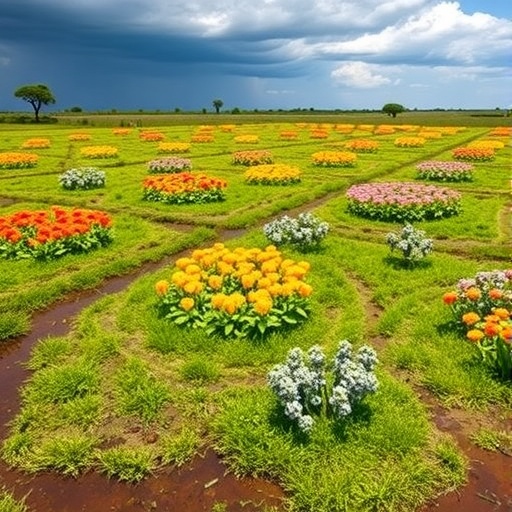
As climate change accelerates, understanding the intricate relationships between land use and surface temperature is more crucial than ever. A groundbreaking study by Luo and Quaas, published in Communications Earth & Environment in 2026, addresses a hitherto underexplored dimension of this relationship: the diurnal variations in land surface temperature arising from cropland biophysical properties across tropical Africa. This research not only bridges a critical knowledge gap in regional climate dynamics but also reshapes how scientists and policymakers perceive agricultural impacts on local and global temperature patterns.
Tropical Africa is a region undergoing rapid agricultural expansion and transformation, making it one of the most dynamically changing land-use environments on the planet. Luo and Quaas’s research meticulously analyzes how biophysical characteristics of croplands, such as vegetation cover, soil moisture, and albedo, influence land surface temperature (LST) differently during daytime and nighttime across this vast and climatically diverse landscape. The findings illustrate that cropland effects on temperature are far from uniform and fluctuate markedly between day and night.
The research employs cutting-edge remote sensing data combined with sophisticated modeling to capture these diurnal shifts in temperature with unprecedented spatial resolution. This approach reveals that, during the day, croplands generally show a cooling effect compared to natural vegetation. This cooling largely results from the higher albedo and transpiration rates of cultivated areas, which increase latent heat flux, thereby reducing sensible heat and surface warming. However, at night, the pattern reverses in many regions, where croplands exhibit a warming relative to natural ecosystems, primarily due to reduced soil moisture retention and altered radiative properties.
This diurnal dichotomy highlights the complex interplay of land surface energy processes modulated by human agricultural activity, challenging the prevailing assumption that croplands universally cool the environment. The study importantly stresses that nocturnal warming associated with cropland areas could intensify heat stress during the night, which has serious implications for ecosystems and human populations accustomed to tropical climates.
Moreover, Luo and Quaas delve into regional heterogeneities within tropical Africa, demonstrating that these biophysical impacts vary with climatic zones, soil types, crop management practices, and the extent of irrigation. In wetter tropical zones, the cooling effect is more pronounced during daylight due to abundant moisture facilitating evaporation. Conversely, semi-arid and dry zones show a muted daytime cooling but stronger nighttime warming, owing to limited soil moisture reducing evaporative cooling but permitting greater heat retention after sunset.
Their analysis also takes into account seasonal variations in cropping cycles, emphasizing that timing and crop type can dramatically influence diurnal temperature dynamics. The temporal mismatch between crop phenology and regional climatic conditions determines the degree to which croplands modulate surface energy fluxes and temperatures, underscoring the need for temporally resolved investigations in future land-use-climate interactions.
One striking aspect of this study is the linkage established between these biophysical temperature shifts and potential feedback loops influencing local weather patterns. For example, altered surface temperatures affect atmospheric boundary layer development, convection, and humidity levels, which in turn impact precipitation patterns critical for agriculture itself. Such feedbacks suggest that cropland management is integral not only to mitigating climate impacts but also to sustaining agricultural productivity and food security in tropical Africa.
Luo and Quaas’s work also reinforces the utility of satellite-based Earth observation technologies in providing continuous, reliable data sets for monitoring land surface climate interactions at scale. By integrating multiple remote sensing platforms, the authors capture fine-scale spatial and temporal variations that ground-based measurements alone could never achieve across such a vast and diverse region.
This research opens new avenues for climate model improvement by providing detailed empirical constraints on land surface parameterizations. Current global climate models often assume simplified or static representations of cropland biophysical characteristics, which this study shows to be inadequate given the substantial diurnal and regional variations documented here. Incorporating such nuanced data can enhance predictions of regional climate responses to land-use change, helping prepare for future scenarios of agricultural expansion.
From a policy perspective, these insights are invaluable. They suggest that sustainable agricultural practices in tropical Africa should be designed with an awareness of their temperature modulation effects, optimizing crop choices, irrigation, and land management to minimize adverse nocturnal heating while maintaining production. This is especially pertinent for vulnerable communities where night temperatures critically influence health, labor productivity, and crop yields.
The study also raises important questions about climate justice and adaptation. Tropical Africa, often disproportionately affected by global warming despite contributing minimally to greenhouse gas emissions, faces unique challenges. Understanding how local land-use decisions interplay with climate factors empowers regional stakeholders to formulate context-specific interventions that leverage albedo management, soil conservation, and irrigation strategies to combat heat extremes.
Furthermore, this investigation underlines the multifaceted nature of anthropogenic climate influences, moving beyond greenhouse gas emissions alone to encompass how land surface modifications drive local climatic microenvironments. It calls for integrated approaches that combine agricultural development with environmental stewardship, recognizing that cropland landscapes are dynamic interfaces between human activity and planetary climate systems.
In summary, Luo and Quaas’s 2026 study presents an eye-opening narrative of how cropland biophysical properties intricately sculpt land surface temperatures with stark diurnal contrasts across tropical Africa. Their rigorous use of remote sensing and modeling delineates a clearer picture of land-atmosphere interactions, challenging simplistic assumptions and opening pathways toward more climate-resilient agricultural strategies. As the world grapples with mounting heat extremes and food security crises, such nuanced scientific insights are indispensable for shaping informed, sustainable policies in vulnerable tropical regions.
The research not only emphasizes that daytime cooling benefits from crop cultivation are counterbalanced by nocturnal warming, but it also stresses the importance of local context—climate, soil, and human practices—in determining these effects. These findings urge scientists, agriculturalists, and policymakers alike to consider the full diurnal cycle when evaluating the climatic consequences of land-use change, especially in ecologically sensitive and climatically critical tropical Africa.
Ultimately, this work enhances our understanding of the subtle yet powerful ways cropland biophysical properties influence land surface temperature dynamics and regional climate. As we look toward a sustainable future, recognizing and harnessing these dynamics could become a linchpin for mitigating climate impacts on some of the world’s most vulnerable landscapes.
Cite Scienmag News
Violet Maxwell. (April 2, 2026). Cropland Impacts on African Land Temperatures Vary Daily. Scienmag. https://scienmag.com/cropland-impacts-on-african-land-temperatures-vary-daily/
Violet Maxwell. "Cropland Impacts on African Land Temperatures Vary Daily." Scienmag, 2 April 2026, https://scienmag.com/cropland-impacts-on-african-land-temperatures-vary-daily/. Accessed 3 September 2026.
Violet Maxwell. "Cropland Impacts on African Land Temperatures Vary Daily." Scienmag. April 2, 2026. https://scienmag.com/cropland-impacts-on-african-land-temperatures-vary-daily/


