


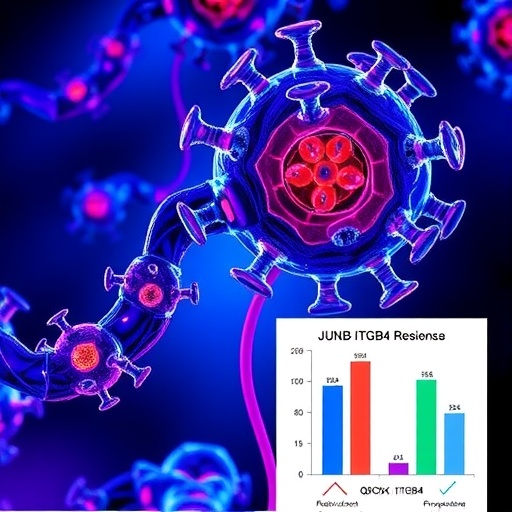
In a groundbreaking study set to redefine our understanding of targeted therapies in lung cancer, a team of researchers led by Liu, Wang, Qi, and colleagues unveils novel molecular insights that could dramatically influence treatment strategies for patients with EGFR-mutant lung adenocarcinoma. Published in the prestigious journal Cell Death Discovery in 2026, this research reveals a previously underappreciated non-enzymatic role of the quiescin sulfhydryl oxidase 2 (QSOX2) protein. This function directly governs the JUNB-ITGB4 signaling axis, ultimately modifying cancer cell behavior to increase resistance against osimertinib, a frontline epidermal growth factor receptor (EGFR) inhibitor widely used in clinical settings.
Lung adenocarcinoma, particularly subtypes harboring mutations in the EGFR gene, represents a significant therapeutic challenge due to inevitable acquired resistance to tyrosine kinase inhibitors such as osimertinib. Osimertinib has been a beacon of hope, offering improved survival for patients, but resistance mechanisms limit its long-term efficacy. The team’s meticulous exploration into QSOX2 shines light on an alternative pathway cancer cells exploit, independent of QSOX2’s conventional enzymatic oxidase activity, to mount a formidable defense against the targeted drug.
What sets this study apart is its focus on QSOX2’s non-enzymatic function. Traditionally recognized for catalyzing disulfide bond formation essential for extracellular matrix remodeling, QSOX2 here assumes a distinct regulatory role within the intracellular milieu. The researchers utilized a sophisticated combination of CRISPR-Cas9 gene editing, transcriptomic profiling, and proteomic analyses to demonstrate that QSOX2 interacts directly with transcription factor JUNB. This interaction modulates the expression of integrin beta 4 (ITGB4), a critical player in cell adhesion, migration, and survival signaling pathways, thereby establishing a direct molecular link that enhances the tumor cells’ evasive capabilities against osimertinib.
Extensive mechanistic dissection revealed how the QSOX2-JUNB complex augments ITGB4 expression, activating downstream signaling cascades that confer robust resistance phenotypes. This axis supports enhanced cellular adhesion and invasion, promoting not only drug resistance but also aggressiveness and potential metastatic capacity. Notably, these findings challenge the conventional framework attributing drug resistance solely to mutations or kinase reprogramming, highlighting tumor plasticity mediated through non-canonical protein functions.
The implications for therapeutic intervention are immense. Recognizing QSOX2’s non-enzymatic role opens up new avenues for combinatorial treatments targeting the ancillary signaling pathways sustaining drug resistance. By disrupting the QSOX2-JUNB interaction or directly inhibiting ITGB4 function, oncologists might circumvent the durability problem faced by current EGFR-targeted therapies. The study advocates for pharmaceutical efforts to develop agents that selectively inhibit these molecular interactions without hindering QSOX2’s enzymatic activity, minimizing off-target toxicity.
Importantly, the research team corroborated their molecular findings using patient-derived xenograft models and clinical samples, confirming that high QSOX2 expression correlates with poorer osimertinib response and decreased overall survival. This translational approach underscores the clinical relevance and potential prognostic utility of QSOX2 and its associated pathway components in personalized treatment regimens.
Beyond its practical applications, this research challenges us to rethink the multifaceted roles proteins can assume within cancer biology. QSOX2 exemplifies a moonlighting protein that possesses dual functionalities — an enzymatic domain traditionally linked to oxidative protein folding and a non-enzymatic regulatory capacity influencing transcriptional networks. The molecular flexibility observed here may be a widespread phenomenon, warranting broader investigation across various oncogenic contexts.
Furthermore, the JUNB transcription factor, typically implicated in stress response and cellular proliferation, emerges as a pivotal coordinator in this resistance mechanism, positioning it as a potential therapeutic target itself. Coupled with integrin beta 4’s known involvement in cancer progression and metastatic niches, the interconnectedness of these molecules paints a compelling picture of complex intracellular signaling axes that cancer cells hijack to survive therapeutic pressures.
Crucial to the study’s success was its multidisciplinary approach. By integrating computational biology with meticulous lab experimentation, including co-immunoprecipitation and chromatin immunoprecipitation sequencing, the researchers mapped the direct interactions and recruitment events leading to transcriptional regulation. This comprehensive investigative framework sets a new standard for delineating non-enzymatic protein functions within oncogenic pathways.
Given the ongoing global burden of lung adenocarcinoma and the persistent challenge of overcoming therapeutic resistance, these findings provide a beacon of hope. Future research inspired by this study could not only improve patient outcomes by prolonging drug sensitivity but also contribute substantially to the development of next-generation precision medicines aimed at crippling cancer’s adaptive networks.
While many previous investigations into osimertinib resistance have focused on genetic mutations and downstream signaling alterations, the mechanistic clarity offered by this study reveals a novel paradigm: functional versatility of proteins like QSOX2 in resistance evolution. This highlights the need to expand our molecular lens beyond enzyme activity alone, considering alternative functional domains and interactions that might fuel disease progression.
As targeted therapy continues to evolve, the insights from Liu et al.’s study underscore that successful intervention may depend as much on disrupting protein-protein interactions and non-enzymatic regulatory circuits as it does on inhibiting kinase activity. Such nuanced understanding will be vital in guiding drug design and improving therapeutic durability.
Looking forward, the medical community eagerly anticipates follow-up studies to explore inhibitors specifically aimed at the QSOX2-JUNB-ITGB4 axis and their potential synergy with existing EGFR inhibitors. Clinical trials evaluating such combinatorial strategies could represent the next frontier in personalized oncology for EGFR-mutant lung adenocarcinoma.
In summary, this landmark research illuminates non-enzymatic functions of QSOX2 as a crucial determinant of osimertinib resistance through modulation of the JUNB-ITGB4 axis. By providing robust experimental evidence and clinical correlations, it opens novel therapeutic vistas with promising potential to reshape treatment paradigms against resistant lung cancer forms. The molecular intricacy unraveled here exemplifies the complex adaptability of tumor biology, underscoring an urgent need for innovative, multifaceted therapeutic designs.
Cite Scienmag News
Ophelia Keating. (April 2, 2026). QSOX2 Drives Osimertinib Resistance via JUNB-ITGB4 Axis. Scienmag. https://scienmag.com/qsox2-drives-osimertinib-resistance-via-junb-itgb4-axis/
Ophelia Keating. "QSOX2 Drives Osimertinib Resistance via JUNB-ITGB4 Axis." Scienmag, 2 April 2026, https://scienmag.com/qsox2-drives-osimertinib-resistance-via-junb-itgb4-axis/. Accessed 4 September 2026.
Ophelia Keating. "QSOX2 Drives Osimertinib Resistance via JUNB-ITGB4 Axis." Scienmag. April 2, 2026. https://scienmag.com/qsox2-drives-osimertinib-resistance-via-junb-itgb4-axis/


