


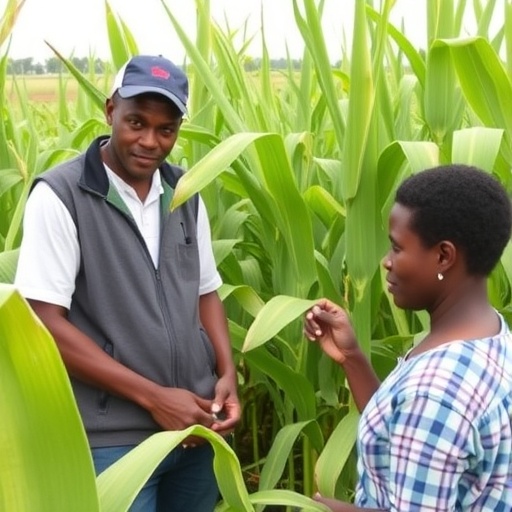
In the heartland of South Africa’s agricultural landscape, maize stands as a staple crop feeding millions and underpinning food security across the continent. Recent research has shed light on a pressing challenge threatening this vital crop: the resilience of pests against genetically modified Bt maize cultivars, and its quantifiable impact on yield losses. This groundbreaking study, led by Tack, Cooper, Nalley, and colleagues, unravels the complex dynamics behind Bt resilience and offers an unprecedented depth of insight into how pest adaptation is eroding the gains achieved through biotechnology.
Bt maize, engineered to express Bacillus thuringiensis (Bt) toxins, revolutionized pest management and crop protection when first introduced. The modification targets specific insect pests, particularly lepidopteran species like stem borers, which historically devastated maize fields. For years, Bt crops have significantly reduced the need for chemical pesticides, facilitated higher yields, and contributed to sustainable agriculture practices throughout South Africa. However, the evolution of resistance among pest populations has increasingly threatened these benefits, raising alarms in scientific and farming communities alike.
The study meticulously quantifies the economic and agronomic consequences of this resilience, employing advanced statistical models integrated with field data spanning several growing seasons. By comparing yields from Bt maize fields to those planted with non-Bt counterparts under similar environmental and management conditions, the researchers isolated the yield penalty directly attributable to pest resistance. Their findings reveal a sobering reality: despite the initial robustness of Bt cultivars, resilience traits in pests have led to statistically significant yield reductions that now jeopardize food production efficiency and farmers’ livelihoods.
Delving deeper into the genetic and ecological mechanisms, the research highlights that Bt resistance is not a uniform phenomenon but varies across different maize cultivars and geographic regions within South Africa. Certain cultivars displayed higher susceptibility, largely due to variations in Bt toxin expression levels and the inherent genetic variability of local pest populations. This heterogeneity underscores the challenge of deploying uniform pest management strategies and the need for tailored, site-specific interventions that account for regional pest dynamics and cultivar responses.
Central to the study is the exploration of resistance management strategies, emphasizing the critical role of integrated pest management (IPM). The authors advocate for a multi-pronged approach combining crop rotation, refuge areas planted with non-Bt maize to sustain susceptible pest populations, and judicious use of chemical pesticides. They caution, however, that overreliance on any single tactic risks accelerating resistance development, necessitating ongoing surveillance and adaptive management grounded in scientific evidence.
In addition to field experiments, genomic analyses within the study identified key mutations in pest populations that confer resistance to the Bt toxin. These genetic markers provide a powerful tool for monitoring resistance emergence and spread, enabling early intervention to mitigate its impact. The implications extend beyond South Africa’s borders, as similar resistance mechanisms are detected in other maize-growing regions globally, signaling a worldwide challenge to Bt crop sustainability.
The economic ramifications outlined in the study are equally compelling. Yield losses attributed to Bt resilience translate into reduced incomes for farmers, increased reliance on chemical pesticides with associated environmental costs, and elevated risks of food insecurity in vulnerable communities. By quantifying these losses in economic terms, the research provides a compelling case for increased investment in resistance management research and extension services to educate farmers on best practices.
Crucially, Tack and colleagues’ study challenges the perception that Bt crops alone are sufficient to combat pest threats. Instead, it frames the issue within a broader agroecological context, recognizing that pest populations are highly dynamic and capable of rapid adaptation. This paradigm shift calls for policymakers, researchers, and agricultural stakeholders to rethink current frameworks and prioritize resilience-building strategies that integrate biotechnological innovation with ecological principles.
The implications for global food security resonate strongly, especially as climate change exacerbates pest pressures and alters crop-pest interactions. The study’s findings highlight the urgency of developing next-generation genetically engineered crops with stacked or novel modes of action, alongside fostering agricultural systems that promote biodiversity and ecosystem services. Failure to address Bt resilience could undermine decades of progress in crop protection and intensify the challenges faced by smallholder farmers.
Moreover, the research adds an important voice to the ongoing debate regarding genetically modified organisms (GMOs) in agriculture. It underscores that while GMOs offer transformative potential, their long-term success hinges on sustainable deployment, rigorous scientific monitoring, and inclusive policies that consider socio-economic and environmental dimensions. These insights are critical for informing global regulatory frameworks and shaping public discourse on GMO technology.
The methodology applied by the researchers is noteworthy for its rigor and holistic approach. By combining fieldwork, molecular genetics, ecological modeling, and socio-economic analysis, the study presents a comprehensive picture of Bt resilience impacts. This interdisciplinary strategy exemplifies how modern agricultural challenges require convergent science that bridges natural and social sciences to devise effective solutions.
Future research directions proposed in the study prioritize the development of resistance diagnostics, expanded field trials across diverse agroecological zones, and the exploration of alternative pest control technologies. Emphasis is also placed on participatory research involving farming communities to co-create contextually relevant strategies, ensuring that scientific advancements translate into practical benefits on the ground.
In conclusion, Tack, Cooper, Nalley, and their team provide a critical wake-up call. Bt maize cultivars, once heralded as a silver bullet against pests, now face formidable challenges from evolving pest resilience that threaten to reverse yield gains in South Africa. Only through integrated, science-driven strategies that span genetics, ecology, economics, and social engagement can this threat be surmounted, securing the future of maize production and food security in the region and beyond. This research stands as a testament to the complexity of agricultural biotechnology and the necessity of adaptive management in an ever-changing biological landscape.
Tack, J., Cooper, C.F., Nalley, L.L. et al. Quantifying yield losses from Bt resilience among maize cultivars in South Africa. Nat Commun (2026). https://doi.org/10.1038/s41467-026-71156-x
Cite Scienmag News
Alan Morgan. (April 1, 2026). Measuring Bt Resilience Impact on South African Maize. Scienmag. https://scienmag.com/measuring-bt-resilience-impact-on-south-african-maize/
Alan Morgan. "Measuring Bt Resilience Impact on South African Maize." Scienmag, 1 April 2026, https://scienmag.com/measuring-bt-resilience-impact-on-south-african-maize/. Accessed 6 September 2026.
Alan Morgan. "Measuring Bt Resilience Impact on South African Maize." Scienmag. April 1, 2026. https://scienmag.com/measuring-bt-resilience-impact-on-south-african-maize/


