


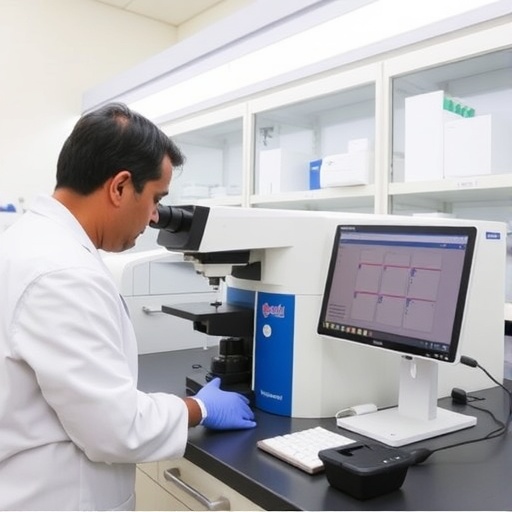
The College of Health at Lehigh University has officially unveiled its latest scientific endeavor, the Health and Environmental Assessment Laboratory (HEAL) Service Center, a cutting-edge core facility dedicated to advancing molecular analysis at the nexus of environmental science and human health. Nestled within the modern confines of the Health, Science, and Technology (HST) building, this 36,000-square-foot laboratory space embodies a forward-thinking ecosystem where innovation and discovery converge.
The HEAL Service Center is designed not merely as a shared resource but as a transformative platform that democratizes access to high-resolution mass spectrometry technologies. By doing so, it empowers researchers from diverse disciplines and institutions—including academic, governmental, and industrial sectors—granting them the unprecedented ability to obtain precise, reliable data without the cumbersome overhead associated with owning and managing sophisticated analytical instruments.
At the core of the HEAL Service Center’s capabilities lies the Thermo Fisher Vanquish liquid chromatography (LC) system seamlessly paired with the formidable Q Exactive Orbitrap mass spectrometer. This sophisticated tandem configuration delivers unrivaled sensitivity and mass accuracy, allowing for both targeted quantification of known analytes and untargeted discovery of previously unidentified compounds. Such technological prowess unlocks new avenues in environmental toxicology, metabolomics, and proteomics by enabling detection at trace levels across complex sample matrices such as water, soil, dust, plasma, urine, and tissue.
Beyond the physical infrastructure, the center boasts a specialized team led by a PhD-level research scientist who collaborates closely with investigators at every stage of their projects. This expert stewardship facilitates tasks ranging from meticulous sample preparation and tailored method development to intricate data processing for large-scale omics datasets. The staff’s expertise extends to designing novel analytical approaches for emerging contaminants, thus ensuring the center remains at the forefront of scientific challenges posed by evolving environmental threats.
The HEAL Service Center functions as a vital incubator for nurturing the next generation of scientists. Students engaged at the facility gain hands-on experience with state-of-the-art mass spectrometry techniques, evolving from novices in sample processing to confident interpreters of multidimensional data. Such immersive training not only cultivates technical competence but also instills an appreciation for the critical role molecular analysis plays in elucidating how environmental variables impact human physiology and disease mechanisms.
For faculty, the center acts as a strategic research asset, especially advantageous when competing for extramural funding. Access to preliminary data generation and expert guidance in experimental design enhances grant applications, positioning researchers to undertake ambitious projects with greater confidence. This synergy bolsters Lehigh University’s reputation as a hub for pioneering investigations into the molecular underpinnings of environmental health.
Geographically, the center’s location offers logistical advantages. Situated within an hour’s drive of major metropolitan areas like Philadelphia and New York City, it serves not only local academic partners but also regional industry stakeholders who require timely and precise analytical services. This proximity reduces turnaround times, a critical factor for projects dependent on rapid data acquisition to inform decision-making processes in environmental monitoring and pharmaceutical development.
The scientific scope of the HEAL Service Center encompasses a broad spectrum of analytical areas. Environmental contaminants analyzed include pesticides, herbicides, pharmaceuticals, PFAS compounds, and a gamut of persistent organic pollutants. Through comprehensive untargeted metabolomic profiling, researchers can unravel complex biochemical disruptions induced by environmental stressors. Concurrently, proteomic investigations provide invaluable insights into alterations in protein expression, enabling a molecular-level understanding of cellular responses to toxic exposures.
Importantly, the center’s open-concept laboratory fosters interdisciplinary collaboration, encouraging synergy across fields such as toxicology, epidemiology, environmental science, and molecular biology. This integrated approach facilitates holistic research paradigms where data integration and systems biology converge to deepen our knowledge of environmental factors shaping human health outcomes.
The HEAL Service Center’s operational philosophy centers on accessibility and partnership. By alleviating the need for individual investigators to procure and maintain expensive instrumentation, the center promotes resource efficiency and scientific inclusivity. This model not only amplifies research capacity at Lehigh University but also strengthens regional scientific infrastructure, positioning the institution as a leader in environmental and health sciences.
As environmental challenges continue to evolve—increasingly marked by complex chemical mixtures and emerging contaminants—the demand for sophisticated, high-throughput analytical platforms becomes paramount. The HEAL Service Center rises to meet these challenges by combining state-of-the-art technology with expert human capital, ultimately driving transformative discoveries that elucidate the intricate interplay between environment and human biology.
The launch of the HEAL Service Center marks a significant milestone, encapsulating Lehigh University’s commitment to fostering innovation, interdisciplinary collaboration, and comprehensive training in molecular sciences. This facility is poised to become a cornerstone for impactful research that not only advances scientific understanding but also informs policy decisions and public health interventions aimed at safeguarding communities from environmental hazards.
For inquiries regarding the HEAL Service Center and to request services, interested parties may contact the center directly via email at inhealt@lehigh.edu, initiating access to a premier resource dedicated to unraveling the molecular signatures of environmental health.
Cite Scienmag News
Ophelia Keating. (April 1, 2026). Lehigh University College of Health Launches HEAL Service Center: A Cutting-Edge Shared High-Resolution Mass Spectrometry Facility. Scienmag. https://scienmag.com/lehigh-university-college-of-health-launches-heal-service-center-a-cutting-edge-shared-high-resolution-mass-spectrometry-facility/
Ophelia Keating. "Lehigh University College of Health Launches HEAL Service Center: A Cutting-Edge Shared High-Resolution Mass Spectrometry Facility." Scienmag, 1 April 2026, https://scienmag.com/lehigh-university-college-of-health-launches-heal-service-center-a-cutting-edge-shared-high-resolution-mass-spectrometry-facility/. Accessed 3 September 2026.
Ophelia Keating. "Lehigh University College of Health Launches HEAL Service Center: A Cutting-Edge Shared High-Resolution Mass Spectrometry Facility." Scienmag. April 1, 2026. https://scienmag.com/lehigh-university-college-of-health-launches-heal-service-center-a-cutting-edge-shared-high-resolution-mass-spectrometry-facility/


