


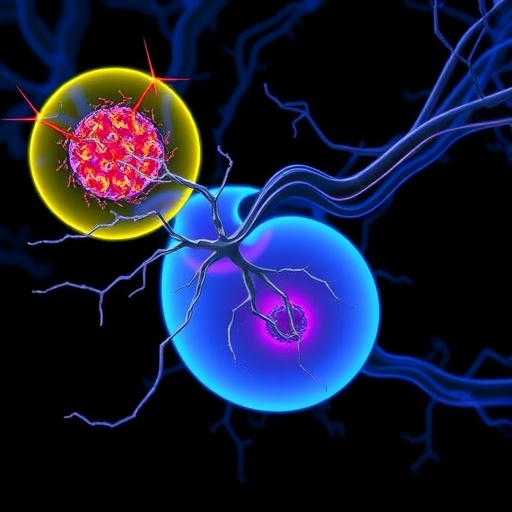
In a groundbreaking study reshaping our understanding of neural crest cell development, researchers have unveiled new insights into the fate determination and migratory behavior of these pivotal progenitors that contribute to diverse tissue types across the vertebrate body. Neural crest cells, known for their remarkable pluripotency and extensive migratory capacity, have long been a subject of intense scientific fascination and debate. Until now, the degree to which these cells retain multipotency following delamination from the neural tube and the patterns by which their progenies disperse to form sensory and sympathetic ganglia have remained elusive.
The research team employed sophisticated CRISPR barcoding techniques in murine models coupled with mosaic variant lineage tracing in humans to unpick the complexities of neural crest progenitor dynamics. These approaches allowed for an unprecedented resolution of clonal relationships among neural crest derivatives. Crucially, the findings revealed robust bilateral clonal dispersal along the rostrocaudal axis—meaning that progenitor cells proliferate and colonize tissues distributed along the length of the body axis symmetrically on both sides. This long-range dispersal challenges previous assumptions of highly localized clonal territories in neural crest-derived structures.
Surprisingly, despite this extensive rostrocaudal migration, there was a strikingly limited overlap in the clonal origins of sensory and sympathetic lineages. This suggests that rudimentary fate restrictions exist early during neural crest differentiation, confining descendant cells to either sensory or sympathetic pathways rather than retaining broad multipotency. The lineage divergence appears to be not a product of stochastic fate acquisition post-delamination, but rather a preordained bias tightly linked to their embryonic origin within the neural tube.
Complementing the genetic lineage tracing, computational modeling of mosaic variants supported a model wherein a majority of neural crest cells are already fate-restricted before delamination occurs. This insight addresses a major controversy within developmental biology, where the extent of in vivo multipotency of delaminated neural crest cells has been hotly contested. Rather than a homogeneous pool of multipotent cells migrating out and choosing their fate in a permissive environment, the evidence now strongly favors a pre-specified cohort primed to contribute selectively to either sensory or sympathetic ganglia.
Furthermore, dynamic live imaging experiments performed on quail embryos added a novel mechanistic layer to this developmental narrative. These studies revealed that fibroblast growth factor (FGF) signaling plays a central role in driving rostrocaudal dispersion of the neural crest progenitors across the embryonic body axis. This FGF-dependent migration underscores a tightly regulated biochemical environment that orchestrates the spatial distribution of neural crest cells, highlighting how extrinsic cues are integral in shaping the eventual anatomical organization of the peripheral nervous system.
Collectively, these findings redefine the developmental architecture of the neural crest, emphasizing that fate predisposition is fundamentally established within the confines of the neural tube. Only a minor subpopulation of delaminated neural crest cells appears to retain genuine multipotency, capable of giving rise to both sensory and sympathetic derivatives. This nuanced understanding revises longstanding models that assumed a broad multipotent potential maintained post-delamination and accretion of extrinsic fate cues as the principal determinant.
Importantly, this research bridges insights across species by integrating data from both mouse and human models, thereby enhancing the translational relevance of the results. The congruent patterns observed in human mosaic variant analyses point to deeply conserved mechanisms in neural crest biology, offering potential avenues for exploring developmental disorders and regenerative therapies centered on neural crest derivatives.
The revelation of robust bilateral clonal spread raises intriguing questions about the temporal window and regulatory inputs governing neural crest progenitor proliferation and dispersion. It also compels a reassessment of how early molecular cues map onto spatial lineage segregation, possibly informing new strategies to manipulate neural crest cells in regenerative medicine and disease modeling contexts.
Moreover, the methodological innovation exemplified by the dual application of CRISPR barcoding and mosaic variant tracing represents a significant leap forward in lineage tracing technologies. The ability to trace progenitor-descendant relationships at such high resolution and with bilateral symmetry considerations promises to catalyze a new era of developmental biology research.
This study not only refines the fundamental biological narrative surrounding neural crest fate specification but also sets the stage for further inquiries into how signaling pathways like FGF orchestrate complex migratory behaviors and tissue integration. Such work will likely illuminate novel target points for therapeutic intervention in neurocristopathies and peripheral neuropathies linked to aberrant neural crest development.
In summary, this compelling research presents a sophisticated model integrating fate restriction within the neural tube, expansive rostrocaudal clonal migration, and FGF-driven dispersal. Collectively, these mechanisms choreograph the developmental assembly of sensory and sympathetic ganglia from the neural crest. This integrated perspective marks a major milestone, enhancing our holistic appreciation of vertebrate embryogenesis and peripheral nervous system formation.
Cite Scienmag News
Denise Maddox. (April 1, 2026). Formation of Sensory and Sympathetic Ganglia. Scienmag. https://scienmag.com/formation-of-sensory-and-sympathetic-ganglia/
Denise Maddox. "Formation of Sensory and Sympathetic Ganglia." Scienmag, 1 April 2026, https://scienmag.com/formation-of-sensory-and-sympathetic-ganglia/. Accessed 4 September 2026.
Denise Maddox. "Formation of Sensory and Sympathetic Ganglia." Scienmag. April 1, 2026. https://scienmag.com/formation-of-sensory-and-sympathetic-ganglia/


