


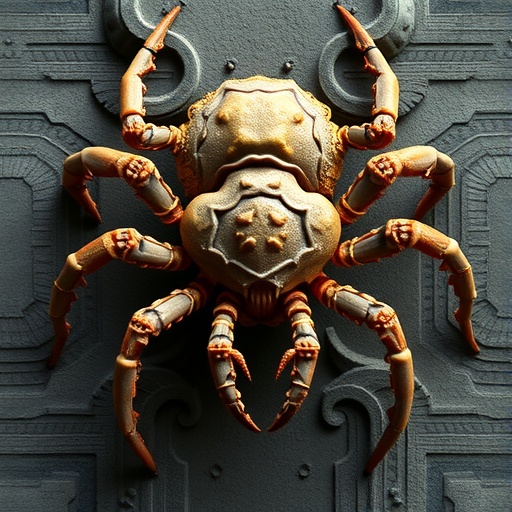
In the arid expanse of Utah’s West Desert, an extraordinary revelation has emerged from the depths of deep time, dramatically reshaping our understanding of arthropod evolution. This discovery centers on Megachelicerax cousteaui, a 500-million-year-old arthropod whose fossilized remains exhibit the earliest known chelicera—the specialized claw-like feeding appendages emblematic of the chelicerate lineage, which comprises spiders, scorpions, horseshoe crabs, and sea spiders. This finding not only pushes back the origin of chelicerates by some 20 million years but also illuminates a critical phase in the evolution of complex anatomical structures during the Cambrian period.
The fossil, meticulously cleaned over fifty hours under high magnification by Rudy Lerosey-Aubril, revealed an intricate morphology unlike anything previously documented in Cambrian arthropods. Measuring just over 8 centimeters, M. cousteaui boasts a sophisticated dorsal exoskeleton with a clearly demarcated head shield and nine segmented body regions. Each anatomical section possesses appendages tailored for distinct functions: six pairs of limbs specialized for sensory input and feeding are positioned on the head shield, while the body segments are lined with plate-like respiratory structures bearing a strong resemblance to the modern horseshoe crab’s book gills. This level of specialization highlights a sophisticated physiological design emerging rapidly after the Cambrian Explosion.
What makes M. cousteaui particularly groundbreaking is its unmistakable chelicera—a pioneering adaptation that sets chelicerates apart from other arthropods. While insects typically sport antennal sensory appendages, chelicerates possess these claw-like structures for grasping and, in some species, venom delivery. Before this discovery, unequivocal fossil evidence of chelicerae from the Cambrian was absent, limiting scientists to Ordovician specimens, notably those from the Fezouata Biota in Morocco dating back roughly 480 million years. The Megachelicerax fossils thus represent the earliest unequivocal snapshot of this critical evolutionary innovation.
The findings not only revise the timeline for chelicerate emergence but also provide invaluable insight into the assembly of their dual-segmented body plan. This bipartite division—a head with specialized appendages distinct from a segmented trunk equipped with respiratory structures—is a hallmark of chelicerate anatomy. Its presence in M. cousteaui indicates that such complex body segmentation was well established by the mid-Cambrian, supporting theories that the rapid diversification of form and function following the Cambrian Explosion catalyzed the early establishment of modern arthropod bauplans.
Intriguingly, despite this swift anatomical innovation, early chelicerates like M. cousteaui did not immediately rise to ecological dominance. Instead, simpler groups such as trilobites maintained prevalence for millions of years before chelicerates diversified and colonized terrestrial niches. This decoupling of morphological innovation from immediate evolutionary success underscores the nuanced interplay between biological adaptation and environmental factors in shaping evolutionary trajectories.
The evolutionary ramifications of this discovery extend beyond paleontological curiosity. By bridging a 20-million-year temporal gap in the chelicerate fossil record, M. cousteaui offers a crucial transitional morphology linking Cambrian arthropods that lacked chelicerae with later Ordovician synziphosurines—horseshoe crab-like chelicerates possessing more derived anatomical features. This phylogenetic connection reshapes longstanding debates, harmonizing previously competing hypotheses and illustrating the gradual emergence of sophisticated features in response to selective pressures.
Morphologically, M. cousteaui exemplifies a fascinating intermediate state, where the chelicera had evolved before the head appendages lost their outer branches, a transformation critical for the spider-like limb structure seen in extant chelicerates. Such insight elucidates how anatomical modularity and appendage specialization co-evolved, offering a window into the developmental constraints and innovations underpinning arthropod diversification.
The preservation of the fossil itself is a testament to meticulous collection and curation efforts spanning decades. Discovered in the mid-Cambrian Wheeler Formation by avocational fossil collector Lloyd Gunther and housed at the University of Kansas Biodiversity Institute and Natural History Museum since 1981, this specimen languished in obscurity until Lerosey-Aubril’s renewed examination under a fine needle microscope reanimated its scientific significance. This narrative highlights the indispensable role of scientific collections and dedicated curators in facilitating groundbreaking discoveries.
Naming Megachelicerax cousteaui after Jacques-Yves Cousteau reflects the researchers’ homage to the legendary ocean explorer, whose legacy transformed humanity’s perception of undersea biodiversity and inspired generations to appreciate marine life’s complexity. Just as Cousteau unveiled the hidden depths of contemporary oceans, M. cousteaui unveils the deep evolutionary roots of a prominent arthropod lineage, bringing to light an ancient chapter in the history of life on Earth.
Today, chelicerates encompass an astonishing diversity with over 120,000 known species inhabiting terrestrial and aquatic ecosystems across the globe. From medically significant ticks and agricultural-impacting mites to the ubiquitous spiders and resilient horseshoe crabs, their ecological and societal importance is immense. Understanding their ancient origins and evolutionary pathways enriches our appreciation of their role in shaping ecosystems and provides perspectives on the evolutionary dynamics driving biodiversity.
This discovery underscores a broader scientific narrative: evolutionary innovation does not guarantee immediate ecological ascendancy. Biological novelty must intersect with favorable environmental conditions and timing to translate into evolutionary success. The case of M. cousteaui exemplifies this principle, revealing a lineage rich with morphological sophistication that bided its time before thriving, illustrating the complex dance of evolution sculpted by both intrinsic and extrinsic forces.
In conclusion, the well-preserved fossil of Megachelicerax cousteaui serves as a pivotal piece in the evolutionary puzzle, documenting the Cambrian advent of chelicerates and the early emergence of their defining chelicerae. It confirms that by the mid-Cambrian, a remarkable level of anatomical complexity resembling modern chelicerate blueprints had already materialized, offering a detailed chronicle of one of the most successful arthropod groups’ deep evolutionary roots. As paleontologists continue to peel back layers of geological history, such discoveries reaffirm the dynamic ingenuity of life and its evolutionary odyssey through deep time.
Cite Scienmag News
Gavin Prescott. (April 1, 2026). Ancient 500-Million-Year-Old Clawed Predator Redefines the Evolution of Spiders and Horseshoe Crabs. Scienmag. https://scienmag.com/ancient-500-million-year-old-clawed-predator-redefines-the-evolution-of-spiders-and-horseshoe-crabs/
Gavin Prescott. "Ancient 500-Million-Year-Old Clawed Predator Redefines the Evolution of Spiders and Horseshoe Crabs." Scienmag, 1 April 2026, https://scienmag.com/ancient-500-million-year-old-clawed-predator-redefines-the-evolution-of-spiders-and-horseshoe-crabs/. Accessed 3 September 2026.
Gavin Prescott. "Ancient 500-Million-Year-Old Clawed Predator Redefines the Evolution of Spiders and Horseshoe Crabs." Scienmag. April 1, 2026. https://scienmag.com/ancient-500-million-year-old-clawed-predator-redefines-the-evolution-of-spiders-and-horseshoe-crabs/


