


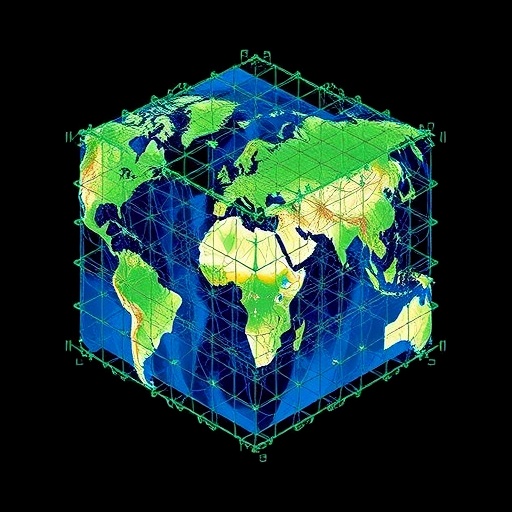
In a groundbreaking development published in the journal Big Earth Data, researchers have unveiled an innovative AI cube framework designed to revolutionize the analytics of large-scale Earth Observation (EO) data. This pioneering approach integrates advanced GeoAI models directly into geospatial data cube infrastructures, setting a new standard for how spatial data is processed, analyzed, and utilized. By leveraging the latest artificial intelligence techniques within a scalable, cloud-native environment, the framework offers unprecedented improvements in both analytical capability and computational efficiency.
Traditional methods for handling Earth Observation data have largely relied on data cubes—multidimensional arrays of spatially and temporally aligned geospatial information. While these data cubes provide a robust structure for managing diverse satellite imagery and sensor datasets, their analytical capabilities have historically been constrained by rigid processing pipelines and limited model integration. This limitation has often led to bottlenecks in processing speed and delays in generating actionable insights, hindering timely decision-making in environmental monitoring, resource management, and disaster response.
The newly proposed AI cube framework transcends these constraints by embedding GeoAI models natively within the data cube environment. At its core lies a sophisticated integration mechanism that couples a vast model warehouse with intelligent model selection algorithms. This design allows for seamless matching of AI models to specific spatial-temporal data contexts, ensuring that the most effective analytical techniques are dynamically applied. The framework’s capacity to execute parallel inference pipelines further accelerates the analytical process, drastically reducing the time from data ingestion to insight generation.
Implemented on the Open Geospatial Engine (OpenGE) platform, the AI cube framework leverages the open-source ecosystem’s scalability, interoperability, and extensibility. OpenGE’s spatial data infrastructure capabilities complement the AI cube’s needs for high-throughput data management and complex computational workflows. The synergy enables analyses that were previously computationally prohibitive, facilitating near-real-time assessments over vast geographic extents, which is especially crucial for rapid environmental events such as wildfires, floods, or deforestation monitoring.
Benchmarking results highlight the transformative impact of this framework. The integration of AI models and parallel inference has led to an over 80% reduction in inference time compared to conventional data cube processing methods. This dramatic speedup not only enhances the relevance of EO-derived insights but also lowers computational costs and energy consumption, aligning with sustainability goals in big data analytics. The study’s authors emphasize that such efficiency gains make large-scale, complex Earth Observation analysis more accessible to a broader range of stakeholders, including governmental agencies, researchers, and private sector entities.
Beyond performance improvements, the AI cube framework introduces a paradigm shift in how spatial data infrastructures are conceptualized. Rather than viewing AI models as external analytical tools applied after data cube processing, this approach embeds AI capabilities intrinsically within the data infrastructure. This convergence fosters a new class of AI-ready spatial data infrastructures that streamline workflows, reduce data redundancy, and support real-time decision-making. The model warehouse itself is a repository of pre-trained and customizable GeoAI models, ranging from land cover classification and change detection to biomass estimation and urban growth monitoring.
The intelligent model selection component represents another key innovation. Instead of static, one-size-fits-all model application, the framework employs metadata-driven algorithms that assess data characteristics, temporal and spatial resolution, and user-defined analytical objectives. This dynamic model selection ensures that analysis remains context-aware and adaptable, which significantly improves accuracy and relevance. It also supports continuous learning scenarios where models can be updated or retrained as new data becomes available, enhancing adaptability to evolving Earth system processes.
Moreover, the AI cube framework’s adoption of parallel inference pipelines is critical for handling the massive scale of global EO datasets. By distributing computation across cloud resources and executing multiple models concurrently on different spatial tiles or time slices, the system achieves optimal resource utilization. This parallelization capability not only speeds up processing but also allows for complex multi-model fusion strategies, where the outputs of several AI models can be integrated to produce more comprehensive analytical products.
The implications of this research extend beyond academic interest. Governments tasked with monitoring environmental compliance, climate change impacts, and natural disaster response stand to benefit enormously from integrating AI cube frameworks into their operational systems. The ability to quickly analyze satellite data with AI-enhanced precision supports policy formulation, resource allocation, and emergency management with a responsiveness previously unattainable. Similarly, industries such as agriculture, forestry, and urban planning can harness these capabilities to optimize practices, enhance sustainability, and reduce operational risks.
In addition to improving performance and utility, the study acknowledges the importance of open, interoperable architectures for broad adoption. By building on OpenGE, a platform compliant with established geospatial standards, the AI cube framework ensures compatibility with existing data infrastructures and user tools. This strategic alignment facilitates integration into current EO data ecosystems, lowering barriers to entry for institutions wishing to upgrade their analytical capabilities.
This advance also signals a broader trend in geospatial sciences, where the fusion of AI and spatial data infrastructures moves toward generating what might be called “intelligent geospatial platforms.” Such platforms not only store and disseminate data but also embed analytical intelligence, enabling autonomous or semi-autonomous decision support workflows. The AI cube framework exemplifies this trend by orchestrating data and model co-location, scalable computation, and automated model governance within a single cohesive system.
The authors of the study conclude that their framework lays a solid foundation for future innovations in large-scale Earth Observation analytics. They envision enhancements such as incorporating federated learning to preserve data privacy, integrating multimodal data (combining EO with socioeconomic or IoT data), and deploying edge computing strategies to process data closer to sensors. These avenues promise even more responsive, accurate, and nuanced environmental intelligence.
In summary, the AI cube framework presented in this cutting-edge research signifies a pivotal evolution of geospatial data infrastructures. By embedding GeoAI models within a data cube backbone and enhancing analytical throughput with smart model selection and parallel inference, the framework dramatically boosts the analytical capabilities of Earth Observation platforms. This innovation not only accelerates the pace at which we translate raw satellite observations into actionable knowledge but also embodies a strategic shift toward AI-enabled, real-time spatial data processing architectures that will redefine how society monitors and responds to planetary changes.
News Publication Date: Information not provided.
Web References: Information not provided.
References: Information not provided.
Cite Scienmag News
Violet Maxwell. (April 1, 2026). Advancing AI Cube Technology for Earth Observation Data Analysis in Distributed Systems. Scienmag. https://scienmag.com/advancing-ai-cube-technology-for-earth-observation-data-analysis-in-distributed-systems/
Violet Maxwell. "Advancing AI Cube Technology for Earth Observation Data Analysis in Distributed Systems." Scienmag, 1 April 2026, https://scienmag.com/advancing-ai-cube-technology-for-earth-observation-data-analysis-in-distributed-systems/. Accessed 4 September 2026.
Violet Maxwell. "Advancing AI Cube Technology for Earth Observation Data Analysis in Distributed Systems." Scienmag. April 1, 2026. https://scienmag.com/advancing-ai-cube-technology-for-earth-observation-data-analysis-in-distributed-systems/


