


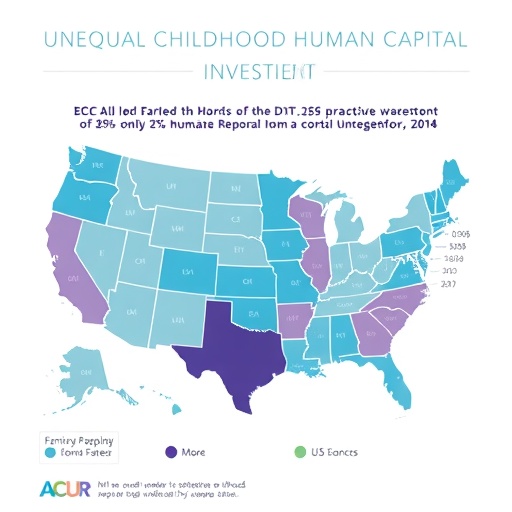
In a groundbreaking study recently published in Nature Communications, researchers have dissected the intricate disparities in childhood human capital investments across the United States, illuminating systemic inequities that shape developmental trajectories from a young age. This comprehensive analysis, spearheaded by Blazar, Boudreaux, Klees, and colleagues, offers an unprecedented panoramic view of how economic, social, and policy-related factors converge to influence the quantity and quality of investments directed toward children’s growth and potential nationwide.
The study delves into human capital investments — encompassing educational opportunities, nutritional provisions, healthcare access, and extracurricular enrichment — that critically impact cognitive and socio-emotional development. By leveraging a rich mosaic of data sources ranging from administrative records to census metrics and longitudinal surveys, the researchers construct a multifaceted framework to chart where and why children receive differing levels of developmental support. Such support is pivotal, as early investments trigger a cascade influencing skills acquisition, academic achievement, and ultimately lifelong economic outcomes.
What emerges from this exhaustive inquiry is a stark portrait of entrenched inequality. Children in economically disadvantaged areas, disproportionately from minority backgrounds, face significantly lower investments, not merely in monetary terms but in the holistic support systems integral to nurturing human capital. This disparity manifests early, often before formal schooling begins, underscoring the urgency of policy interventions targeted at prenatal and early childhood phases. The researchers argue convincingly that these early deficits set the stage for entrenched achievement gaps, which widen over time and perpetuate cycles of poverty and social stratification.
Methodologically, the team employs advanced econometric modeling to isolate the effects of diverse variables — including household income, parental education, neighborhood characteristics, and state-level policy frameworks — on the distribution of human capital investments. Sophisticated spatial analysis reveals that geographic clustering exacerbates disparities, with “investment deserts” prevalent in certain urban and rural locales. These findings challenge simplistic assumptions that access alone ensures equitable outcomes, instead highlighting the nuanced ways structural factors hinder equal opportunity.
Adding depth to their analysis, the authors integrate longitudinal tracking of individual investment trajectories, illuminating how early investment deficiencies compound and ripple through critical developmental milestones. They examine differential exposure to high-quality preschool education, enrichment activities like music and sports, as well as access to nutritious food and preventative healthcare services. The data paint a complex picture where even within seemingly resource-sufficient environments, children’s experiences vary markedly along socioeconomic lines.
The implications of these results are profound for policymakers, educators, and social scientists alike. The study identifies targeted leverage points where interventions could yield outsized returns, such as increasing funding for early childhood education programs in underserved communities and expanding parental support services. Moreover, the authors highlight the interconnectedness of investments — demonstrating that improving access in one domain (e.g., healthcare) without parallel enhancements in others (e.g., educational resources) results in suboptimal outcomes.
Importantly, the research also scrutinizes existing policy frameworks, revealing that some well-intentioned programs inadvertently exacerbate inequalities through uneven implementation or by failing to address root causes. For instance, subsidies designed to increase preschool enrollment often disproportionately benefit families already positioned to take advantage, leaving the most vulnerable children behind. This insight underscores the need for more nuanced, equity-focused policy design informed by granular data such as that provided by this study.
On the technological front, the team utilizes machine learning algorithms to predict areas at highest risk of underinvestment, enabling the development of proactive strategies that mobilize resources before disparities deepen further. These predictive tools represent a promising convergence of big data analytics and social policy formulation, offering a roadmap toward more responsive and adaptive human capital investment strategies.
Beyond statistical analyses, the study engages conceptually with the idea of human capital as a cumulative and interactive process, dependent not only on discrete inputs but also synergistic interactions among family, school, and community environments. This perspective advances existing scholarship by shifting emphasis from isolated factors to systemic dynamics that sustain or disrupt developmental momentum over time.
The findings resonate amid ongoing national conversations about educational equity and social justice, contributing empirical heft to debates on how to dismantle barriers that disproportionately affect minority and low-income children. By revealing both the scale and intricacy of disparities, the study reinforces calls for integrated, multisectoral interventions that weave together health, education, and social support systems.
This research also provokes vital ethical considerations around allocation of public resources and the framing of childhood development as a societal responsibility rather than an individual or family burden. The authors contend that equitable human capital investment is foundational not only to personal flourishing but also to economic competitiveness and social cohesion at the national level.
In synthesis, Blazar and colleagues’ study crystallizes a nuanced understanding of the multi-dimensional gaps in childhood human capital investment. It provides an analytical scaffold upon which stakeholders can build more equitable and effective policies, emphasizing early intervention, geographic targeting, and cross-sector coordination. As the U.S. grapples with persistent educational and economic inequities, this research offers both a diagnostic tool and a strategic guidepost toward leveling the playing field for future generations.
Ultimately, the study’s innovative use of data and theory sets a new benchmark for research on human capital disparities. Its insights invite ongoing inquiry and action, highlighting the critical importance of investing equitably in the youngest members of society to foster inclusive growth and shared prosperity. With policy implications that stretch far beyond any single domain, this work charts a vital course toward a more just and opportunity-rich America.
Blazar, D., Boudreaux, M., Klees, S. et al. Disparities in childhood human capital investments in the United States. Nat Commun 17, 2746 (2026). https://doi.org/10.1038/s41467-026-70316-3
Cite Scienmag News
Denise Maddox. (March 31, 2026). Unequal Childhood Human Capital Investment in U.S. Scienmag. https://scienmag.com/unequal-childhood-human-capital-investment-in-u-s/
Denise Maddox. "Unequal Childhood Human Capital Investment in U.S." Scienmag, 31 March 2026, https://scienmag.com/unequal-childhood-human-capital-investment-in-u-s/. Accessed 3 September 2026.
Denise Maddox. "Unequal Childhood Human Capital Investment in U.S." Scienmag. March 31, 2026. https://scienmag.com/unequal-childhood-human-capital-investment-in-u-s/


