


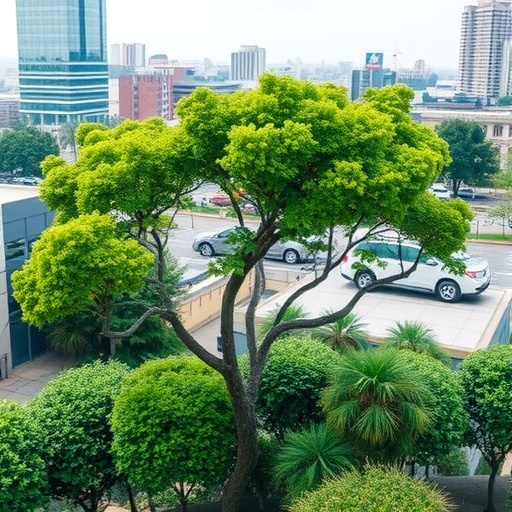
As the world faces escalating urban heat challenges exacerbated by climate change, understanding the cooling effects of natural landscapes has become critical. A groundbreaking new study by Huang, C., Ning, J., Qiu, X., and colleagues, published in npj Urban Sustainability, sheds unprecedented light on how blue-green spaces function as natural air conditioners in subtropical water-network cities. Their meticulous quantification of cooling thresholds opens promising pathways for urban planners striving to combat urban heat islands while enhancing city livability.
Urban areas in subtropical climates endure intense heat stress, often magnified by sprawling concrete, asphalt, and limited vegetation. Blue-green spaces—comprising water bodies, parks, vegetation cover, and integrated networks thereof—are widely acknowledged to mitigate thermal discomfort by lowering ambient temperatures. However, until now, the precise cooling capacities and threshold levels at which these spaces exert significant thermal relief remained elusive. This seminal research fills that knowledge gap by combining high-resolution spatial analysis with urban microclimate modeling.
The authors selected a water-network city in a subtropical region as their study area, where intertwined natural and artificial water channels coexist alongside urban greenery. Such environments offer a unique laboratory to dissect the intertwined cooling contributions of both water and vegetation. By integrating satellite thermal imagery, land use data, and climate variables, the team developed sophisticated models pinpointing specific cooling thresholds for blue-green spaces. Their approach blended remote sensing with in situ temperature monitoring, providing both macro and micro-scale insights.
Crucially, the study defined “cooling thresholds” as the minimum size or spatial proportion of blue-green elements required to trigger significant reductions in near-surface urban temperatures. Results revealed distinct nonlinear cooling dynamics: below threshold values, cooling effects were marginal and patchy; surpassing these thresholds yielded exponential drops in local temperatures, often exceeding 2–3°C. This quantitative evidence underscores the importance of not only creating blue-green infrastructure but ensuring sufficient scale and connectivity to maximize their efficacy.
The presence of water surfaces was confirmed as a powerful cooling agent, largely due to evaporative cooling and high heat capacity. However, the study distinguished between the cooling strengths of open water bodies, narrow canals, and vegetated patches adjacent to water channels. Water bodies alone contributed robust cooling zones, but synergistic arrangements where water bodies were bordered by dense vegetation produced amplified and more persistent cooling effects. Such spatial configurations are essential for sustainable urban temperature management.
Moreover, seasonal and diurnal variations were rigorously examined to understand how blue-green cooling operates under different climatic conditions. Nighttime cooling benefits were particularly noteworthy; evaporative and radiative cooling persisted longer in water-network environments than in purely green or built-up areas. This temporal dimension highlights the potential of water-vegetation matrices in alleviating heat stress, especially during warm nights when urban heat islands disproportionately threaten vulnerable populations.
Another pivotal aspect explored was spatial distribution and connectivity of blue-green elements. Fragmented green patches failed to deliver substantial thermal relief, while continuous networks formed natural temperature corridors facilitating heat dissipation. The study advocates urban design strategies prioritizing connected blue-green infrastructure, which synergizes mitigation outcomes beyond the additive impacts of isolated green or blue spaces.
The research further explores the implications of urban morphology—the arrangement and height of buildings—on the cooling thresholds of blue-green spaces. Dense high-rise clusters can obstruct airflow and solar radiation patterns, attenuating the cooling performance of adjacent greenery and water features. In contrast, mid-rise developments with open courtyards enable better airflow, enhancing the efficacy of the blue-green network. Urban planners must thus balance density and open space design to optimize thermal comfort.
Importantly, the authors also explored the socioeconomic dimensions of blue-green cooling benefits. Equitable access to these natural cooling landscapes can mitigate health disparities intensified by climate change. Their findings suggest that targeted investment in water-integrated green infrastructure in economically disadvantaged neighborhoods could serve as a vital adaptation and resilience strategy, reducing heat-related morbidity and mortality.
From a technical standpoint, the team employed advanced geospatial statistics coupled with machine learning algorithms to identify and model thermal patterns accurately. These methodologies allowed them to simulate various urban planning scenarios and assess their cooling potentials. Their predictive capabilities equip policymakers with evidence-based tools to guide sustainable urban development tailored to regional microclimates and social contexts.
In line with global climate action agendas, this study advocates for mainstreaming blue-green infrastructure into urban resilience frameworks. The quantified cooling thresholds serve as actionable metrics to inform minimum green and blue space requirements in zoning laws, green urbanism policies, and smart city initiatives. By moving beyond qualitative endorsements of nature-based solutions, this research empowers cities to embed precise thermal mitigation targets in their climate adaptation pathways.
The novelty and rigor of this investigation also pioneer new interdisciplinary research avenues. Linking landscape ecology, urban climatology, hydrology, and social equity expands the understanding of how natural and built environments coalesce to shape urban thermal regimes. Future studies can build on these findings to explore interactions with air pollution dynamics, biodiversity conservation, and human behavioral responses to heat stress.
In conclusion, Huang and colleagues illuminate the transformative potential of blue-green space networks in subtropical urban environments, translating complex ecological functions into tangible planning metrics. Their evidence-based insights bridge scientific inquiry and practical applications, charting a hopeful course toward cooler, healthier, and more climate-resilient cities worldwide. As urban centers grapple with escalating heat challenges, embracing intelligently designed blue-green infrastructures promises not only thermal relief but also enhanced quality of urban life.
Cite Scienmag News
Courtney Benton. (March 31, 2026). Measuring Blue-Green Space Cooling in Subtropical Cities. Scienmag. https://scienmag.com/measuring-blue-green-space-cooling-in-subtropical-cities/
Courtney Benton. "Measuring Blue-Green Space Cooling in Subtropical Cities." Scienmag, 31 March 2026, https://scienmag.com/measuring-blue-green-space-cooling-in-subtropical-cities/. Accessed 4 September 2026.
Courtney Benton. "Measuring Blue-Green Space Cooling in Subtropical Cities." Scienmag. March 31, 2026. https://scienmag.com/measuring-blue-green-space-cooling-in-subtropical-cities/


