


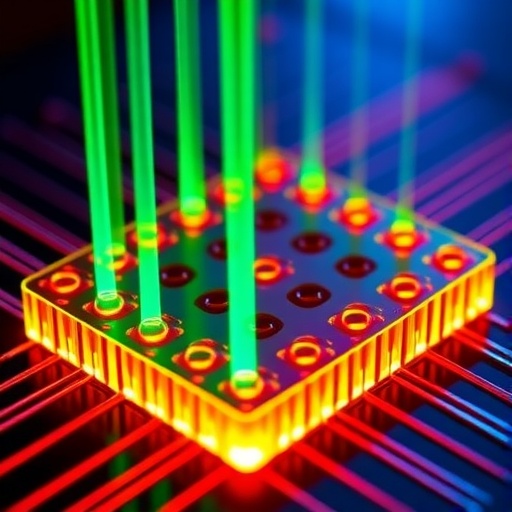
In a remarkable stride toward the practical realization of quantum technology outside the confines of specialized laboratories, researchers from the University of California, Santa Barbara, and the University of Massachusetts Amherst have unveiled a groundbreaking innovation: a chip-scale stabilized visible light laser capable of driving trapped ion atomic optical clocks and qubits. This pioneering achievement signals a pivotal advance in the ongoing quest to create compact, portable, and scalable quantum information systems, thus bridging the gap between laboratory-scale experiments and real-world quantum applications.
At the heart of this development lies a visible light Brillouin laser meticulously engineered on a chip-scale platform. This laser boasts an exceptionally low-frequency noise profile, which is critical for executing delicate quantum operations with ions. The design incorporates a novel chip-integrated coil resonator system, a cornerstone technology cultivated by the UC Santa Barbara research team. This resonator maintains the laser’s optical frequency stability by locking it to the ultra-precise strontium atomic clock transition, a feature typically requiring considerable tabletop equipment in traditional setups.
One of the most compelling aspects of this innovation is its ability to perform at room temperature, a stark contrast to many quantum systems demanding cryogenic environments. The chip integrates a surface electrode ion trap that confines the quantum ions, enabling state preparation and manipulation directly on the chip. Such integration is crucial as it eliminates bulky optical components and extensive manual adjustments characteristic of conventional quantum experiments, facilitating increased robustness, miniaturization, and environmental resistance.
Miniaturization is not merely about size reduction but about opening access to quantum technologies for a broader spectrum of scientists and potential applications. The traditional laser systems and optical instrumentation for trapped ion experiments often monopolize over 90% of experimental setups, spanning large tables and requiring painstaking calibration. Shrinking these components to the size of a deck of cards while retaining or enhancing performance represents an engineering marvel with profound implications for the scalability of quantum devices.
This breakthrough also foreshadows the possibility of deploying quantum technologies in diverse, even extreme environments. Portable quantum circuits based on this integrated photonics approach could find their way not only into laboratories worldwide but also aboard satellites, lunar missions, and deep space probes. Such deployment could dramatically expand the scientific and practical capabilities of quantum sensing, navigation, and fundamental physics experiments conducted far beyond Earth’s surface.
The potential applications unlocked by this chip-scale laser system are staggering. The precision clocks formed by these systems enable unprecedented sensitivity in fundamental science inquiries, including searches for dark matter and dark energy, precise gravitational mapping, and tests of general relativity. Moreover, networks of these integrated quantum clocks could transform Earth observation by detecting minute gravitational shifts associated with geological activity or climate phenomena.
The collaborative effort with UMass Amherst focused heavily on the quantum control architecture, particularly the critical operations of state preparation, manipulation, and measurement (SPAM) of trapped ions. The fidelity of these quantum operations is directly impacted by the noise and stability characteristics of the laser. This chip-based Brillouin laser showcased superior performance, delivering 99.6% SPAM fidelity, notably requiring fewer control pulses — an efficiency gain that translates into faster and more reliable quantum computation and sensing operations.
The integration approach aligns with engineering principles observed in classical computing, where scaling is achieved through miniaturization and photonic integration rather than replicating bulky hardware setups. By embedding not only lasers but also the necessary control and stabilization components onto chips, the pathway to millions of qubits and practical quantum processors becomes clearer and more attainable.
Importantly, the research demonstrates that miniaturization does not entail performance compromise, a perception that has long hindered enthusiasm for integrated photonic quantum devices. On the contrary, this technology reveals that integration can enhance coherence stability and operational fidelity, a finding likely to inspire a paradigm shift in how quantum experiments and devices are designed.
Looking forward, the team plans to continue developing on-chip laser systems that cover the full spectrum of quantum control needs, including additional lasers required for state preparation, clock control, and operational management of quantum qubits. The ultimate goal is an all-encompassing photonic “physics package” that houses the necessary components for trapped ion quantum computing and sensing, optimized for portability and scalability.
This achievement sets a new standard in the quantum technology landscape by merging photonics, precision engineering, and quantum physics into a cohesive, commercially viable platform. The synergy achieved between sophisticated stabilized laser technology and integrated ion trapping is expected to accelerate advances not only in quantum computing but also in quantum metrology and sensing, where precision and stability are paramount.
Professor Daniel Blumenthal of UC Santa Barbara reflects on the broader significance: the conventional wisdom that integrated photonics compromises quality for portability is being decisively overturned. The intersection of photonics engineering with quantum physics heralds a transformational era, where integrated devices can deliver unprecedented performance while enabling unprecedented accessibility and application breadth, fundamentally altering the trajectory of quantum science and technology.
Keywords
Quantum technology, integrated photonics, Brillouin laser, trapped ions, atomic clocks, quantum computing, chip-scale devices, quantum sensing, laser stabilization, ion traps, precision measurement, scalable quantum systems
Cite Scienmag News
Katie Riggs. (March 30, 2026). Scientists Showcase Integrated Stabilized Laser Chips Executing Clock and Quantum Operations on Room-Temperature Trapped Ion Qubits. Scienmag. https://scienmag.com/scientists-showcase-integrated-stabilized-laser-chips-executing-clock-and-quantum-operations-on-room-temperature-trapped-ion-qubits/
Katie Riggs. "Scientists Showcase Integrated Stabilized Laser Chips Executing Clock and Quantum Operations on Room-Temperature Trapped Ion Qubits." Scienmag, 30 March 2026, https://scienmag.com/scientists-showcase-integrated-stabilized-laser-chips-executing-clock-and-quantum-operations-on-room-temperature-trapped-ion-qubits/. Accessed 3 September 2026.
Katie Riggs. "Scientists Showcase Integrated Stabilized Laser Chips Executing Clock and Quantum Operations on Room-Temperature Trapped Ion Qubits." Scienmag. March 30, 2026. https://scienmag.com/scientists-showcase-integrated-stabilized-laser-chips-executing-clock-and-quantum-operations-on-room-temperature-trapped-ion-qubits/


