


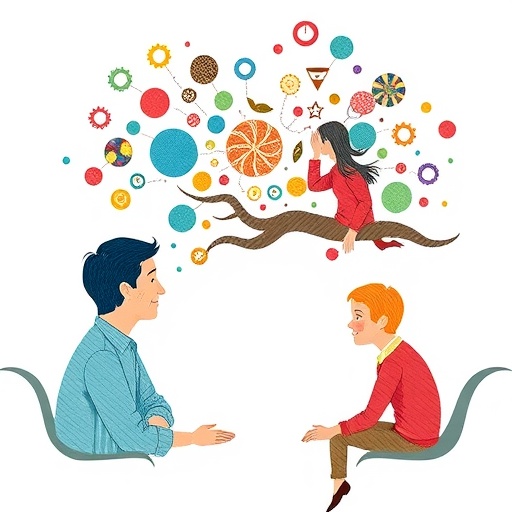
In recent years, rumination has solidified its reputation as a formidable adversary in mental health discourse, frequently characterized as an inward-looking cycle of persistent, maladaptive thought patterns. Traditionally confined to the realm of individual psychology, rumination is often seen as a solitary intrapersonal habit—an incessant replaying of negative thoughts that anchors individuals to emotional distress and cognitive stagnation. However, emerging research disrupts this long-standing framework by highlighting a critical, yet underappreciated, dimension: the deep entanglement of rumination within interpersonal relationships. A pioneering study published in Nature Mental Health introduces the Dynamic Interpersonal Model of Rumination (DIM-Rum), a paradigm shift that reconceptualizes rumination from a static personal struggle into a complex, recursive, and dynamic interpersonal process that continuously shapes, and is shaped by, social interactions.
To fully appreciate this innovative approach, it is essential to first dissect the canonical understanding of rumination. Psychological scholarship has predominantly portrayed rumination as an intrapersonal phenomenon, emphasizing its repetitive and uncontrollable nature, whereby negative thoughts are recycled without resolution. This internal dialogue is implicated in a wide spectrum of psychiatric conditions, including depression, anxiety, and stress-related disorders. Traditional models focus principally on cognitive and affective mechanisms within the individual, such as impairments in attentional control and emotional regulation. Such models have informed therapeutic interventions including cognitive-behavioral strategies aimed at disrupting rumination at the individual level.
Yet, this inward focus misses a vital piece of the puzzle: the social context in which rumination unfolds. The DIM-Rum framework surges beyond the confines of the individual mind, recognizing rumination as deeply embedded within social fabrics. It posits that rumination is not merely a private mental act but unfolds through ongoing interpersonal feedback loops. These loops involve reciprocal influences where the ruminator’s thoughts and emotions affect interpersonal behaviors, which in turn elicit responses from others, feeding back to influence the initial ruminative process. This cyclical and dynamic nature suggests that rumination operates not in solitude but as a social dance that molds relationships and is shaped by them in equal measure.
One compelling insight from this model is the recognition that rumination can act as both a cause and consequence of interpersonal dynamics. For instance, a person who ruminates about social exclusion may behave in ways that inadvertently reinforce feelings of rejection, such as withdrawing or expressing irritability, thereby provoking responses that confirm their negative anticipations. This recursive feedback loop traps individuals in socially reinforcing patterns of rumination that exacerbate mental distress. Thus, rumination becomes a shared interpersonal event, not simply a self-contained cognitive process.
Understanding rumination through the lens of dynamic interpersonal interaction opens new vistas for research methodologies. The DIM-Rum suggests employing real-time social behavioral tracking, ecological momentary assessments, and even dyadic analyses that capture the bidirectional influences between individuals. Traditional laboratory assessments, while valuable, often strip away the relational context and temporal dynamics intrinsic to interpersonal rumination. Incorporating sophisticated network modeling and time-series analyses may reveal nuances in how rumination ebbs and flows within social exchanges, thereby charting novel trajectories for intervention.
This interpersonal reconception also carries profound implications for therapeutic intervention. Clinical approaches grounded solely in intrapersonal cognition may overlook the potent social mechanics sustaining rumination. Interventions inspired by DIM-Rum could focus on disrupting maladaptive interpersonal feedback loops, employing techniques that address communication patterns, social problem-solving, and relationship dynamics alongside cognitive restructuring. Group therapies or couples counseling may be particularly effective, recognizing that engaging the social environment directly can attenuate the recursive cycles of rumination.
Moreover, the DIM-Rum encourages a broader view of mental health that transcends individual pathology to encompass social well-being. It underscores how mental health difficulties can be situated within, and perpetuated by, relational contexts, thus nudging mental health paradigms toward a more systemic, ecological perspective. This shift invites collaboration across psychology, sociology, and neuroscience to untangle the richly woven social threads underpinning rumination.
The framework also calls for revisiting findings from diverse research areas, integrating insights from social cognition, attachment theory, and emotion regulation research. Attachment styles, for instance, may modulate how rumination manifests interpersonally—securely attached individuals might engage differently in feedback loops compared to those with insecure attachment schemas. Similarly, the capacity for effective emotion regulation may determine whether interpersonal interactions exacerbate or alleviate ruminative cycles.
Furthermore, DIM-Rum sheds light on the phenomenon of co-rumination, wherein interpersonal sharing of repetitive negative thoughts serves as a double-edged sword. While social sharing may provide emotional support, excessive dwelling within dyads can intensify distress and reinforce negative thinking patterns. Understanding these nuanced dynamics is vital for tailoring mental health interventions that leverage social support without reinforcing harmful rumination.
Another salient dimension explored by the model is the temporal evolution of rumination within relationships. The dynamic aspect emphasizes that rumination’s interpersonal patterns are not fixed but fluctuate over time, influenced by changing social contexts, relational histories, and individual psychological states. This temporal perspective aligns with contemporary calls for longitudinal research designs capable of capturing the fluid interplay between individual cognition and social interaction across different time scales.
Technological advances, including digital phenotyping through smartphones and wearable sensors, offer promising tools for operationalizing the DIM-Rum’s dynamic interpersonal perspective. These technologies enable the continuous monitoring of social behavior, physiological states, and contextual factors, affording unprecedented insight into the lived experience of rumination as it unfolds within the social world. Such rich data can inform personalized and context-aware interventions that anticipate and disrupt destructive rumination loops before they escalate.
In addition to clinical populations, the new model has relevance for understanding everyday mental health challenges. Rumination is not restricted to diagnosable disorders but permeates normative stress responses and social stressors. By elucidating the interpersonal dynamics of rumination, DIM-Rum may inform preventative strategies and public mental health initiatives targeting relational resilience and adaptive coping in broader populations.
Crucially, the Dynamic Interpersonal Model of Rumination does not supplant existing intrapersonal frameworks but complements and extends them, advocating an integrative perspective. It underscores that rumination’s etiology and maintenance cannot be fully deciphered without attending to the reciprocal dance between internal cognition and external relational feedback. This integrative stance encourages cross-disciplinary dialogue, bridging cognitive neuroscience, clinical psychology, and social sciences to foster a richer understanding.
DIM-Rum’s unveiling invites the scientific community to recalibrate research priorities and clinical practices. It challenges researchers to design studies that incorporate interpersonal variables, temporal dynamics, and mutual influence, moving beyond static snapshots of rumination. For clinicians, it highlights the importance of engaging social contexts as active arenas for therapeutic change.
In sum, the Dynamic Interpersonal Model of Rumination represents a groundbreaking evolution in conceptualizing one of mental health’s core processes. By repositioning rumination as a recursive, social phenomenon enacted through dynamic feedback loops within relationships, this model not only enriches theoretical understanding but also innovates therapeutic pathways. As the mental health field continues to grapple with the pervasive impacts of rumination, embracing its interpersonal dimensions offers a promising frontier for more effective, holistic, and compassionate care.
Cite Scienmag News
Glenn Wilkins. (March 30, 2026). Rethinking Rumination: A Dynamic Interpersonal Model. Scienmag. https://scienmag.com/rethinking-rumination-a-dynamic-interpersonal-model/
Glenn Wilkins. "Rethinking Rumination: A Dynamic Interpersonal Model." Scienmag, 30 March 2026, https://scienmag.com/rethinking-rumination-a-dynamic-interpersonal-model/. Accessed 4 September 2026.
Glenn Wilkins. "Rethinking Rumination: A Dynamic Interpersonal Model." Scienmag. March 30, 2026. https://scienmag.com/rethinking-rumination-a-dynamic-interpersonal-model/


