


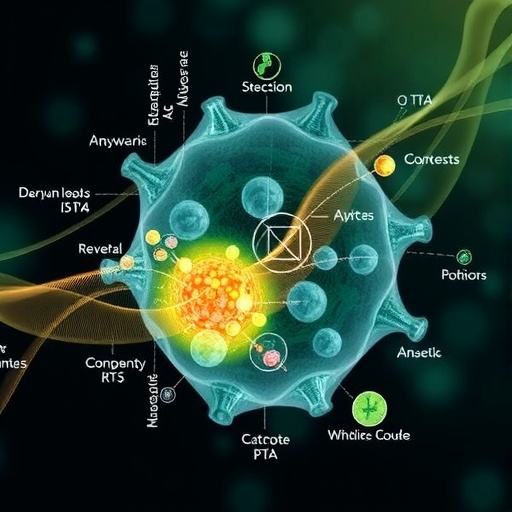
In a groundbreaking study poised to transform our comprehension of cellular dynamics, researchers at Oregon Health & Science University (OHSU) have unveiled an intricate system of internal fluid flows within cells that efficiently ferry critical proteins to their destinations. This discovery turns a long-standing biological assumption on its head by revealing that cells utilize directed “trade winds” of cytoplasmic fluid to transport essential molecules, thereby ensuring rapid and precise localization at the moving front edges of cells. These findings, published in Nature Communications, elucidate a vital mechanism underpinning cell migration, cancer metastasis, and tissue repair.
For decades, the paradigm in cell biology held that free-floating soluble proteins inside cells moved predominantly through diffusion—a random, undirected process dependent on Brownian motion. Under this model, molecules like actin, pivotal for generating cellular force and structural integrity, were thought to gradually reach functional sites by chance encounters. This diffusion-based view, however, lacked explanatory power for the remarkably fast and directed accumulation of such proteins at the leading edge during active cell movement.
The OHSU team, co-led by associate professors Dr. Catherine Galbraith and Dr. James Galbraith, first stumbled upon this phenomenon serendipitously while conducting a neuroscience lab exercise. By selectively photobleaching fluorescently labeled proteins with a laser line across the rear of live cells, they observed an unexpected secondary dark line forming at the cell front. This unexpected pattern indicated a flux of actin molecules that could not be accounted for solely by diffusion. Instead, their data pointed toward a directional cytoplasmic current sweeping proteins forward.
Harnessing advancements in live-cell super-resolution imaging, notably the interferometric photoactivated localization microscopy (iPALM) technique co-developed in part by the Galbraiths, researchers could visualize the three-dimensional distribution and movement of individual actin molecules at unprecedented nanometer spatial resolution. These images revealed a compartmentalized flow within the cytoplasm, characterized by a concentrated actin‑myosin condensate barrier that delineates the leading-edge compartment from the rest of the cell interior. This barrier functions as a transient pseudo-organelle, regulating the spatial targeting of fluid flows within the cell.
Using a novel fluorescent assay dubbed FLOP (Fluorescence Leaving the Original Point), the researchers activated fluorescence at pinpoint locations and tracked how the signal dispersed. The data demonstrated rapid, directed transport of soluble proteins toward the leading edge, vastly outrunning what would be expected by diffusion alone. This intracellular flow is nonspecific, delivering multiple protein types simultaneously, thereby constituting a robust and efficient delivery mechanism critical for cell protrusion, adhesion site formation, and morphology changes.
The biological implications of this cellular fluidic system are profound. Cell migration necessitates a coordinated shift in the cell’s cytoskeletal network and associated proteins to dynamically remodel its structure and generate force. Until now, the mechanisms ensuring sharp spatial localization of these components were unclear. These tradewinds within the cytoplasm provide a heretofore unrecognized physical process that orchestrates intracellular trafficking to fuel the cell’s leading edge.
Importantly, the study highlights potential avenues for understanding aggressive cancer cell behavior. Highly invasive cancer cells appear to possess an enhanced capacity to generate these directed cytoplasmic flows, ensuring swift delivery of motility-related proteins to their leading edges. By dissecting the molecular regulation of these flows, researchers hope to uncover vulnerabilities that could be exploited to hinder cancer metastasis, opening the door to targeted therapeutic strategies that disrupt pathological cell migration without impairing normal tissue function.
The discovery arose from a multidisciplinary collaboration that integrated expertise in cell biology, advanced microscopy, physics, and biomedical engineering. Key experimental assets were accessed through partnerships with the Howard Hughes Medical Institute’s Janelia Research Campus, home to cutting-edge imaging facilities unavailable in most research centers. These interactions proved instrumental in refining imaging assays and verifying observations using complementary methodologies like fluorescence correlation spectroscopy.
The identification of this compartmentalized flow also challenges the classic view of cytoplasm as a homogeneous medium, instead portraying it as a spatially dynamic environment with distinct biochemical microdomains shaped by physical barriers such as the actin-myosin condensate. These compartments modulate flow patterns, acting as cellular weather systems that influence the distribution and timing of molecular delivery much like how jet streams steer atmospheric conditions.
Looking forward, the research sets the stage for transformative explorations in synthetic biology and targeted drug delivery by leveraging these intracellular transport pathways. Moreover, understanding how subtle modulations in these flows might alter cell physiology and disease progression could illuminate novel diagnostic markers or intervention points in pathologies ranging from cancer to immune dysfunction and tissue degeneration.
As Dr. Catherine Galbraith noted, “All we had to do was look—the flows were there all along, hidden in plain sight. Now we understand how cells actively harness internal fluid streams to move proteins precisely where they need to go.” This shift in perspective from passive diffusion to active intracellular tradewinds revolutionizes cell biology, offering fresh insight into the fundamental processes that govern life at the microscopic scale.
News Publication Date:
30-Mar-2026
Web References:
http://dx.doi.org/10.1038/s41467-026-70688-6
Cite Scienmag News
Nathaniel Bowman. (March 30, 2026). OHSU Study Reveals Cellular ‘Trade Winds’ Guiding Movement and Repair. Scienmag. https://scienmag.com/ohsu-study-reveals-cellular-trade-winds-guiding-movement-and-repair/
Nathaniel Bowman. "OHSU Study Reveals Cellular ‘Trade Winds’ Guiding Movement and Repair." Scienmag, 30 March 2026, https://scienmag.com/ohsu-study-reveals-cellular-trade-winds-guiding-movement-and-repair/. Accessed 3 September 2026.
Nathaniel Bowman. "OHSU Study Reveals Cellular ‘Trade Winds’ Guiding Movement and Repair." Scienmag. March 30, 2026. https://scienmag.com/ohsu-study-reveals-cellular-trade-winds-guiding-movement-and-repair/


