


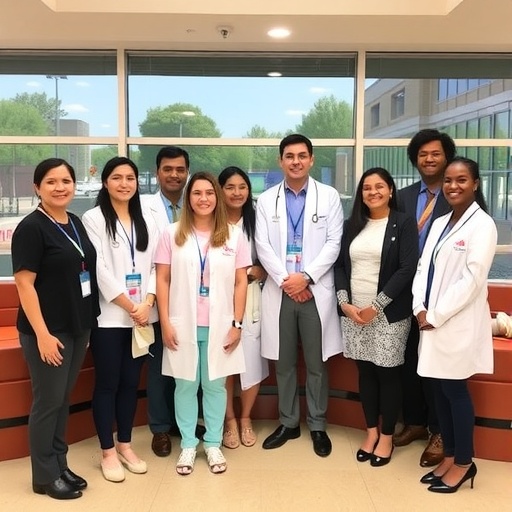
In a transformative advancement for pediatric healthcare education, UT Health San Antonio—the academic health center of The University of Texas at San Antonio—has announced a landmark $6.5 million philanthropic endowment from San Antonio benefactor Harvey E. Najim. This generous contribution establishes the Harvey E. Najim Pediatric Health Scholars Program, a strategic initiative dedicated to cultivating a future cadre of pediatric specialists across dentistry, medicine, and nursing tailored to the needs of San Antonio and its neighboring communities. By targeting the financial and systemic barriers that often impede specialized healthcare training, this program is designed to fortify the pediatric workforce pipeline, expand access to high-caliber specialty care, and enact sustainable improvements in regional child health outcomes.
The pediatric healthcare workforce deficiency within Texas, particularly for pediatric dentists, medical subspecialists, and nurse practitioners, poses significant challenges to timely and effective care for children. This shortage disproportionately affects low-income and uninsured families, amplifying health disparities across vulnerable populations. The Najim Pediatric Health Scholars Program directly addresses this gap by providing competitive, merit-based financial support to 36 pediatric dental residents, 24 pediatric medical subspecialists, and 32 pediatric nurse practitioners during their advanced training years. This investment targets critical junctures in medical education when debt accumulation and lower remuneration may otherwise deter specialization in pediatrics.
Through the provision of scholarships—specifically three per year allocated across dentistry, medicine, and nursing—the initiative not only incentivizes academic excellence but also nurtures community engagement among trainees. These scholarships aim to empower students committed to pediatric community service, reinforcing the program’s dual mission of academic rigor and social responsibility. By sustaining post-graduate education and subspecialty residency pathways within Texas, the program leverages well-documented workforce retention trends. Data highlight that approximately 59% of physicians completing graduate medical education (GME) in Texas remain within the state, surging to over 86% when both medical school and residency training occur locally. Such statistics underscore the program’s potential for lasting regional impact.
Harvey E. Najim’s philanthropic portfolio demonstrates a consistent dedication to educational empowerment and community advancement within San Antonio. His previous initiatives include the Najim Center for Innovation and Career Advancement and significant investments in student success programs and food security within the university community. This latest endowment extends his legacy into pediatric healthcare—a domain where specialized clinical expertise directly influences lifelong wellbeing. Najim emphasizes the program’s role in providing experiential, hands-on education as fundamental to cultivating skilled, compassionate healthcare practitioners adept at meeting the region’s pediatric needs.
Institutional leaders at UT Health San Antonio echo this vision, underscoring the program’s strategic alignment with regional health priorities. President Taylor Eighmy highlighted the intrinsic value of investing in pediatric healthcare education to yield extensive community benefits. Meanwhile, Dr. Francisco Cigarroa, senior executive vice president for health affairs, characterized the gift as “transformational” and “innovative,” pointing to its capacity to save and enhance lives by equipping future pediatric specialists to serve underserved populations with high-quality care.
The complexity of pediatric health demands interdisciplinary collaboration across clinical specialties. Dr. Robert Hromas, dean of the Long School of Medicine, emphasized the importance of expanding pediatric subspecialty training to address both access and quality disparities. Simultaneously, Dr. Sonya R. Hardin of the School of Nursing noted that Advanced Practice Registered Nurses play a vital role in delivering primary pediatric care, particularly within vulnerable communities in Bexar County. This multi-disciplinary educational approach ensures a robust and versatile workforce able to meet diverse pediatric health challenges.
The program’s targeted support alleviates substantial financial pressures encountered by residents and advanced-degree trainees engaged in pediatric specialty education. Dr. Kenneth Hargreaves, dean of the School of Dentistry, specifically underscored the critical need for investment in pediatric dental residents, a specialty frequently challenged by workforce shortages and financial constraints. By cushioning these economic burdens, the Najim program enables promising candidates to focus on advanced clinical training, enhancing both skill acquisition and readiness to serve in pediatric healthcare environments upon graduation.
Nationally, pediatric health access remains a pressing concern, with over 13% of Texas children reported uninsured in 2024 according to data from the Kaiser Family Foundation. This gap in insurance coverage correlates with delayed or unmet medical needs, emphasizing the urgency for a well-supplied, highly trained pediatric workforce. The Najim Pediatric Health Scholars Program aims to mitigate these systemic challenges by fostering training pathways that produce clinicians committed to serving uninsured and low-income families in South Texas, thereby addressing inequities at their root.
The anticipated long-term impact of this program is multifold: not only will it increase the immediate availability of expert pediatric care within the region, but it will also generate a multiplier effect through graduates’ extended clinical careers. As future pediatricians, dentists, and nurse practitioners emerge from this initiative equipped with advanced skills and community-oriented perspectives, the cumulative benefit to child health metrics in San Antonio and beyond promises to be substantial. By integrating rigorous education, financial support, and community commitment, the program represents a model for pediatric workforce development with replicable potential across other underserved regions.
UT Health San Antonio stands as a pivotal institution in advancing medical education and healthcare delivery across South Texas. With a diverse faculty exceeding 1,500 providers and patient encounters surpassing 2.5 million annually, the institution offers a comprehensive training ecosystem spanning medicine, dentistry, nursing, and allied health disciplines. The integration of scholarship, research, and clinical practice at UT Health enables an environment conducive to innovation and excellence, positioning it uniquely to capitalize on the Najim Pediatric Health Scholars Program’s objectives.
This unprecedented philanthropic investment in pediatric healthcare education exemplifies the critical synergy between private philanthropy and public health strategy. By strategically addressing workforce shortages through targeted financial support and advanced training opportunities, the program articulates a responsive, forward-looking solution crucial to improving health equity and clinical outcomes for children in Texas. As the Harvey E. Najim Pediatric Health Scholars Program unfolds, it is poised to redefine the standard for pediatric specialization support, inspiring similar initiatives and catalyzing systemic change in healthcare workforce development nationwide.
News Publication Date: March 26, 2026
Web References:
– https://www.uthscsa.edu/
– https://www.kff.org/state-health-policy-data/state-indicator/children-0-18/?currentTimeframe=0&sortModel=%7B%22colId%22:%22Location%22,%22sort%22:%22asc%22%7D
– https://www.dshs.texas.gov/sites/default/files/legislative/2022-Reports/Physician-Supply-and-Demand-Projections-2021-2032.pdf
– https://news.uthscsa.edu/staying-power/
Cite Scienmag News
Harold Sullivan. (March 26, 2026). UT Health San Antonio Receives $6.5 Million to Launch Harvey E. Najim Pediatric Health Scholars Program Enhancing Pediatric Workforce Development. Scienmag. https://scienmag.com/ut-health-san-antonio-receives-6-5-million-to-launch-harvey-e-najim-pediatric-health-scholars-program-enhancing-pediatric-workforce-development/
Harold Sullivan. "UT Health San Antonio Receives $6.5 Million to Launch Harvey E. Najim Pediatric Health Scholars Program Enhancing Pediatric Workforce Development." Scienmag, 26 March 2026, https://scienmag.com/ut-health-san-antonio-receives-6-5-million-to-launch-harvey-e-najim-pediatric-health-scholars-program-enhancing-pediatric-workforce-development/. Accessed 3 September 2026.
Harold Sullivan. "UT Health San Antonio Receives $6.5 Million to Launch Harvey E. Najim Pediatric Health Scholars Program Enhancing Pediatric Workforce Development." Scienmag. March 26, 2026. https://scienmag.com/ut-health-san-antonio-receives-6-5-million-to-launch-harvey-e-najim-pediatric-health-scholars-program-enhancing-pediatric-workforce-development/


