


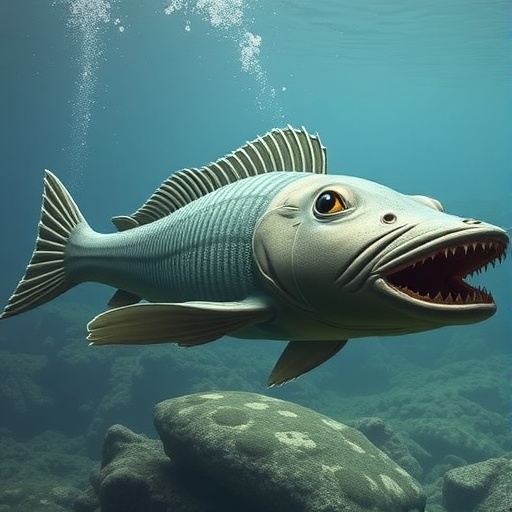
In a groundbreaking revelation reshaping our understanding of prehistoric aquatic life, an international team of scientists from the Natural History Museum of Geneva (MHNG) and the University of Geneva (UNIGE) has uncovered compelling evidence that some ancient coelacanths, fish species that thrived approximately 240 million years ago, employed their lungs not solely for respiration but intriguingly for underwater hearing. This discovery, unveiled in the highly regarded journal Communications Biology, taps into the prowess of synchrotron imaging—a sophisticated X-ray technique that allows researchers to examine fossilized structures at an extraordinarily fine micrometric scale.
Coelacanths have long captured scientific fascination, particularly since their unexpected rediscovery in the 20th century, defying the previous belief that they were extinct. With modern representatives limited to two species within the genus Latimeria, these fish occupy a unique evolutionary niche, being more closely related to terrestrial vertebrates than to most other fish. These extant coelacanths inhabit deep marine environments, relying exclusively on gill respiration. Yet, their ancient Triassic ancestors exhibited remarkable morphological diversity, inhabiting various ecosystems and, crucially, possessing well-developed lungs encased in distinctive bony plates arranged akin to roof tiles. Until now, these lungs were primarily interpreted as air-breathing organs, but the new study ventures beyond this notion, hinting at a dual sensory and respiratory role.
Pioneering this exploration, Lionel Cavin, curator at MHNG and adjunct professor at UNIGE’s Department of Genetics and Evolution, spearheaded the examination of Triassic coelacanth fossils unearthed in Lorraine, France. Employing the European Synchrotron Radiation Facility (ESRF) in Grenoble, Cavin’s team harnessed the facility’s particle accelerator capabilities to visualize the fossils’ internal anatomy with unprecedented clarity. This non-destructive imaging unveiled remarkably preserved ossified lungs, adorned with wing-like bony extensions at their tips—structures evocative of auditory apparatus.
Supplementing fossil analysis, comparative embryological studies on modern coelacanths revealed the presence of a canal connecting the inner ear’s hearing and balance organs within the skull, a feature critical for sound transduction. Synthesizing these observations, researchers propose that in these Triassic coelacanths, the ossified lung’s bony wings operated as sound collectors, channeling vibrations through the connecting canal directly to the inner ear, effectively serving as an underwater auditory system. This hypothesis draws inspiration from known vertebrate analogs, notably the Weberian apparatus in freshwater fish like carp and catfish, where swim bladders communicate with inner ears via specialized ossicles to detect sound waves.
The Weberian apparatus exemplifies an evolutionary testament to auditory specialization, wherein an air-filled organ amplifies mechanical pressure waves, enabling fish to perceive acoustic signals underwater effectively. Translating this principle to coelacanths, the ossified lung’s structural modifications represent a parallel solution, wherein the lung, filled with air or gas, functioned as a resonating body to intercept sound vibrations otherwise imperceptible due to the aquatic environment’s density. Thus, the coelacanth’s unique lung anatomy signifies an elegant sensory adaptation enhancing environmental perception.
Intriguingly, the auditory function of the lung appears to have been lost during coelacanth evolution, correlating with their shift to deeper marine habitats. As evolutionary pressures mounted, the lungs regressed, rendering this sound detection system obsolete for modern species inhabiting oxygen-depleted abyssal zones. Nonetheless, vestigial anatomical remnants in extant coelacanth skulls retain echoes of this ancient sensory complexity, offering a portal into the evolutionary narrative of vertebrate sensory systems.
This research illuminates the multifaceted roles organs may assume across evolutionary timescales, challenging traditional, singular-function interpretations. The lung’s dual respiratory and auditory capacity in ancient coelacanths underscores the dynamic interplay of structure and function in vertebrate adaptation. Furthermore, these insights enrich our comprehension of vertebrate ancestral sensory modalities, drawing fascinating parallels with human evolutionary history and suggesting that early aquatic ancestors may have possessed similarly intricate sensory apparatuses.
The applications of advanced synchrotron imaging techniques, as demonstrated here, represent a new frontier in paleobiology, allowing scientists to decode fossilized anatomy with remarkable precision without destructive sampling. This heralds a transformative era for evolutionary biology, enabling the reconstruction of sensory systems and behaviors of extinct species with unparalleled detail.
Ultimately, the findings compel a reconsideration of how prehistoric aquatic vertebrates interacted with their environments, blending respiratory and sensory functionalities in innovative ways. By uncovering an auditory mechanism lost to deep-ocean dwelling descendants, the study enriches the mosaic of evolutionary adaptations and highlights the nuanced complexities underlying vertebrate acoustic perception.
This discovery not only unravels the hidden capabilities of coelacanth lungs but also redefines expectations of organ multifunctionality in extinct species. It invites further investigation into other fossil groups, potentially revealing additional examples where sensory and physiological systems converged uniquely in evolutionary history.
As research progresses, deciphering the evolutionary pathways that led to the coelacanth’s sensory adaptations may shed light on the early diversification of vertebrate hearing mechanisms. This could have broader implications for understanding the evolution of terrestrial hearing in vertebrates, considering coelacanths’ pivotal phylogenetic position adjacent to land-adapted species.
In sum, the revelation of a dual respiratory and auditory function in the coelacanth lung exemplifies the interplay of evolutionary innovation and environmental adaptation. This discovery, with its profound implications for sensory biology and vertebrate evolution, captures the imagination of scientists and enthusiasts alike, promising to fuel ongoing scientific inquiry and reshaping our understanding of life’s ancient underwater realms.
News Publication Date: 19-Mar-2026
Web References: http://dx.doi.org/10.1038/s42003-026-09708-6
Cite Scienmag News
Gavin Prescott. (March 26, 2026). Prehistoric Coelacanths Used Their Lungs to Hear Underwater, New Study Reveals. Scienmag. https://scienmag.com/prehistoric-coelacanths-used-their-lungs-to-hear-underwater-new-study-reveals/
Gavin Prescott. "Prehistoric Coelacanths Used Their Lungs to Hear Underwater, New Study Reveals." Scienmag, 26 March 2026, https://scienmag.com/prehistoric-coelacanths-used-their-lungs-to-hear-underwater-new-study-reveals/. Accessed 4 September 2026.
Gavin Prescott. "Prehistoric Coelacanths Used Their Lungs to Hear Underwater, New Study Reveals." Scienmag. March 26, 2026. https://scienmag.com/prehistoric-coelacanths-used-their-lungs-to-hear-underwater-new-study-reveals/


