


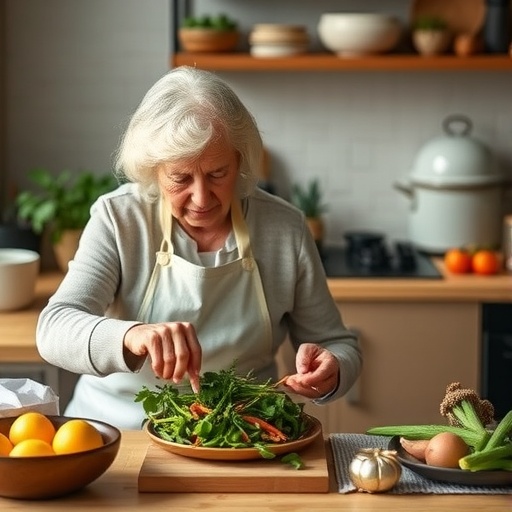
In a groundbreaking study recently published in the Journal of Epidemiology & Community Health, researchers from Japan have revealed a compelling association between home cooking and a reduced risk of dementia among older adults. The research, encompassing a large cohort of nearly 11,000 participants aged 65 and above, underscores the potential cognitive benefits of preparing meals at home, demonstrating that engaging in this seemingly routine activity may significantly mitigate dementia risk. This study not only highlights an often-overlooked lifestyle factor but also introduces nuanced insights into how cooking frequency and skill level interact in shaping cognitive health outcomes.
The impetus for this research emerges from notable societal shifts over recent decades, in which populations worldwide have progressively leaned towards eating out, ordering takeaways, or consuming processed frozen foods rather than cooking from scratch. Japanese scientists express concern particularly for older adults, for whom meal preparation is not merely a culinary task but an important source of physical and cognitive engagement. Cooking, they argue, integrates complex motor skills, executive functioning, sensory coordination, and memory, potentially acting as both physical and mental exercise that contributes to cognitive reserve.
To explore these hypotheses, the investigators utilized data from the Japan Gerontological Evaluation Study (JAGES), a vast, longitudinal cohort tracking the cognitive health trajectories of community-dwelling older adults. Over a six-year span leading up to 2022, participants’ cooking habits and competencies were rigorously documented alongside health outcomes, specifically monitoring the incidence of dementia requiring long-term care. The cohort was diverse, comprising a fifth aged over 80, a majority retired, and wide socioeconomic variance, allowing for generalizable insights within similar demographic settings.
Participants self-reported their cooking frequency, categorized from never cooking to preparing meals more than five times per week. In addition to frequency, culinary competence was assessed across seven distinct skills, ranging from basic abilities like peeling fruits and vegetables to more complex tasks such as making stews. These layered measures permitted the researchers to dissect not just whether cooking affected dementia risk but how the extent of one’s cooking skills potentially modulated this relationship.
Results revealed a dose-response relationship whereby individuals cooking from scratch at least once a week exhibited a significant reduction in dementia risk compared to those cooking less than once weekly. Concretely, men who cooked regularly reduced their dementia risk by 23%, while women achieved a 27% risk reduction. More strikingly, those with limited cooking skills who nonetheless engaged in home meal preparation saw their dementia risk plummet by an impressive 67%. This particular finding suggests that even novice engagement with cooking could offer robust neuroprotective benefits.
Intriguingly, for individuals with high cooking competency, increasing the frequency of home cooking beyond a certain threshold did not confer additional dementia risk reductions. This plateau effect hints at a nuanced interplay where initial engagement and cognitive challenge associated with developing and maintaining cooking skills might be more beneficial than mere repetition by highly skilled cooks. Consequently, the cognitive stimulation derived from overcoming new challenges and engaging in multifaceted tasks may represent a critical protective mechanism.
Importantly, the analysis incorporated control variables such as lifestyle factors, household income, years of education, and other cognitively stimulating activities like crafting, volunteering, and gardening. This robust adjustment strengthens the argument that the observed protective effects are independently associated with cooking frequency and skill rather than confounded by socioeconomic or generalized activity variables. Such methodological rigor lends credibility to the notion that home cooking itself may help build cognitive reserve.
Notwithstanding its strengths, the study remains observational, cautioning against drawing definitive causal conclusions. Registry data primarily captured cases of dementia severe enough to require long-term care, potentially excluding milder cognitive impairment cases. Additionally, the classification system for cooking skills did not differentiate perfectly between those unable to cook due to physical or cognitive constraints versus those who simply preferred not to cook, which could affect interpretation. Cultural specificity in dietary habits and cooking styles also limits extrapolation beyond the Japanese context.
Nonetheless, the findings illuminate important pathways for dementia prevention strategies, emphasizing the creation of environments that encourage older adults to engage in meal preparation. Beyond nutritional factors, home cooking may serve as a complex cognitive and physical activity that supports brain health, particularly in vulnerable populations with limited prior culinary experience. Social policy and public health initiatives might thus benefit from integrating cooking skill development as a key component in healthy aging frameworks.
As the global population ages and the prevalence of dementia rises, such lifestyle-centered interventions could offer scalable, accessible means to reduce disease burden. Encouraging older adults to prepare meals at home, whether through community cooking classes, state-supported programs, or familial encouragement, may foster not only physical well-being but also sustained cognitive function. This study compellingly argues that the kitchen, often perceived as a mundane domestic space, might in fact be a vital locus for dementia prevention.
In conclusion, the Japanese cohort study presents substantial evidence linking home cooking frequency and skill with lower dementia risk, spotlighting the potential of culinary activity as a non-pharmacological intervention. As research continues to unravel the mechanisms linking daily behaviors and neurodegeneration, the role of cooking merits heightened attention. Fostering environments where older adults can confidently engage in meal preparation may serve as an effective, joyful, and culturally adaptable strategy to combat the looming dementia epidemic.
Cite Scienmag News
Cassandra Pierce. (March 25, 2026). Cooking a homemade meal weekly may reduce dementia risk in older adults by 30%. Scienmag. https://scienmag.com/cooking-a-homemade-meal-weekly-may-reduce-dementia-risk-in-older-adults-by-30/
Cassandra Pierce. "Cooking a homemade meal weekly may reduce dementia risk in older adults by 30%." Scienmag, 25 March 2026, https://scienmag.com/cooking-a-homemade-meal-weekly-may-reduce-dementia-risk-in-older-adults-by-30/. Accessed 3 September 2026.
Cassandra Pierce. "Cooking a homemade meal weekly may reduce dementia risk in older adults by 30%." Scienmag. March 25, 2026. https://scienmag.com/cooking-a-homemade-meal-weekly-may-reduce-dementia-risk-in-older-adults-by-30/


