


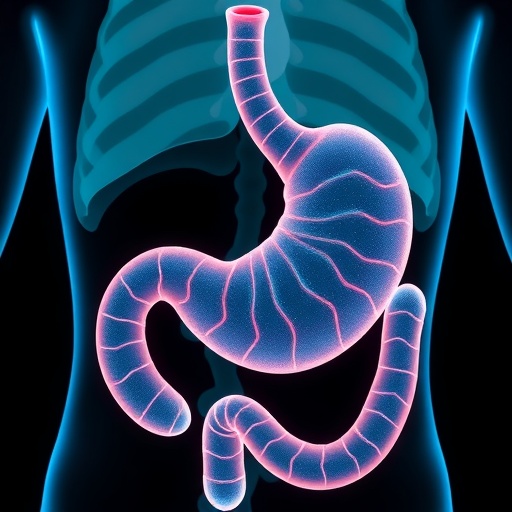
In a groundbreaking development in the field of biomedical engineering and surgical innovation, researchers have unveiled a novel acid-tolerant injectable bioadhesive designed specifically for the sutureless repair of large gastric perforations. This remarkable advancement addresses one of the most pressing challenges in gastrointestinal surgery, whereby conventional suturing methods often prove inadequate or risky, particularly in the harsh acidic environment of the stomach. The newly formulated adhesive promises to revolutionize clinical approaches by enabling rapid, minimally invasive repair that significantly reduces complications and improves patient outcomes.
Gastric perforations, which involve a breach or hole in the stomach lining, represent urgent medical emergencies that require prompt intervention to prevent severe infection, peritonitis, and even death. Traditional surgical repair typically relies on suturing the perforation site, a method that, while effective, entails inherent trauma and postoperative complications such as leakage, delayed healing, and infection. Suturing also requires significant surgical expertise and time, factors that can critically affect survival and recovery, especially in emergency settings or resource-limited environments.
The innovation offered by the team stems from chemically engineering a bioadhesive with remarkable acid tolerance and robust mechanical properties, enabling it to maintain structural integrity and adhesive strength despite prolonged exposure to gastric acid. The underlying chemistry leverages novel polymeric materials capable of forming stable covalent bonds under acidic conditions, a challenge that has previously limited the applicability of bioadhesives in the stomach. This breakthrough bioadhesive not only withstands the corrosive gastric environment but also mimics natural tissue mechanics, allowing it to conform intimately to the irregular surface of perforations.
One of the most significant features of this bioadhesive is its injectability. Designed for minimally invasive delivery, it can be precisely applied through narrow needles or catheters directly into the site of injury. Upon injection, the adhesive rapidly solidifies, forming a strong, flexible seal over the perforation without the need for sutures or staples. This enhances surgical efficiency by reducing procedure time and minimizes trauma to adjacent tissues, factors critical to lowering postoperative complications such as inflammation and fibrosis.
Comprehensive in vitro and in vivo studies conducted by the research team have demonstrated the bioadhesive’s excellent biocompatibility, showing no adverse immune response or cytotoxicity in gastrointestinal tissues. Animal models with induced large gastric perforations further validated the material’s effectiveness. The adhesive promoted rapid sealing, prevented leakage, and facilitated tissue regeneration over time, outperforming existing methods significantly. Most importantly, the acid resilience ensured the adhesive maintained its functionality over extended periods, overcoming a major hurdle for clinical application in the acidic gastric niche.
From a mechanistic perspective, the bioadhesive employs a dual crosslinking strategy that combines covalent bonding with physical entanglements, resulting in a material that is both extraordinarily strong and adaptable. Such duality enhances durability without sacrificing flexibility, crucial for the dynamic movements of the stomach during digestion and peristalsis. The adhesive’s molecular design was inspired by natural mussel adhesive proteins which exhibit remarkable adhesive properties in wet, saline environments, and this biomimicry forms the cornerstone of its effectiveness in the harsh gastric milieu.
This technology also holds promise beyond gastric applications. The principles of acid-tolerant bioadhesion introduced here could be extended toward repairing other acidic or challenging internal environments, including parts of the digestive tract and certain urological structures. The versatility and safety profile open avenues for its use in emergency medicine, trauma care, and potentially even outpatient procedures where sutureless repair might reduce hospital stay and healthcare costs.
Regulatory considerations for clinical translation have been carefully addressed by the researchers, who have emphasized scalable manufacturing protocols and adherence to existing biocompatibility standards. The adhesive’s components are selected from materials with prior FDA approval for other biomedical applications, facilitating streamlined pathways toward human clinical trials. Additionally, the injectable delivery mechanism is designed to be compatible with current endoscopic and laparoscopic equipment, ensuring integration into established surgical workflows without the need for costly retraining or equipment overhaul.
In terms of patient impact, the availability of a sutureless, injectable bioadhesive could transform the prognosis for patients suffering from large gastric perforations, a condition often presenting in emergency rooms with limited time for complex surgical intervention. The rapid application, reliable sealing, and acid resistance translate to reduced risk of complications such as peritonitis and sepsis, shorter recovery times, and decreased dependence on postoperative intensive care. For vulnerable populations such as the elderly or those with comorbidities, this innovation could significantly enhance safety and quality of life outcomes.
The implications for healthcare systems are equally profound. By minimizing the invasiveness of gastric repair procedures and shortening surgical times, the bioadhesive technology promises to reduce burdens on surgical units, lower hospital resource utilization, and decrease costs associated with prolonged hospitalization and reoperations. It also has potential utility in resource-poor settings where access to advanced surgical expertise may be limited, enabling effective emergency intervention with minimal infrastructure requirements.
Looking ahead, the research team plans to advance this bioadhesive toward clinical trials, aiming to establish safety and efficacy in human subjects. Parallel development efforts are underway to tailor the formulation for specific clinical scenarios, optimize delivery methods, and explore synergies with regenerative medicine approaches such as incorporation of bioactive molecules that promote healing and tissue integration. The versatility and robustness of this adhesive framework position it as a platform technology that could underpin a new generation of bioadhesive surgical materials.
The scientific community has welcomed this advancement enthusiastically, recognizing it as a quintessential example of interdisciplinary innovation. The convergence of polymer chemistry, materials science, bioengineering, and clinical medicine embodied in this work exemplifies how collaborative efforts can overcome longstanding clinical challenges. As the global burden of gastrointestinal diseases continues to rise, innovations like this acid-tolerant injectable bioadhesive offer transformative potential for improving care and outcomes in a cost-effective manner.
Moreover, this research underscores the critical importance of designing biomaterials that function in physiologically relevant, often hostile environments—a frontier that remains ripe for exploration. The success of this adhesive highlights how mimicking natural biological strategies can inform the design of next-generation therapeutics and medical devices that integrate seamlessly with the body’s complex biochemistry and mechanics.
As the technology progresses and enters broader clinical deployment, ongoing studies will be essential to monitor long-term outcomes, potential biodegradability of the adhesive, and any unforeseen interactions within the gastric ecosystem. Nonetheless, the foundational proof-of-concept established here sets a new standard for what is achievable in bioadhesive science and surgical innovation. This acid-tolerant injectable bioadhesive is poised to become a disruptive technology that will redefine how we approach surgical repair of gastric and possibly other challenging visceral injuries.
The excitement generated by this research extends beyond its immediate clinical impact. It inspires a new paradigm for designing functional biomaterials tailored to extreme physiological conditions, encouraging researchers to explore uncharted territories where conventional materials have fallen short. The lessons learned from this acid-tolerant adhesive are likely to catalyze innovations across multiple biomedical fields, from implantable devices to drug delivery systems, catalyzing a broader transformation in how medicine interfaces with biology.
In summary, this pioneering work delivers a compelling solution to one of gastrointestinal surgery’s most persistent problems through the development of an injectable, acid-resistant bioadhesive for sutureless repair. Through sophisticated materials engineering, biomimicry, and translational commitment, the research marks a decisive leap forward, aligning scientific ingenuity with pressing clinical needs. As the global medical community eagerly anticipates the clinical transition of this technology, the future of gastric injury repair looks not only less invasive but profoundly more effective.
Wang, Z., Cao, B., Li, L. et al. Acid-tolerant injectable bioadhesive for sutureless repair of large gastric perforation.
Nat Commun (2026). https://doi.org/10.1038/s41467-026-71031-9
Cite Scienmag News
Ophelia Keating. (March 25, 2026). Acid-Resistant Bioadhesive Enables Sutureless Gastric Repair. Scienmag. https://scienmag.com/acid-resistant-bioadhesive-enables-sutureless-gastric-repair/
Ophelia Keating. "Acid-Resistant Bioadhesive Enables Sutureless Gastric Repair." Scienmag, 25 March 2026, https://scienmag.com/acid-resistant-bioadhesive-enables-sutureless-gastric-repair/. Accessed 3 September 2026.
Ophelia Keating. "Acid-Resistant Bioadhesive Enables Sutureless Gastric Repair." Scienmag. March 25, 2026. https://scienmag.com/acid-resistant-bioadhesive-enables-sutureless-gastric-repair/


