


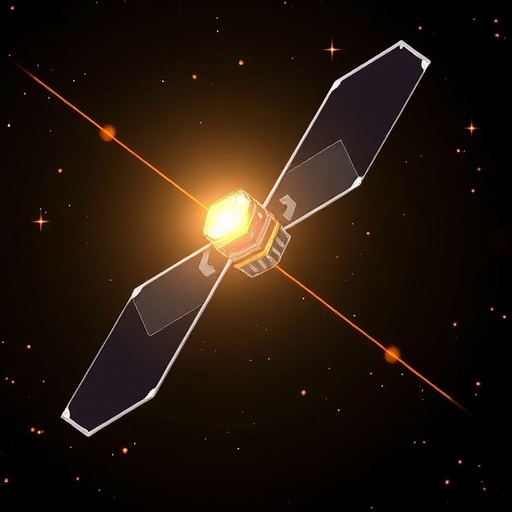
In a groundbreaking advancement poised to revolutionize satellite communication, a team of Japanese researchers from the Institute of Science Tokyo has unveiled an innovative method to enable swarms of pico-satellites to collaboratively act as a single, large phased-array antenna. This development promises to transform direct-to-smartphone communication by overcoming the limitations inherent in current satellite systems. Instead of depending on a single, colossal satellite equipped with a costly and fragile phased-array antenna, the researchers propose thousands of minuscule satellites working in formation—a leap forward that could enable ubiquitous, reliable, and affordable global network coverage.
The concept of connecting everyday smartphones directly to satellites, termed direct-to-device (D2D) communication, has gained significant traction in recent years. Such a system would close the connectivity gap in remote and hard-to-reach areas like oceans, vast deserts, and mountainous regions where terrestrial networks falter or are completely absent. Central to achieving this vision is the deployment of phased-array antennas: intricate assemblies of numerous tiny radiating elements. These elements, by synchronizing the phase and amplitude of their radio frequency signals, electronically steer highly focused beams without the need for mechanical orientation mechanisms. This capability is essential for maintaining robust, high-speed communication links with moving satellites and ground devices.
While the utilization of phased-array antennas in space is well-established, it comes at a steep cost and risk. Current satellite designs necessitate large, complex, and expensive payloads that are vulnerable to single points of failure. If one critical component malfunctions, the entire apparatus may be rendered inoperative, resulting in loss of service and costly replacements. Furthermore, synchronizing thousands of antenna elements with the high precision needed for beamforming typically relies on physical wiring within the satellite, which is impractical or impossible to replicate across multiple free-flying satellites in orbit.
To address these critical challenges, Associate Professor Atsushi Shirane and his research team at the Laboratory for Future Interdisciplinary Research of Science and Technology (Institute of Science Tokyo) have pioneered a novel “non-wired” phased-array architecture. Their approach distributes antenna elements across a mega-constellation of pico-satellites—each a miniature satellite carrying individual phased-array elements—as opposed to centralizing them on a single platform. This constellation operates in tight formation, maintaining relative positional accuracy, and crucially achieves synchronization wirelessly via a method they describe as “spatial wireless combining and distributing technology.”
At the heart of this architecture is a gateway satellite that broadcasts a highly stable reference signal. Every pico-satellite in the constellation locks onto this reference, allowing them to maintain tight phase coherence without needing physical cables or local oscillator hardware. This wireless synchronization dramatically reduces the energy consumption and physical space requirements of the individual pico-satellites, enabling substantial miniaturization. The compactness of these unit satellites is a significant advantage: it permits ride-share opportunities during rocket launches, drastically cutting deployment expenses compared to launching large, monolithic satellites.
To validate the theoretical framework and practical viability of their concept, the team designed and produced a custom transceiver chip using standard silicon CMOS (Complementary Metal-Oxide-Semiconductor) manufacturing processes. This choice not only lowers unit costs but also integrates seamlessly with existing mass production techniques widely used in consumer electronics. The chip supports advanced communication protocols aligned with current long-term evolution (LTE) cellular standards, ensuring compatibility with modern smartphones.
Subsequent experiments employed these chips embedded within miniature wireless modules arranged to emulate satellite formations. The results were striking: the system achieved highly precise beam steering essential for phased-array operation and facilitated robust, high-quality data transmission employing complex modulation schemes. This proof-of-concept trial demonstrated, beyond doubt, that wireless synchronization of distributed antenna elements in free space is technically feasible and can support the direct-to-smartphone communications envisioned.
Beyond cost and technical feasibility, this distributed phased-array approach vastly improves system resilience. In contrast to conventional large satellites, where a single failure can cripple the antenna or entire mission, the network of thousands of pico-satellites possesses innate redundancy. Even if multiple units fail, the formation dynamically compensates, preserving the antenna’s overall functionality. This robustness is a vital asset for scalability and long-term operational viability in harsh space environments.
The implications of this near-future technology are profound. By harnessing the combined power of countless miniaturized satellites acting in concert, future communication networks can transcend geographical barriers and economic hurdles that currently impede global connectivity. Realizing direct-to-device satellite links at scale will enable continuous, high-speed internet access for billions—even in the most inaccessible regions—supporting everything from emergency response teams in disaster zones to remote scientific outposts and everyday smartphone users on the move.
Presented at the prestigious 2026 IEEE International Solid-State Circuits Conference (ISSCC), this work not only bridges cutting-edge semiconductor design with aerospace engineering but also charts a promising path toward democratizing telecommunications. As development progresses, the foundational technologies described here will serve as catalysts for satellite traffic innovations,/orbit management strategies, and integration with existing and future 5G and 6G standards.
Furthermore, by utilizing commercially proven CMOS technology for the transceiver chip, mass production timelines and cost barriers will be minimized, accelerating deployment readiness. Future research directions encompass optimizing satellite formation dynamics, advancing synchronization algorithms under variable orbital perturbations, and integrating these arrays with multi-band satellite constellations to enhance bandwidth allocation.
In summary, the pioneering research from Institute of Science Tokyo heralds a transformative future for satellite-based wireless networks. Their distributed phased-array system offers an elegant, scalable, and economically viable solution for direct-to-device communications that could underpin truly global internet access, marking a significant milestone in both satellite technology and wireless communications.
Keywords
satellite communication, direct-to-device, phased-array antenna, pico-satellites, satellite constellations, wireless synchronization, CMOS technology, beam steering, global connectivity, formation flight, non-wired phased arrays, satellite networks
Cite Scienmag News
Grant Pearson. (March 25, 2026). Thousands of Pico-Satellites Poised to Revolutionize Mobile Connectivity with Space Networks. Scienmag. https://scienmag.com/thousands-of-pico-satellites-poised-to-revolutionize-mobile-connectivity-with-space-networks/
Grant Pearson. "Thousands of Pico-Satellites Poised to Revolutionize Mobile Connectivity with Space Networks." Scienmag, 25 March 2026, https://scienmag.com/thousands-of-pico-satellites-poised-to-revolutionize-mobile-connectivity-with-space-networks/. Accessed 3 September 2026.
Grant Pearson. "Thousands of Pico-Satellites Poised to Revolutionize Mobile Connectivity with Space Networks." Scienmag. March 25, 2026. https://scienmag.com/thousands-of-pico-satellites-poised-to-revolutionize-mobile-connectivity-with-space-networks/


