


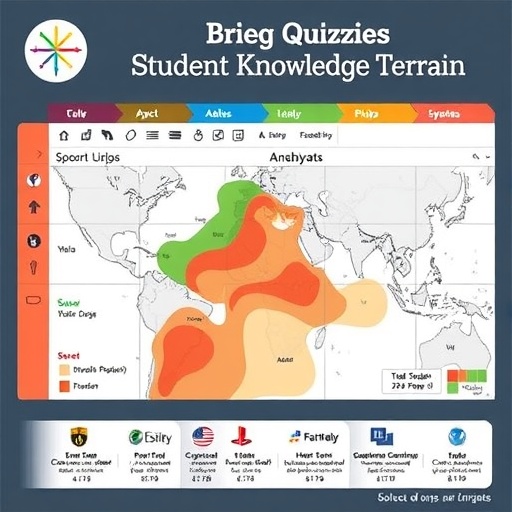
In the rapidly evolving landscape of education technology, Dartmouth College researchers have introduced a groundbreaking mathematical framework that transforms conventional multiple-choice quizzes into rich, multi-dimensional maps of student knowledge. This innovative approach harnesses the power of text embedding models—tools integral to modern artificial intelligence systems—to create intricate topographies illustrating individual learners’ conceptual understanding. By doing so, the framework reveals precise peaks and valleys in knowledge, offering a nuanced perspective far beyond traditional scoring methods.
Traditional assessments have long faced criticism for their inability to effectively capture what students truly understand. A single quiz score, such as 50%, offers limited insight; it fails to distinguish between a student who fully grasps half the material and another who partially understands all of it. The Dartmouth team’s method seeks to bridge this gap by mapping knowledge across interconnected ideas, reflecting the real-world structure of learning where understanding one concept often correlates with related knowledge.
At the heart of this new method lies the use of text embedding models, which translate concepts into coordinates within a high-dimensional space. Unlike previous educational tools that evaluate isolated questions, these models consider semantic relationships between concepts. For example, gravity and magnetism naturally cluster close together in this conceptual landscape, while unrelated domains like genetics and art history occupy distant regions. This enables an estimation of student proficiency not only on presented questions but also on adjacent, conceptually linked knowledge areas.
The researchers tested their framework with 50 undergraduate students at Dartmouth, who engaged with online physics lectures provided by Khan Academy. By analyzing student responses before and after the lectures, the team demonstrated that their knowledge maps dynamically reflect learning progress. These maps not only captured gains in specific areas but also accurately forecasted which questions students would answer correctly, showcasing powerful predictive capabilities.
This knowledge-mapping technique mirrors the intuitive mental models employed by experienced educators. When a teacher works one-on-one with students, they often unconsciously create a cognitive map of the learner’s understanding to tailor explanations and connections. Dartmouth’s framework mathematically approximates this process, making it scalable and applicable to larger, remote, or online learning contexts where personalized human instruction is limited.
One of the most promising implications of this approach is its potential to revolutionize personalized education at scale. AI tutoring systems equipped with such detailed knowledge maps can deliver tailored feedback that adapts in real time to each student’s evolving competence. This addresses a fundamental challenge in online education — providing individualized guidance comparable to what attentive teachers offer in traditional settings.
Jeremy Manning, the lead senior author and associate professor of psychological and brain sciences, emphasizes that this framework enhances, rather than replaces, human instructors. “Human teachers remain unparalleled in their ability to understand and respond to students’ needs,” Manning notes. “Our contribution aims to broaden the reach of effective teaching by equipping AI tools with deeper insights into learner understanding.”
Paxton Fitzpatrick, the study’s lead author, further underscores the necessity of personalization in modern education. With increasing reliance on online platforms, many students miss out on the tailored support essential for mastering complex subjects. By leveraging the latent structure in students’ quiz responses, the new model enables AI systems to identify specific misunderstandings and knowledge gaps quickly, providing accurate, individualized interventions.
Technically, the system embeds quiz questions within a high-dimensional semantic vector space generated by AI text models. Each response then updates a probabilistic map of the student’s knowledge, refining predictions about familiarity with interrelated concepts. This elegant union of natural language processing and cognitive science reflects an interdisciplinary breakthrough, demonstrating how advances in AI can directly serve pedagogical goals.
The published results in Nature Communications confirm that knowledge maps created by this framework not only track learning progression but also outperform traditional assessment techniques in predictive accuracy. They provide educators and AI tutors alike with a rich, interpretable representation of student cognition, unlocking new possibilities for adaptive content delivery and learning strategies.
Looking ahead, the Dartmouth research group has launched a publicly accessible demonstration of their system, inviting users to experience interactive knowledge mapping firsthand. The platform allows learners to see their conceptual strengths and weaknesses visualized in real time and offers curated educational resources to help bridge understanding gaps, fostering self-directed learning empowered by AI.
This pioneering work exemplifies a broader trend toward integrating sophisticated AI methodologies with educational practice, aiming to democratize access to quality learning experiences. By mathematically modeling the complex terrain of human knowledge, Dartmouth researchers have opened a new frontier where technology and pedagogy join forces to transform how we assess, understand, and ultimately enhance learning outcomes worldwide.
News Publication Date: 24-Mar-2026
Web References: Public Demo
References: Manning, J.R., Fitzpatrick, P. et al., Nature Communications, DOI: 10.1038/s41467-026-69746-w
Cite Scienmag News
Reid Dalton. (March 25, 2026). Innovative Tool Charts Student Knowledge Terrain Through Brief Quizzes. Scienmag. https://scienmag.com/innovative-tool-charts-student-knowledge-terrain-through-brief-quizzes/
Reid Dalton. "Innovative Tool Charts Student Knowledge Terrain Through Brief Quizzes." Scienmag, 25 March 2026, https://scienmag.com/innovative-tool-charts-student-knowledge-terrain-through-brief-quizzes/. Accessed 4 September 2026.
Reid Dalton. "Innovative Tool Charts Student Knowledge Terrain Through Brief Quizzes." Scienmag. March 25, 2026. https://scienmag.com/innovative-tool-charts-student-knowledge-terrain-through-brief-quizzes/


