


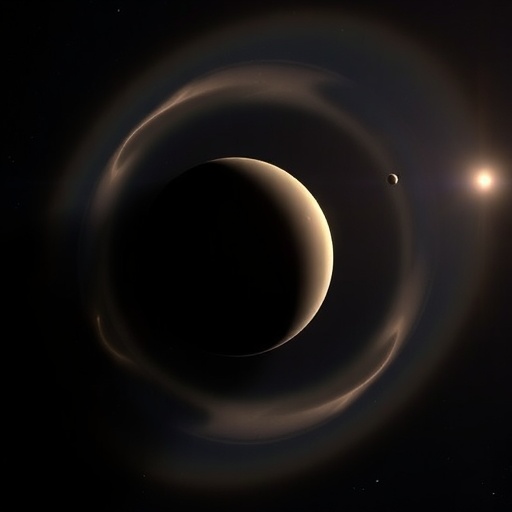
Astronomers have unveiled a groundbreaking view into the early stages of planetary system formation with the discovery and confirmation of two nascent gas giant planets orbiting the young star WISPIT 2. Utilizing some of the most advanced observational instruments available at the European Southern Observatory (ESO), this rare glimpse into a system akin to our early Solar System challenges and enriches current models of planet formation. The star’s surrounding protoplanetary disc, composed of gas and dust, has long been theorized as the cradle of planets, and WISPIT 2 now offers an unprecedented laboratory for studying these formative processes in exquisite detail.
The initial detection of the first planet, WISPIT 2b, in 2025 proved a milestone, revealing a Jupiter-like planet approximately five times the mass of Jupiter residing at a considerable distance—60 times the Earth-Sun separation—from its host star. This initial finding was instrumental in validating the efficacy of current high-contrast imaging techniques in observing young giant planets embedded in circumstellar material. More recently, astronomers have confirmed the existence of a second planet, WISPIT 2c, orbiting significantly closer to the star, at roughly one-quarter of WISPIT 2b’s orbital radius, but boasting a mass twice as great. The confirmation of WISPIT 2c was achieved through synergistic use of ESO’s Very Large Telescope (VLT) and the cutting-edge VLT Interferometer (VLTI), underscoring remarkable advancements in high-resolution imaging and interferometric capabilities.
The star WISPIT 2’s extensive and complex disc laden with gas and dust is marked by distinct gaps and rings—signatures indicative of ongoing planet formation. These features arise as forming planets gravitationally influence their immediate environment, carving out material along their orbits while accumulating mass. The presence of at least one additional gap in the outer regions suggests further planetary bodies could be in formation, potentially including a Saturn-mass planet hinted at by the narrowness and shallowness of this outer clearing. Such a dynamic and structured disc provides an exceptional natural laboratory to test theories regarding planet-disc interactions and the sequential assembly of planetary architectures.
Employing the Spectro-Polarimetric High-contrast Exoplanet REsearch instrument (SPHERE) on the VLT, astronomers utilized adaptive optics and coronagraphy to negate atmospheric distortion and suppress the overwhelming glare of the central star. This technique exposed the faint structural details of the disc and made it possible to detect the embedded protoplanets. To distinguish planetary companions from disc clumps or background sources, the team harnessed GRAVITY+, an advanced interferometric instrument on the VLTI, which synthesizes the light from multiple telescopes to achieve unprecedented spatial resolution and sensitivity. The combination of SPHERE’s imaging prowess and GRAVITY+’s precise astrometry provided irrefutable evidence that the newly identified object was indeed a nascent planet rather than a transient disc phenomenon.
The discovery of two planets forming contemporaneously in the WISPIT 2 system is exceptionally rare, with PDS 70 remaining the only other known star with multiple directly imaged protoplanets to date. However, unlike PDS 70, WISPIT 2’s disc is notably more expansive and exhibits a complex array of gaps and rings, suggesting a more intricate evolutionary process and planet-forming activity. This multiplicity points toward planetary systems emerging not as isolated events but as interconnected phenomena, where forming planets influence each other’s growth and migratory pathways, shaping the eventual architecture of their systems.
WISPIT 2 serves as an analog to the early Solar System, allowing astronomers an opportunity to examine the conditions that may have given rise to our own planetary family billions of years ago. The gas giant planets within this young system closely resemble Jupiter in composition and scale but reflect a still-evolving stage where the interactions between the planetary embryos and the disc material remain observable. These formative interactions provide key insights into how gas giants accumulate mass, migrate, and ultimately stabilize in their orbits, processes that remain a subject of intense theoretical modeling and debate.
The confirmation of WISPIT 2c’s planetary nature depended crucially on recent technological leaps. The capacity of GRAVITY+ to scrutinize planets orbiting close to their stars, an area notoriously difficult to study due to the overwhelming stellar brightness, represents a technological breakthrough. This advancement has pushed the boundaries of interferometric imaging, enabling the isolation of faint planetary signals at close stellar separations with high astrometric precision. Such precision measurements are vital for understanding the orbital dynamics and mass distribution within young planetary systems.
The gaps identified within the protoplanetary disc are both cause and effect of planet formation. As dust and gas particles coalesce under the gravitational influence of the forming planets, these gaps widen and become prominent features detectable by high-resolution imaging. Dust rings outside these gaps consist primarily of material not yet accreted or pushed outward by planetary gravitation. The intricate interplay between accretion and disc sculpting offers a window into how planets influence the evolution of their birth environment, and how this environmental feedback in turn affects the growth of neighboring planets.
Anticipation is building for the potential discovery of additional planets in the system, particularly the suspected Saturn-mass body that may be responsible for the third gap further from the central star. If confirmed, such a find would reinforce the notion that planetary systems form hierarchically, with varied planetary masses and orbital properties emerging from a single disc. The forthcoming Extremely Large Telescope (ELT), slated for completion within this decade, promises to revolutionize the study of such systems with its unprecedented light-gathering power and spatial resolution. It could enable direct imaging of these smaller and more distant forming planets previously beyond detection limits.
Beyond the immediate scientific implications for planet formation theory, the WISPIT 2 system exemplifies the power of international collaboration and technological innovation in astronomy. The successful integration of observing facilities across continents and instruments operating across different wavelength domains epitomizes a new era of multifaceted astronomy. This discovery underscores how combined observational strategies—marrying direct imaging with interferometry—accelerate the detection and characterization of nascent exoplanets embedded in complex circumstellar environments.
The researchers behind this landmark discovery include experts from institutions across Europe and the United States, combining their expertise in adaptive optics, interferometry, and theoretical modeling to illuminate these distant worlds in formation. Their work, published in The Astrophysical Journal Letters, outlines not only the observations but also the rigorous analysis and modeling that cemented the planetary status of these objects. This comprehensive approach ensures that the data-driven conclusions reported stand as robust milestones in the field of exoplanetary science.
As astronomers continue to refine observational techniques and leverage next-generation telescopes, systems like WISPIT 2 will increasingly inform our understanding of the formative phases of planetary systems. This knowledge enhances predictive models for planet formation and migration, the composition and structure of young planetary atmospheres, and the distribution of planetary types. Thus, WISPIT 2 represents not only a glimpse into a distant star’s nursery but also a stepping stone toward unraveling the broader cosmic narrative of how planetary systems, including our own, came to be.
News Publication Date: April 2024
Web References:
– ESO press release and observatory website, https://www.eso.org
– SPHERE instrument page, https://www.eso.org/public/teles-instr/paranal-observatory/vlt/vlt-instr/sphere/
– GRAVITY+ instrument overview, https://www.eso.org/public/teles-instr/paranal-observatory/vlt/vlt-instr/gravity+/
– Previous planetary system PDS 70 discovery, https://www.eso.org/public/news/eso1821/
References:
– Lawlor, C. et al. “Formation of multiple gas giant planets in the WISPIT 2 system,” The Astrophysical Journal Letters, 2024.
Keywords
Protoplanetary disc, planet formation, gas giant planets, WISPIT 2, Very Large Telescope, VLT Interferometer, SPHERE instrument, GRAVITY+, adaptive optics, direct imaging, planetary system formation, exoplanets
Cite Scienmag News
Grant Pearson. (March 25, 2026). Two Planets Spotted Forming in Disk Around Young Star: A Solar System in the Making? Scienmag. https://scienmag.com/two-planets-spotted-forming-in-disk-around-young-star-a-solar-system-in-the-making/
Grant Pearson. "Two Planets Spotted Forming in Disk Around Young Star: A Solar System in the Making?" Scienmag, 25 March 2026, https://scienmag.com/two-planets-spotted-forming-in-disk-around-young-star-a-solar-system-in-the-making/. Accessed 3 September 2026.
Grant Pearson. "Two Planets Spotted Forming in Disk Around Young Star: A Solar System in the Making?" Scienmag. March 25, 2026. https://scienmag.com/two-planets-spotted-forming-in-disk-around-young-star-a-solar-system-in-the-making/


