


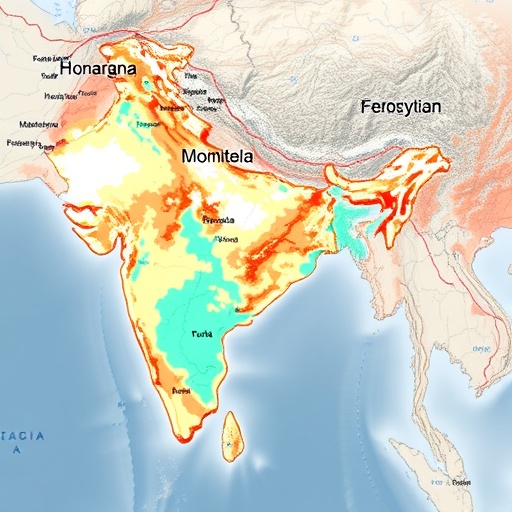
The Indo-Gangetic Basin, one of the most densely populated and economically vital regions in South Asia, has long grappled with severe air quality issues, particularly concerning particulate matter of size less than 2.5 micrometers, known as PM2.5. These fine particles penetrate deep into human respiratory systems and are linked to numerous health problems, including respiratory diseases, cardiovascular conditions, and premature mortality. Monitoring and estimating surface-level PM2.5 concentrations is therefore crucial for public health policies and mitigation strategies. A pioneering study recently published in Scientific Reports presents a novel approach for estimating surface PM2.5 across this vast region by integrating advanced MERRA-2 atmospheric reanalysis data with state-of-the-art machine learning techniques.
MERRA-2, or the Modern-Era Retrospective analysis for Research and Applications version 2, is a sophisticated global atmospheric reanalysis product developed by NASA. It provides comprehensive meteorological and aerosol-related data, including aerosol optical depth and various chemical composition tracers, at an unprecedented spatial and temporal resolution. These data serve as essential inputs to model and analyze atmospheric pollutants. However, one challenge persists: MERRA-2’s data represent atmospheric column properties and reanalyzed estimates, not direct surface concentration measurements of pollutants like PM2.5, which are most relevant for human exposure assessments.
The study leverages machine learning as a transformative tool to bridge this gap. By training algorithms on ground-based monitoring data alongside MERRA-2 reanalysis outputs, the research team developed predictive models that accurately estimate surface PM2.5 concentrations across the Indo-Gangetic Basin. The machine learning framework assimilates various atmospheric variables, including aerosol optical properties, meteorological parameters such as temperature, humidity, wind speed, and planetary boundary layer height, all contributing to the dispersion and concentration of particulate matter at the surface level.
One significant advantage of this approach is its scalability and coverage. Ground monitoring stations, while providing precise data, are sparsely distributed across the Indo-Gangetic region, leaving many populous areas without direct observations. Remote sensing approaches, often hindered by cloud cover and limited spatial resolution, also struggle to provide continuous, high-fidelity data. The hybrid MERRA-2 plus machine learning model transcends these limitations, offering a high-resolution surface PM2.5 concentration map that can inform both local and regional air quality management.
The Indo-Gangetic Plain experiences a complex interplay of emission sources, including biomass burning, vehicular emissions, industrial pollutants, and dust storms, with seasonal variations profoundly impacting PM2.5 levels. Traditional models often fail to capture these dynamics due to limited parameterization or insufficient training data. However, the machine learning models in this research adeptly capture non-linear relationships and seasonal nuances in aerosol dispersion, offering unprecedented insights into temporal trends of air quality.
Model validation against independent ground measurements demonstrated strong predictive accuracy, with the machine learning-driven estimates closely mirroring observed PM2.5 levels. This validation underpins the model’s robustness and potential to be operationalized for near real-time air quality monitoring and forecasting. The applicability extends beyond epidemiological studies to urban planning, emergency response during pollution episodes, and public advisories on health hazards.
This research further highlights the evolving role of multidisciplinary techniques in environmental science. Utilizing machine learning in tandem with atmospheric reanalysis datasets represents a significant methodological advancement. It reflects a shift from purely physics-based models towards hybrid data-driven approaches that can accommodate complex environmental systems where direct measurement remains challenging. The approach offers a template for other regions globally struggling to quantify air pollution and its health impacts.
Moreover, the study’s implications for policy are profound. The Indo-Gangetic Basin spans several administrative regions and countries, posing challenges for consolidated air quality governance. A unified, large-scale, high-resolution PM2.5 estimation framework could facilitate cross-border collaborations on air quality mitigation and shared resource management. Accurate exposure data also empower health agencies to better design interventions and allocate medical resources.
An exciting facet of the study is its potential to capture trends related to climate variability and anthropogenic activity changes. With the ongoing shifts in agricultural practices, industrial emissions, and urbanization, the ability to detect emerging pollution hotspots and changing baseline conditions is a decisive advantage. It opens avenues for assessing the effectiveness of implemented environmental regulations over time through empirical data.
The study also sheds light on the critical influence of meteorology on PM2.5 distribution. Parameters such as wind patterns, temperature inversions, and humidity significantly modulate aerosol dispersion and deposition. By incorporating these meteorological variables from MERRA-2, the model reflects daily variability and episodic pollution spikes, thereby providing a dynamic perspective rather than static average concentrations.
The Indo-Gangetic Basin faces unique pollution episodes, especially related to crop residue burning during post-harvest seasons, which injects massive quantities of fine particulates into the atmosphere, deteriorating air quality. The model’s performance in capturing such episodic events demonstrates the sensitive and responsive nature of the machine learning approach, offering valuable tools for anticipatory public health warnings.
Looking forward, the integration of satellite remote sensing data with MERRA-2 and ground observations could further enhance spatial resolution and data completeness. Incorporating emerging data sources such as low-cost sensor networks and citizen science contributions might refine model accuracy and foster community engagement in air quality management.
The study exemplifies the growing synergy between earth observation data, computational advances, and environmental health science. It stands as a testament to how harnessing big data and machine learning can produce actionable insights for one of the world’s most challenging air pollution regions. As data availability and computational power continue to rise, such interdisciplinary approaches are poised to revolutionize air quality monitoring globally.
In conclusion, this landmark research marks a critical milestone in air pollution estimation, particularly for the Indo-Gangetic Basin where precise and comprehensive surface PM2.5 data have been elusive. By combining MERRA-2 reanalysis with machine learning, the study delivers reliable, high-resolution PM2.5 concentration maps that promise to advance scientific understanding, public health protection, and policy development in a region burdened by some of the world’s highest air pollution levels. As the global community confronts escalating environmental and health challenges, such innovative approaches illuminate the path toward more effective and data-driven air quality management solutions.
Cite Scienmag News
Russell Cooper. (March 25, 2026). Machine Learning Maps PM2.5 in Indo-Gangetic Basin. Scienmag. https://scienmag.com/machine-learning-maps-pm2-5-in-indo-gangetic-basin/
Russell Cooper. "Machine Learning Maps PM2.5 in Indo-Gangetic Basin." Scienmag, 25 March 2026, https://scienmag.com/machine-learning-maps-pm2-5-in-indo-gangetic-basin/. Accessed 7 September 2026.
Russell Cooper. "Machine Learning Maps PM2.5 in Indo-Gangetic Basin." Scienmag. March 25, 2026. https://scienmag.com/machine-learning-maps-pm2-5-in-indo-gangetic-basin/


