


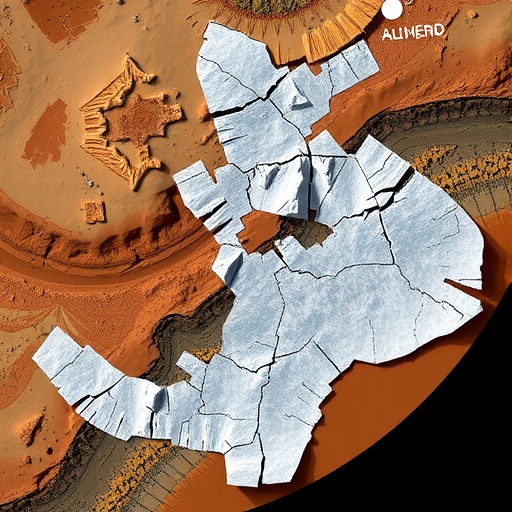
In a groundbreaking revelation that deepens our understanding of Mars’ climatic history, a team of planetary scientists led by Vos, Forget, and Lange has presented compelling evidence that the mid-latitude subsurface ice on Mars is not merely a transient or newly deposited feature. Instead, their latest research, published in Communications Earth & Environment, redefines this ice as a relic of a once extensive ice sheet that once enveloped large portions of the planet’s mid-latitudes. This discovery has significant implications for Mars’ climatic evolution and the planet’s potential habitability in its ancient past.
For decades, the Martian ice reservoirs concentrated at the poles have captured most scientific attention. However, extensive deposits of ice buried beneath the surface vast regions in the mid-latitudes have puzzled researchers, raising questions about their origin and longevity. The common theory until now posited that these ice bodies might be relatively recent, formed from atmospheric deposition during periods when Mars’ axial tilt—or obliquity—induced climatic shifts that favored ice accumulation. The research by Vos and colleagues challenges this notion by providing a comprehensive analysis indicating these ice deposits are remnants of a thick ice sheet that covered vast expanses millions of years ago.
Using an integration of sophisticated climate simulations and subsurface data collected from orbiters equipped with radar instruments, the authors reconstructed Mars’ ancient climate and ice dynamics. By simulating Mars’ obliquity cycles and their impact on atmospheric moisture transport, they demonstrated that past conditions were favorable for the growth of extensive ice sheets at middle latitudes. These conditions likely prevailed during periods when Mars’ axial tilt reached higher angles, triggering a redistribution of volatiles from the poles toward the mid-latitudes.
Furthermore, radar soundings from instruments like SHARAD (Shallow Radar) aboard NASA’s Mars Reconnaissance Orbiter reveal thick, layered ice stratigraphy beneath the surface, consistent with an ancient ice sheet rather than isolated or patchy ice deposits. This layered structure—characteristic of repeated deposition events—corroborates the hypothesis that the ice accumulated over prolonged epochs, dramatically reshaping the Martian landscape. Evidence for glacial processes including moraines and flow features further supports an extensive icy cover that once dominated the mid-latitudes.
One of the most profound implications of this finding is its impact on our understanding of Mars’ paleoclimate and potential habitability windows. The presence of massive ice sheets, comparable perhaps to Earth’s ice ages, indicates periods of higher humidity and more active water cycling between surface reservoirs and the atmosphere. These wetter intervals, although still cold, may have allowed for transient liquid water stable at or near the surface, thus providing habitable niches for microbial life. This challenges the long-standing paradigm of Mars as a relentlessly dry environment and opens new avenues for targeting astrobiological investigations.
The study also sheds light on the mechanisms responsible for the dramatic climate transitions that Mars has undergone. The past ice sheets’ growth and retreat correlate closely with the planet’s orbital parameters, reinforcing the crucial role of orbital forcing in shaping Martian climate. During high obliquity phases, polar ice sublimates and redistributes toward mid-latitudes, accumulating snow and ice. Conversely, when obliquity decreases, the ice sheets retreat, sublimating and leaving behind the buried ice detected today. This dynamic cycle of ice sheet waxing and waning over millions of years parallels Earth’s glacial-interglacial patterns but unveils its distinct Martian signature.
Technological advances in planetary radar sounding have been pivotal in revealing the internal layering and extent of this subsurface ice. The radar data, combined with topographical mapping and climate modeling, allowed the research team to create a multidimensional picture of the ice sheets’ structure and temporal evolution. Their models incorporated complex feedback mechanisms involving atmospheric pressure and temperature, dust cycles, and ice-albedo effects to accurately reflect Mars’ environmental conditions during these periods of ice sheet formation.
Beyond advancing fundamental planetary science, these findings have practical implications for the future of Mars exploration. The stable subterranean ice reservoirs in the mid-latitudes represent potentially accessible water resources for human missions, offering a critical supply for life support and fuel production. Unlike the poles, where extreme temperatures and difficult terrain prevail, mid-latitude ice storage could facilitate crewed mission planning and settlement approaches, reducing mission risk and expense.
Moreover, understanding the past distribution and dynamics of Martian ice sheets is key to interpreting surface geology and geomorphology. Glacial erosion and deposition have sculpted much of Mars’ mid-latitude landscape, influencing crater preservation, sediment transport, and valley networks. Thus, reconstructing the ice sheet history helps parse the geologic record, unraveling the sequence of climatic and hydrologic events that shaped the planet’s surface seen today.
The researchers emphasize that this subsurface ice is surprisingly well-preserved, even after millions of years of sublimation and climate shifts. This preservation is attributed to the protective overlying regolith layer which acts as an insulating blanket, limiting sublimation losses and maintaining the ice in a metastable state. Understanding these preservation processes is crucial for estimating Mars’ water inventory and assessing its potential atmosphere-surface exchange over geological timescales.
This research harnesses interdisciplinary expertise across planetary geomorphology, atmospheric physics, and glaciology, illustrating the value of collaborative science in planetary exploration. It underscores the importance of combined remote sensing and theoretical approaches to decipher complex planetary processes that cannot be directly observed. The insights into Mars’ cryosphere now prompt new questions about the longevity and stability of similar ice deposits elsewhere on the planet.
Looking ahead, the team advocates for targeted radar and surface missions to further characterize ice sheet extents and their interaction with Martian geology. In situ investigations and sample return missions could provide definitive age constraints and compositional analysis of ice and entrained sediments, giving a more nuanced understanding of Mars’ climate evolution. Such endeavors will also be critical in evaluating the potential for subsurface habitats preserved within these icy relics.
In conclusion, the identification of Martian mid-latitude subsurface ice as remnants of a past ice sheet transforms our comprehension of Mars’ climatic narrative. It highlights Mars as a planet shaped by dynamic ice-related processes more reminiscent of Earth’s glacial history than previously acknowledged. This discovery not only invigorates the scientific quest to decode Mars’ past but also underpins strategic planning for humanity’s future outside our home planet.
Cite Scienmag News
Violet Maxwell. (March 21, 2026). Martian Mid-Latitude Ice: Relic of Ancient Sheet. Scienmag. https://scienmag.com/martian-mid-latitude-ice-relic-of-ancient-sheet/
Violet Maxwell. "Martian Mid-Latitude Ice: Relic of Ancient Sheet." Scienmag, 21 March 2026, https://scienmag.com/martian-mid-latitude-ice-relic-of-ancient-sheet/. Accessed 3 September 2026.
Violet Maxwell. "Martian Mid-Latitude Ice: Relic of Ancient Sheet." Scienmag. March 21, 2026. https://scienmag.com/martian-mid-latitude-ice-relic-of-ancient-sheet/


