


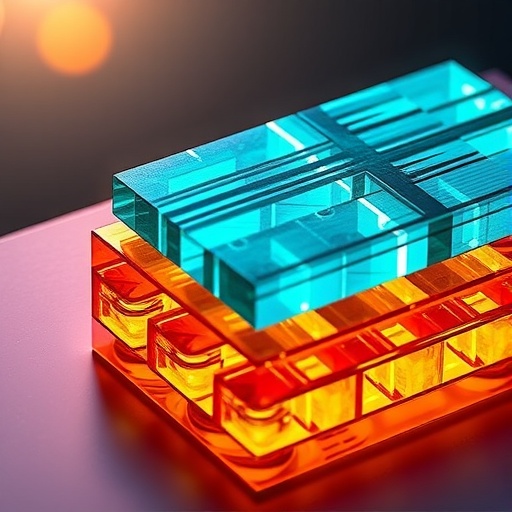
In the relentless pursuit of higher efficiency and longer operational lifetimes for perovskite solar cells, one of the most formidable challenges remains the creation of stable, selective interfaces capable of sustaining device integrity under stress. Recent research, breaking new ground in interface engineering, has unveiled a novel strategy predicated on the formation of amorphous self-assembled multilayers (a-SAMULs) that address these critical limitations. These advanced interfaces not only enhance hole-selectivity but also drastically improve the resilience of perovskite solar cells against reverse bias stress and ion migration, phenomena that have long impeded their commercial viability.
The cornerstone of this innovative approach lies in the molecular design and assembly of self-assembled monolayers (SAMs), a class of ultrathin organic coatings known to tune interfacial properties. Traditional SAMs, while effective in modifying surface energies and facilitating charge extraction, suffer from inherent shortcomings linked to their crystalline or highly ordered nature. The crystallinity, though beneficial for charge transport, often leads to discontinuities at the interface, weak adhesion, and pathways conducive to ion migration—factors that culminate in device degradation and failure under prolonged operation or dynamic bias conditions.
Addressing the limitations of conventional SAMs, the research team has synthesized and characterized a pair of phosphonic acid derivatives: (4-(7H-dibenzo[c,g]carbazol-7-yl)butyl)phosphonic acid, denoted as CbzNaph, alongside its hydroxyl-functionalized analogue, CbzNaphOH. The presence of intramolecular hydrogen bonding in CbzNaphOH is a deliberate molecular engineering feat designed to introduce steric hindrance and subtle distortions in molecular packing. This steric effect discourages the formation of a crystalline SAM and instead favors the assembly of an amorphous, yet densely packed, multilayer structure—termed a-SAMUL.
The amorphous nature of this self-assembled multilayer brings several critical advantages. Firstly, it forms a homogeneously packed interface, minimizing structural defects and grain boundaries where ion migration typically initiates. Secondly, the a-SAMUL demonstrates notably strong adhesion between the perovskite layer and the substrate, enhancing mechanical robustness and suppressing delamination under operational stresses. These properties collectively mitigate the formation and migration of mobile ionic species within the device, a dominant degradation pathway in perovskite photovoltaics.
Comprehensive spectroscopic analyses, including X-ray photoelectron spectroscopy and grazing incidence wide-angle X-ray scattering, elucidate the distinct molecular packing and electronic environment conferred by the a-SAMULs. These investigations reveal that the tailored interfacial layer maintains excellent energy-level alignment with the hole transport layer, facilitating efficient hole extraction while blocking electrons—a crucial attribute for high fill-factor and open-circuit voltage in solar cells.
Device fabrication integrating the a-SAMUL into the architecture of perovskite solar cells yielded remarkable improvements. Certified power conversion efficiencies (PCEs) surpassing 26% were achieved, placing these cells among the highest performing in the field. More significant, however, was the enhancement in operational stability and breakdown voltage. The devices exhibited reverse bias breakdown voltages exceeding −17 V, a threshold far superior to conventional SAM-modified cells, indicating pronounced resistance to voltage-induced degradation.
Accelerated aging tests conducted under continuous illumination and maximum power point tracking demonstrated outstanding durability, with the a-SAMUL-based devices maintaining over 90% of their initial efficiency beyond 3,000 hours. This stability surpasses typical operation timeframes documented for state-of-the-art perovskite solar cells, underscoring the transformative potential of amorphous multilayer interfaces in real-world applications.
Underlying these performance gains is the suppression of ion migration, a pervasive and detrimental phenomenon in perovskite materials. Ion migration leads to dynamic changes in internal electric fields, causing hysteresis, irreversible chemical reactions at interfaces, and phase segregation within the perovskite lattice. The homogeneous and densely packed a-SAMUL acts effectively as a physical and chemical barrier, preventing the diffusion of mobile ions and stabilizing interfacial charge dynamics.
The molecular design benefits extend beyond merely electromechanical stabilization. The hydroxyl functionalization in CbzNaphOH, combined with the spacer length and intermolecular hydrogen bonding, is critical for the formation of multilayer self-assembled films rather than monolayers. This multilayering effect results in an unusual balance of amorphous order and dense packing, which had not been previously reported as a feature in SAM engineering for optoelectronic devices.
This discovery redefines the paradigm of molecular interface engineering in perovskite solar technology. Instead of seeking perfect order and crystallinity, which historically guided SAM design, inducing controlled amorphousness emerges as a powerful strategy offering mechanical flexibility, defect tolerance, and enhanced ion-blocking capabilities. These insights pave the way for the systematic development of next-generation self-assembled materials that combine chemical functionality with tailored morphology to meet the stringent operational requirements of advance photovoltaics.
Further implications of this work extend to device architectures beyond perovskites. The principles of amorphous multilayer formation and tailored molecular packing may be adapted to other thin-film technologies such as organic photovoltaics and light-emitting diodes, where interface control is equally paramount. The modular chemical synthesis approach to phosphonic acid derivatives also allows for fine-tuning of interfacial electronic properties, thereby facilitating customized device optimization.
In concert with advancements in device encapsulation and perovskite compositional engineering, these robust hole-selective interlayers represent a critical component in overcoming the commercialization bottleneck of perovskite photovoltaics. By delivering unprecedented stability under high reverse bias conditions, a-SAMULs reduce the risk of catastrophic failure modes encountered in real-world module operation, enhancing safety and reliability.
The broader scientific community stands to benefit from these findings, as they exemplify how subtle molecular engineering can translate into macroscale performance enhancements and reliability. Future work will likely explore the interplay between molecular structure, multilayer thickness, and environmental stability, as well as scaling these interfaces for large-area device fabrication without sacrificing uniformity or performance.
This breakthrough reflects a synthesis of chemical ingenuity, materials science, and device engineering that heralds a new era for perovskite solar cells, enabling them to edge ever closer to commercial viability with record efficiencies and formidable stability. As the global demand for sustainable energy continues to surge, these developments illuminate a promising pathway toward cost-effective, high-performance solar technologies capable of widespread adoption.
By reimagining the role of self-assembled molecular layers, the study propels the field toward a horizon where long-term operational durability and top-tier efficiency coexist, marking a pivotal step in unlocking the full potential of perovskite photovoltaics.
Cite Scienmag News
Denise Maddox. (March 20, 2026). Amorphous Multilayers Boost Perovskite Solar Stability. Scienmag. https://scienmag.com/amorphous-multilayers-boost-perovskite-solar-stability/
Denise Maddox. "Amorphous Multilayers Boost Perovskite Solar Stability." Scienmag, 20 March 2026, https://scienmag.com/amorphous-multilayers-boost-perovskite-solar-stability/. Accessed 5 September 2026.
Denise Maddox. "Amorphous Multilayers Boost Perovskite Solar Stability." Scienmag. March 20, 2026. https://scienmag.com/amorphous-multilayers-boost-perovskite-solar-stability/


