


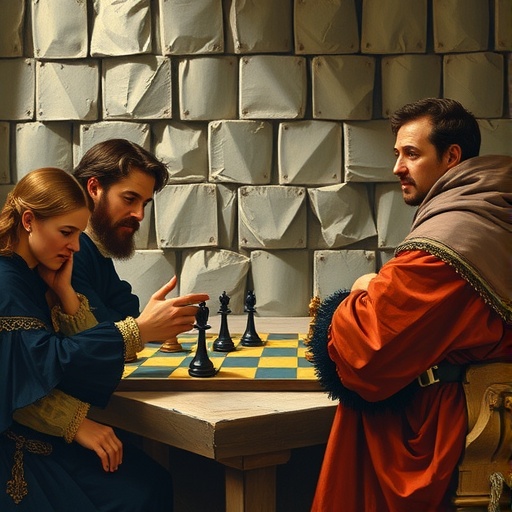
A revelatory illustration from a 13th-century chess manuscript discloses a Black player triumphing over a white-clad cleric, embodying a scene of equality and intellectual rivalry rather than dominance or subjugation. This depiction, found in the renowned Libro de axedrez, dados e tablas created in Seville in 1283 CE under King Alfonso X of Castile, disrupts the contemporary narrative of medieval racial and social paradigms, revealing how chess transcended conventional societal divisions and celebrated cerebral merit above all.
Unlike prevalent medieval portrayals where race and social status are often intertwined with subjugation, conquest, or martyrdom, this manuscript situates the Black chess player and the light-skinned cleric as equals engaged in strategic contest. The peaceful ambiance, marked by leisure elements such as a bottle of red wine and a filled glass, underscores a dignified, intellectual exchange. This nuanced representation is emblematic of broader cross-cultural interactions facilitated by chess during the Middle Ages, which often challenged prevailing racial and social hierarchies.
Historian Dr. Krisztina Ilko of Cambridge University has meticulously analyzed a diverse range of medieval sources, uncovering substantial evidence that chess acted as a subversive platform that defied racial stereotyping and social stratification globally during the Middle Ages. Her seminal work, “Chess and Race in the Global Middle Ages,” brought to light through publication in Speculum and winner of the Medieval Academy of America’s Article Prize in Critical Race Studies, uncovers how chess pieces and their players were depicted with a spectrum of racial identities that illustrated intellectual prowess irrespective of skin color and background.
Central to King Alfonso’s Libro de axedrez is its inclusive portrayal of chess players from Africa, the Middle East, and Asia, each demonstrating intellectual acumen. The manuscript includes a notable match between a Muslim and a Jewish player and another involving four Mongol competitors, one of whom casually rests on a saber with no actual threat implied — the battlefield was solely the chessboard. This iconography contrasts sharply with widespread European perceptions of Mongols as emblematic of brutality and chaos, revealing a more complex recognition of cultural and intellectual diversity in medieval chess literature.
Through the metaphor of chess, medieval chroniclers articulated a vision of a just world governed by strategic equals rather than brute force. Chess was heralded as “war without bloodshed,” symbolizing ideal societal order where merit dictated hierarchy, a conceptual framework that fostered unique interactions among disparate peoples and civilizations during a period rife with racial and religious conflict. The black-and-white contrast on chessboards metaphorically reflected human diversity, yet the stakes transcended color, emphasizing cognition and strategy above all.
While medieval Europe grappled with racial structures and often explicit race thinking—albeit in linguistic and conceptual frameworks different from contemporary notions—chess offered a counter-narrative. Dr. Ilko emphasizes that historical depictions of non-white figures in medieval art have traditionally been interpreted either as exalted or vilified archetypes. However, chess illuminated a more intricate narrative wherein intellectual capacity was the critical measure of value and success, decoupling identity from predetermined social dominance.
This intellectual openness was reinforced by the extensive influence of Islamic scientific thought and cultural exchange in Alfonso’s court. Notably, out of 103 chess problems in the treatise, a significant majority align with Muslim styles of play, underscoring the high regard for Islamic chess masters like the esteemed early 8th-century judge Sa’id ibn Jubair, who was famed for victorious blindfolded gameplay. This acceptance and adaptation highlight medieval Europe’s engagement with eastern intellectual traditions and the complex interplay of cultural appropriation and admiration.
Chess’s etymological roots trace back through Arabic (shatranj) and Middle Persian (chatrang) to the ancient Sanskrit chaturanga, which translates as “four-limbed.” This etymology reflects the original conceptualization of the game: a strategic simulation inspired by the Indian military’s primary divisions—infantry, cavalry, chariots, and elephants. As chess permeated different societies, the visual representation and conceptual symbolism of the chessmen adopted local cultural markers, including distinctive facial features and attire, often utilizing contrasting colors to signify opposing forces and invoking notions of racial difference.
One illuminating example comes from Persian manuscript illustrations of the Shahnama, a monumental epic chronicling the Persian people’s history. These 14th-century images depict the transfer of chess from India to Iran through an emissary with dark skin and unique clothing. Contrary to prior interpretations suggesting the Indian ambassador’s subjugation symbolized Persian superiority, Dr. Ilko argues that this portrayal instead affirmed the ambassador’s dignified elite status as a champion transmitting treasured Indian knowledge. This visual narrative defied prevailing value systems privileging whiteness in both Christian and Islamic contexts.
The Shahnama narrative recounts a diplomatic challenge posed to the Sassanian king Kushraw I Anushirvan, wherein he was tasked with deciphering the intricacies of chess or offering tribute to the Indian king. The failure of the king’s counselors except for the sagacious vizier Būzurjmihr, who unveiled the game’s secrets, underscores the pivotal role of intellect and strategy over brute power or lineage. This diplomatic episode, refracted through the transmission of chess, positions the game as a symbol of intellectual conquest rather than physical subjugation.
Another overlooked artifact that further enriches our understanding is a 14th-century altarpiece from Mallorca dedicated to Saint Nicholas of Myra, currently housed in the Museu de Mallorca. This piece, depicting a dark-skinned man engaged in chess with a light-skinned adversary in a Muslim court setting, visually narrates a miracle from the French play Le Jeu de saint Nicolas (circa 1200). The scene provocatively challenges medieval racial hierarchies by positioning a darker-skinned Muslim king above the light-skinned gambler-thief, subverting conventional valuations of race and virtue prevalent in medieval Christian iconography.
Through these rich historical depictions, we glean that chess operated as more than a pastime; it was a cultural medium fostering intellectual diplomacy, cross-cultural dialogue, and a nuanced reflection of social ideals that transcended rigid racial and hierarchical constraints. Dr. Ilko highlights how chess offers a fresh lens to view the medieval world, broadening scholarship beyond a dominantly Christian framework and revealing a diverse, vibrant Middle Ages informed by global interactions and cognitive excellence.
The enduring appeal and universality of chess today echo its medieval legacy as a game that continues to celebrate intellect, strategy, and equality in competition. As Dr. Ilko prepares her comprehensive volume, The Pawns of History: A New Approach towards the Global Middle Ages, this research invites us to rethink medieval history and consider the transformative potential of intellectual cultures that defied social boundaries, offering a timeless message of human agency and equality.
News Publication Date: March 19, 2024
Web References:
https://www.journals.uchicago.edu/doi/10.1086/729294
http://dx.doi.org/10.1086/729294
References:
Ilko, Krisztina. “Chess and Race in the Global Middle Ages.” Speculum, vol. 99, no. 2, 2024, DOI: 10.1086/729294.
Cite Scienmag News
Courtney Benton. (March 19, 2026). Medieval Chess Fostered Social Integration and Mutual Respect, Study Shows. Scienmag. https://scienmag.com/medieval-chess-fostered-social-integration-and-mutual-respect-study-shows/
Courtney Benton. "Medieval Chess Fostered Social Integration and Mutual Respect, Study Shows." Scienmag, 19 March 2026, https://scienmag.com/medieval-chess-fostered-social-integration-and-mutual-respect-study-shows/. Accessed 3 September 2026.
Courtney Benton. "Medieval Chess Fostered Social Integration and Mutual Respect, Study Shows." Scienmag. March 19, 2026. https://scienmag.com/medieval-chess-fostered-social-integration-and-mutual-respect-study-shows/


