


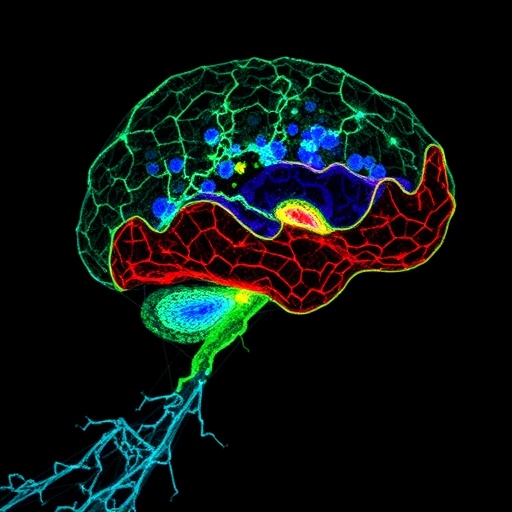
In a ground-breaking study poised to reshape our understanding of viral neuropathogenesis, researchers have leveraged cutting-edge spatial transcriptomics to unravel the intricate cellular choreography driving Japanese encephalitis (JE) progression. This innovative approach has illuminated previously unrecognized intercellular communications centered around the brain’s vasculature, elucidating how these interactions exacerbate viral invasion and pathogenesis in a mouse model. By charting gene expression patterns with unprecedented spatial resolution, this research not only deepens insight into JE but also signals new therapeutic trajectories targeting vascular-centric immune responses.
Japanese encephalitis, a mosquito-borne flavivirus infection prevalent across Asia, notoriously causes severe neurological morbidity and mortality. Despite its global health burden, the detailed cellular mechanisms underpinning JE progression remained enigmatic, largely due to limitations in studying spatially resolved cellular environments within affected brain tissue. Traditional transcriptomic methods, which blend heterogeneous cell populations, obscure the context-dependent gene expression crucial for dissecting pathogenesis. The advent of spatial transcriptomics, which preserves the anatomical architecture while profiling gene expression, now overcomes these barriers, enabling dissection of complex tissue microenvironments in unprecedented detail.
The study employed a well-established murine JE model, infecting mice with Japanese encephalitis virus (JEV) and analyzing brain samples across multiple disease stages. Spatial transcriptomic maps revealed a dynamic landscape of cellular responses concentrated around cerebral blood vessels, suggesting these vascular niches are hubs for pathological signaling during viral encephalitis. Neurons, glial cells, endothelial cells, and infiltrating immune populations exhibited spatially coordinated transcriptional alterations that drove inflammatory cascades and disrupted blood-brain barrier integrity, hallmarks of JE neuropathology.
One of the pivotal revelations was the role of endothelial cells lining brain microvasculature as active participants in JE progression rather than passive conduits. These endothelial cells upregulated chemokines and adhesion molecules, facilitating targeted recruitment of peripheral immune cells into the central nervous system. This vascular-centered immune trafficking orchestrated a localized pro-inflammatory milieu, propagating neuronal injury. The spatial transcriptomics data delineated specific molecular pathways activated in these cells, including interferon signaling and vascular endothelial growth factor (VEGF) pathways.
In parallel, resident microglia and astrocytes displayed distinct spatial transcriptional programs attuned to their proximity to vasculature and infiltrating immune cells. Microglia near inflamed vessels exhibited classical activation profiles characterized by augmented cytokine production and antigen presentation capacity, driving further immune amplification. Astrocytes contributed by modulating extracellular matrix components and releasing neurotoxic mediators, exacerbating neuronal damage. These localized glial responses formed a cellular nexus integrating vascular and immune dynamics during JE.
Neuronal populations likewise responded heterogeneously based on their spatial localization. Neurons adjacent to inflamed vasculature showed heightened expression of stress markers and apoptosis-related genes, correlating with observed neuropathological damage patterns. These spatially resolved gene expression signatures underscore the nuanced interplay between virus-induced immune activation and direct neuronal vulnerability. By mapping these transcriptional gradients, researchers identified candidate signaling nodes that may be targeted to preserve neurofunction.
The spatial transcriptomic approach also traced the temporal progression of JE neuropathology. Early infection stages revealed subtle vascular activation and modest immune cell infiltration, which escalated to robust inflammatory infiltrates and severe blood-brain barrier disruption at peak disease. This temporal-spatial blueprint of molecular events provides a holistic framework to understand how JE evolves from initial viral entry to devastating encephalitic outcomes. Importantly, such knowledge is essential for devising stage-specific therapeutic interventions.
Critically, the endothelial-immune axis uncovered by this study highlights the potential of targeting vascular interactions to mitigate JE severity. Current treatments are primarily supportive, with no specific antivirals or immune modulators proven effective. By spotlighting endothelial cells as orchestrators of immune cell trafficking and inflammatory amplification, novel therapeutic strategies may be designed to stabilize the vascular niche, limit pathogenic immune infiltration, and prevent neural tissue destruction.
Beyond JE, these findings may have broader implications for other neurotropic viral encephalitides. The identification of vascular hubs as critical regulators of CNS immune dynamics suggests a common pathological theme that could be exploited across viral infections affecting the brain. Spatial transcriptomics emerges as a transformative tool for unraveling complex tissue microenvironments, advancing both fundamental understanding and clinical translation.
The technical rigor of the study is evident in the integration of high-resolution spatial gene expression profiling with complementary histopathological and immunofluorescence analyses, ensuring robust validation of findings. Advanced computational pipelines enabled the deconvolution of mixed cell populations and identification of cell-cell interaction networks, exemplifying the confluence of biology and bioinformatics in contemporary infectious disease research.
This study by Ou, Z., Wang, Z., Chen, Q., et al., published in Nature Communications verifies that the microvascular milieu is not merely a landscape through which viruses pass but a dynamic and interactive ecosystem where cellular crosstalk propels disease progression. The spatial transcriptomic maps generated provide a cellular atlas of JE that transforms abstract molecular data into tangible biological insights, paving the way for precision medicine approaches.
As the world anticipates emerging viral threats with neuroinvasive potential, the methodologies and conceptual advances presented here offer a strategic blueprint for future investigations. The marriage of spatial omics technologies and viral neuropathology promises to unlock the intricacies of host-virus interactions with spatial and temporal precision never before achievable.
Ultimately, this research embodies a paradigm shift—from studying isolated cell types or bulk tissue samples to exploring the spatial context of cellular communities during infection—positioning spatial transcriptomics at the forefront of neuroscience and infectious disease research. It charts a promising path toward mechanistically informed interventions to curb the devastating impact of Japanese encephalitis and related viral brain infections.
Cite Scienmag News
Kristina Jarvis. (March 18, 2026). Spatial Transcriptomics Reveals Vascular Drivers in Japanese Encephalitis. Scienmag. https://scienmag.com/spatial-transcriptomics-reveals-vascular-drivers-in-japanese-encephalitis/
Kristina Jarvis. "Spatial Transcriptomics Reveals Vascular Drivers in Japanese Encephalitis." Scienmag, 18 March 2026, https://scienmag.com/spatial-transcriptomics-reveals-vascular-drivers-in-japanese-encephalitis/. Accessed 4 September 2026.
Kristina Jarvis. "Spatial Transcriptomics Reveals Vascular Drivers in Japanese Encephalitis." Scienmag. March 18, 2026. https://scienmag.com/spatial-transcriptomics-reveals-vascular-drivers-in-japanese-encephalitis/


