


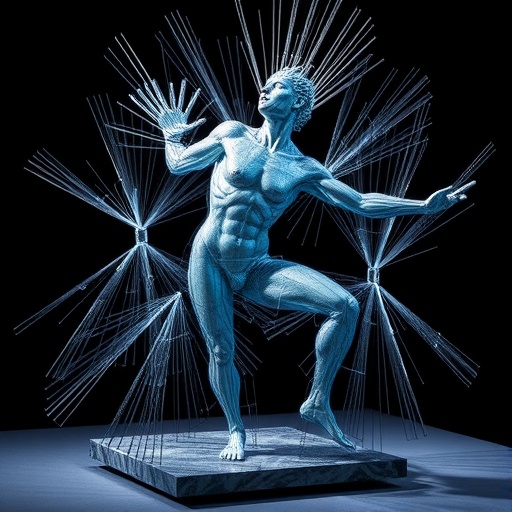
In a groundbreaking advancement set to redefine the landscape of electromagnetic research and applications, a team led by Yang, Liu, and Yu has introduced the “Electromagnetic Sculptor,” a pioneering framework that fuses differentiable geometric optimization with electromagnetic field manipulation. This novel approach, detailed in their recent publication in Communications Engineering, promises an unprecedented level of control and precision in shaping electromagnetic fields, heralding new possibilities across scientific and technological domains.
The core innovation underlying the Electromagnetic Sculptor lies in its use of differentiable geometric optimization—a mathematical and computational technique that allows for the smooth tuning of geometric variables to achieve desired electromagnetic outcomes. Traditional methods of electromagnetic field design often entail laborious trial-and-error iterations or rely on heuristic algorithms that lack guaranteed convergence or optimality. In contrast, the Electromagnetic Sculptor exploits the differentiability of geometric parameters, enabling gradient-based optimization that is both precise and computationally efficient.
Crucially, the framework integrates electromagnetic simulations directly into the optimization loop. By treating the parameters defining geometric structures as continuous and differentiable variables, the system can calculate gradients of electromagnetic field metrics with respect to shape modifications in real-time. This capability facilitates the direct sculpting of fields to meet complex criteria, such as focusing waves into arbitrary patterns, minimizing losses, or engineering field distributions that would be unattainable using fixed geometries.
The implications of this technology are vast and multifaceted. In telecommunications, for instance, antenna designs could be revolutionized by sculpting emission patterns that maximize signal clarity and bandwidth while minimizing interference. Similarly, in medical imaging and therapy, electromagnetic field control at finer scales could improve resolution and target precision, potentially enhancing diagnostic quality and treatment outcomes, especially in non-invasive techniques like MRI or focused ultrasound.
Another transformative aspect of the Electromagnetic Sculptor is its potential impact on metamaterials and photonic devices. Metamaterials—artificially structured materials engineered to control electromagnetic waves—stand to benefit immensely from this approach. The ability to optimize geometric configurations of meta-atoms with gradient-informed updates could accelerate the design cycle, yield novel functionalities such as dynamic beam steering or cloaking, and reduce fabrication uncertainties by guiding tolerances through optimization.
From a computational standpoint, the integration of differentiable programming into electromagnetic design represents a significant stride. The framework leverages advances in automatic differentiation frameworks, typically used in machine learning, to handle Maxwell’s equations and boundary conditions efficiently. This cross-disciplinary approach bridges physics-based modeling and modern optimization algorithms, showcasing the power of combining theoretical rigor with computational innovation.
An additional dimension of the Electromagnetic Sculptor is its adaptability across frequency regimes, from radio frequencies to terahertz and optical spectra. By tailoring geometric parameters according to wavelength scales, the approach can be deployed in a wide array of settings, from large-scale antenna arrays down to nanoscale plasmonic devices. This scalability reinforces its utility for both fundamental research and practical engineering applications.
Moreover, the system provides a framework for addressing complex multiphysics problems where electromagnetic behavior is coupled with thermal, mechanical, or quantum phenomena. The differentiable architecture allows seamless incorporation of coupled simulations, enabling holistic optimization strategies that consider all relevant physical effects simultaneously. This integration could lead to more robust designs that perform reliably in real-world conditions.
The Electromagnetic Sculptor also offers promising avenues in the realm of wireless power transfer and energy harvesting. By precisely shaping electromagnetic fields, the efficiency of energy transfer across space can be optimized, reducing losses and enhancing system robustness. This capability is critical for emerging technologies such as wireless charging of electric vehicles, implantable medical devices, and remote sensor networks.
The research team emphasizes the accessibility of their framework. Built to interface with existing electromagnetic solvers, the Electromagnetic Sculptor is designed to be adoptable by engineers and scientists without requiring deep expertise in optimization theory. This democratization of advanced design tools could catalyze innovation, shortening development times and broadening participation in cutting-edge electromagnetic research.
Importantly, the robustness of solutions derived from the Electromagnetic Sculptor is substantiated by rigorous validation. The authors demonstrate the efficacy of their approach across multiple benchmark scenarios, showing that optimized designs not only meet theoretical criteria but also maintain performance under perturbations such as manufacturing tolerances and environmental variability. This reliability is essential for translating optimized designs into practical, deployable devices.
Besides practical applications, the conceptual leap represented by the Electromagnetic Sculptor expands our fundamental understanding of the interaction between geometry and electromagnetic fields. By providing a continuous and differentiable mapping from geometric configurations to field distributions, the framework opens new research pathways for exploring wave phenomena, resonances, and scattering mechanisms with precision-guided experimentation.
The Electromagnetic Sculptor stands as a testament to the fruitful convergence of physics, mathematics, and computational science. It exploits the intrinsic structure of Maxwell’s equations and geometric parameter spaces, harnessing differentiability to reorder the design paradigm from heuristic adjustments to principled, gradient-based optimization. This shift mirrors transformations seen in other fields such as structural engineering and fluid dynamics, where differentiable optimization has driven leaps in design sophistication.
As electromagnetic technologies underpin a vast range of modern devices and infrastructure—from smartphones and satellites to medical equipment and security systems—the ability to sculpt fields with unparalleled fidelity is poised to create ripple effects throughout society. Enhanced wireless communications, medical diagnostics, energy systems, and sensing technologies are all set to benefit, accelerating the pace at which next-generation devices emerge from concept to reality.
Looking ahead, the integration of machine learning with the Electromagnetic Sculptor’s differentiable core could further amplify its capabilities. By coupling data-driven models with physics-based optimization, hybrid strategies may emerge that exploit patterns gleaned from large datasets while ensuring compliance with physical laws, optimizing both design efficiency and innovation potential.
The release of the Electromagnetic Sculptor framework marks a pivotal moment, opening the door to a new era where electromagnetic fields are not just passively managed but actively sculpted with exquisite precision. This innovation promises to reshape the way we design and interact with electromagnetic phenomena, driving forward the frontiers of science and technology in the years to come.
Cite Scienmag News
Denise Maddox. (March 17, 2026). Electromagnetic Sculptor: Optimizing Fields with Geometry. Scienmag. https://scienmag.com/electromagnetic-sculptor-optimizing-fields-with-geometry/
Denise Maddox. "Electromagnetic Sculptor: Optimizing Fields with Geometry." Scienmag, 17 March 2026, https://scienmag.com/electromagnetic-sculptor-optimizing-fields-with-geometry/. Accessed 6 September 2026.
Denise Maddox. "Electromagnetic Sculptor: Optimizing Fields with Geometry." Scienmag. March 17, 2026. https://scienmag.com/electromagnetic-sculptor-optimizing-fields-with-geometry/


