


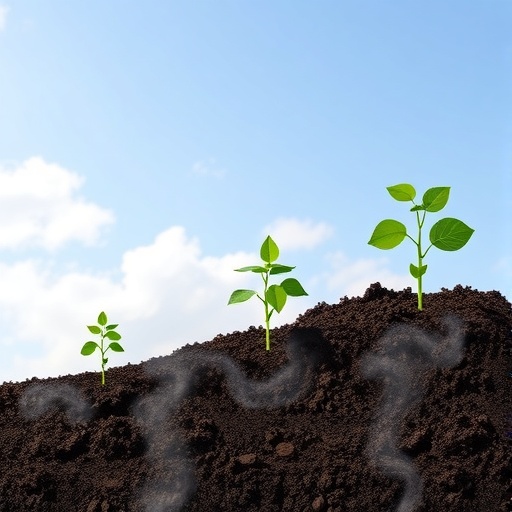
In the relentless march of climate change, one of the most critical battlegrounds lies beneath our feet—in the soil. The scientific community has long sought to understand how rising global temperatures impact soil organic carbon (SOC), a major component of the Earth’s carbon cycle. Recent groundbreaking research by Luo, Ren, and Fatichi, published in Communications Earth & Environment, sheds new light on this elusive relationship, revealing that air and soil warming influence soil organic carbon storage in fundamentally different ways. This discovery not only advances our understanding of terrestrial carbon dynamics but also offers hope and caution for future climate mitigation strategies.
Soil organic carbon is a dynamic reservoir, storing vast amounts of carbon that, if released, could accelerate global warming. Understanding its response to warming is pivotal for predicting future climate trajectories. Traditionally, studies have often conflated air warming with soil warming, assuming that temperature increases in these environments act in tandem. However, the novel investigation conducted by Luo and colleagues meticulously disentangles the complex interactions of air temperature and direct soil temperature influences, concluding that these warming pathways impact SOC storage differently.
Their research utilizes advanced experimental setups combining controlled laboratory incubations with comprehensive field warming experiments. By decoupling the simultaneous effects of air and soil warming, they demonstrate that soil temperature increases have a direct and more pronounced effect on accelerating microbial decomposition rates of organic matter. This leads to rapid carbon turnover and potential losses of stored soil carbon. In contrast, air warming primarily modifies plant physiology and soil respiration through indirect pathways, yielding a less immediate or less intense effect on SOC.
These findings highlight the critical role of microbial communities inhabiting the soil, which are highly sensitive to temperature changes at the microhabitat level. Soil warming elevates microbial metabolic rates and enzymatic activities, hastening the breakdown of complex organic compounds such as lignin and cellulose. Consequently, the rate at which carbon is converted from stable organic forms into carbon dioxide is enhanced, leading to diminished soil carbon stocks over time if not offset by increased plant input.
Conversely, air warming seems to affect soil organic carbon indirectly by altering aboveground plant functions—photosynthesis rates, growth patterns, and litter input. Warmer air temperatures may extend growing seasons in some ecosystems or accelerate phenology, potentially augmenting carbon inputs into the soil. However, these input changes appear insufficient to compensate fully for the enhanced carbon loss due to soil heating, implying a net carbon release risk with continuing climate warming.
One remarkable aspect of Luo et al.’s study is the precision with which they separated the influences of air and soil warming using innovative sensor technology and experimental design. Vertical soil temperature gradients were carefully monitored and manipulated, allowing clear attribution of carbon cycling changes to specific thermal drivers. This methodological rigor paves the way for future research in diverse biomes to validate and extend these findings under varied climatic and edaphic conditions.
The implications of this work extend beyond academic inquiry into the realm of policy and carbon budgeting. Global climate models currently embedded into Earth system models often treat surface warming as a uniform driver, resulting in oversimplified soil carbon feedback representations. Incorporating the nuanced differential effects of air and soil warming, as revealed by Luo and colleagues, could refine these models substantially, leading to more accurate predictions of carbon-climate feedback loops and informing mitigation approaches.
Moreover, this research raises urgent questions about land management practices. Agricultural soils and natural ecosystems exposed to intensified warming regimes may require targeted interventions to preserve their carbon stocks. Strategies such as enhanced organic amendments, cover cropping, reduced tillage, or even modifications to irrigation could help buffer soil systems against destabilization caused by soil temperature increases.
Interestingly, Luo et al. also emphasize the temporal scales of these warming effects. While soil warming precipitates immediate and measurable losses in SOC, the longer-term dynamics involve complex feedbacks. Soil carbon substrates susceptible to rapid decomposition may be quickly depleted, eventually leaving more recalcitrant compounds that decompose more slowly. Air warming-driven shifts in vegetation and microbial community composition might also create evolving conditions that alter carbon cycling trajectories over decades.
Their findings harmonize with recent advances in understanding soil microbial ecology under climate change. Microbial community resilience, adaptation, and functional shifts under sustained warming are areas ripe for further exploration. Delineating how these communities respond differently to air and soil warming could uncover mechanisms to manipulate microbial processes beneficially, enhancing soil carbon sequestration.
While the study focuses largely on temperate ecosystems, it invites questions about tropical and boreal soils. Tropical forests, often carbon-dense and highly biodiverse, may react differently due to their unique thermal and moisture regimes. Similarly, boreal permafrost soils exposed to thawing and warming might exhibit complex interactions as organic matter trapped in frozen layers becomes accessible to microbial degradation. Future research building on Luo et al.’s framework could unlock critical insights across global biomes.
In conclusion, the meticulous work by Luo, Ren, and Fatichi serves as a clarion call for more nuanced perspectives on climate warming’s effects on soil carbon dynamics. By exposing the divergent impacts of air versus soil warming, this study advances our scientific understanding and reinforces the urgent need for targeted approaches to mitigate carbon losses from soils—a cornerstone in the battle against global climate change.
As climate change predicted during this century should reach unprecedented levels of impact, such innovative research provides indispensable guidance for scientists, policymakers, and land stewards worldwide. Safeguarding soil organic carbon stocks through informed strategies will be essential not only for maintaining ecosystem health but also for stabilizing atmospheric carbon dioxide concentrations in an increasingly warming world.
Cite Scienmag News
Hazel Lockwood. (March 17, 2026). Air, Soil Warming Impact Soil Organic Carbon Differently. Scienmag. https://scienmag.com/air-soil-warming-impact-soil-organic-carbon-differently/
Hazel Lockwood. "Air, Soil Warming Impact Soil Organic Carbon Differently." Scienmag, 17 March 2026, https://scienmag.com/air-soil-warming-impact-soil-organic-carbon-differently/. Accessed 29 August 2026.
Hazel Lockwood. "Air, Soil Warming Impact Soil Organic Carbon Differently." Scienmag. March 17, 2026. https://scienmag.com/air-soil-warming-impact-soil-organic-carbon-differently/


