

In a groundbreaking study published in Science of The Total Environment, researchers have unveiled the extensive distribution and intriguing dynamics of particulate thiols across a meridional transect in the western North Pacific Ocean. This pioneering investigation combines broad oceanographic sampling with rigorous laboratory culture experiments to shed light on the biochemical role and environmental implications of thiols, particularly glutathione and cysteine, as markers of marine phytoplankton health and metal stress.
The ocean’s microscopic phytoplankton not only form the base of the marine food web but also regulate critical biogeochemical cycles, including the cycling of sulfur compounds. Thiols, such as glutathione (GSH) and cysteine (Cys), are low molecular weight sulfur-containing organic molecules prevalent in marine organisms. Renowned for their ability to bind metals and serve as antioxidants, these compounds have long been suspected to play pivotal roles in mitigating metal toxicity and oxidative stress induced by sunlight and trace contaminants.
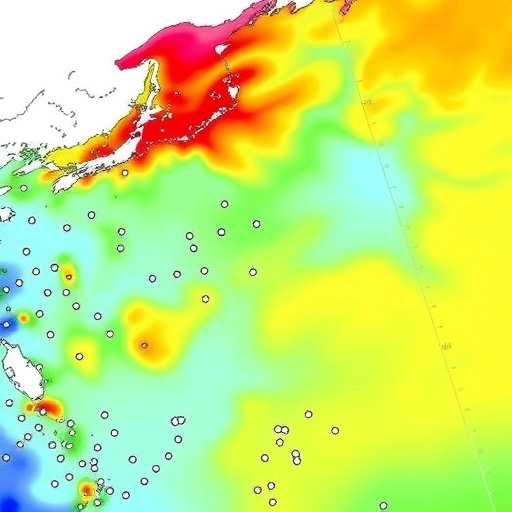
Despite their biological significance, the spatial distribution of particulate thiols in the ocean, especially in oligotrophic and equatorial regions dominated by cyanobacteria, remained largely unexplored due to challenges inherent in open-ocean sampling and sensitive biochemical analyses. Addressing these gaps, a collaborative team led by Prof. Kuo Hong Wong of Kanazawa University and collaborators undertook an ambitious campaign along the GEOTRACES GP22 transect, capturing seawater samples spanning a diverse array of water masses—from subarctic to tropical zones—and systematically quantifying particulate cysteine and glutathione normalized to chlorophyll a concentrations.
Their results reveal marked heterogeneity in thiol concentrations across different water masses, notably Pacific Equatorial Water (PEW), North Equatorial Counter Current (NECC), North Pacific Central Water (NPCW), North Pacific Transition Zone (NPTZ), and Pacific Subarctic Upper Water (PSUW). Strikingly, p-GSH normalized to chlorophyll a exhibited elevated values within the NPCW, a subtropical, oligotrophic, and highly transparent water mass. This unexpected enrichment suggests that particulate glutathione is not solely synthesized de novo by living phytoplankton cells but may also be preserved in particulates derived from senescent or dead phytoplankton, retaining “preformed” thiols even as chlorophyll a degrades.
In parallel, meticulous culture experiments with two emblematic marine phytoplankton species, the cyanobacterium Synechococcus sp. and the diatom Thalassiosira nordenskioeldii, elucidated physiological responses underpinning these spatial trends. Synechococcus sp. notably ramped up particulate glutathione under copper stress, corroborating the notion that these thiols function as biochemical shields ameliorating metal toxicity. This synergy between field observations and controlled laboratory conditions provides compelling evidence that environmental stressors—including elevated light exposure, trace metal contamination through atmospheric deposition, and community composition—jointly sculpt the oceanic thiol landscape.
Furthermore, the study underscores the complexity of thiol biogeochemistry, proposing a conceptual framework whereby the distribution of particulate thiols emerges from the confluence of phytoplankton community structure, physiological stress responses, particulate decomposition rates, and water mass circulation. Of particular interest is the hypothesized preservation mechanism by which glutathione remains intact in detrital particulates within NPCW, implying previously unappreciated resilience of organic sulfur compounds and highlighting their potential as biomarkers of past phytoplankton productivity and environmental stress history.
Looking forward, the researchers advocate for advanced analytical approaches, such as sulfur isotope ratio measurements, to untangle the contributions of biogenic, atmospheric, and detrital sources to the thiol signature. A comprehensive understanding of these sources, coupled with quantitative insights into preservation and degradation kinetics, will be critical to accurately interpret particulate thiol distributions in a changing oceanic environment.
Moreover, given the escalating deposition of anthropogenic metals like copper and mercury via atmospheric aerosols, elucidating their interactive effects with light regimes and phytoplankton physiology remains a top priority. Integrative approaches combining in situ observations, laboratory culture stress experiments, and ecosystem modeling promise to unlock new avenues to employ particulate thiols as sensitive indices of marine environmental stress, offering a novel lens to assess ocean health.
This study not only advances marine biogeochemistry by mapping organic sulfur compound distributions on an ocean basin scale but also paves the way for international collaborations within frameworks like the GEOTRACES project to extend these findings globally. As the scientific community grapples with the multifaceted impacts of climate change and pollution on marine ecosystems, dissecting the subtle chemical signals encoded within particulate thiols offers a valuable tool for monitoring the ocean’s response and resilience.
Kanazawa University, with its commitment to cutting-edge interdisciplinary research and international partnerships, stands at the forefront of these efforts, leveraging expertise in marine chemistry, microbiology, and environmental science. This research exemplifies the university’s dedication to future-oriented intelligence, addressing critical questions of global relevance through innovative science.
In sum, the revelation of particulate thiol biogeography in the western North Pacific enriches our understanding of marine chemical ecology, the interdependence between microbial communities and trace metal cycles, and the subtle interplay between biological production and particulate matter preservation in the ocean. Continuing to disentangle these complex processes will undoubtedly enhance our capacity to predict and mitigate anthropogenic impacts on marine environments worldwide.
News Publication Date: 15-Dec-2025
Web References: DOI link
Cite this news
SCIENMAG. (March 16, 2026). Mapping Particulate Thiol Distribution Across a North-South Transect in the Western North Pacific. https://scienmag.com/mapping-particulate-thiol-distribution-across-a-north-south-transect-in-the-western-north-pacific/
SCIENMAG. "Mapping Particulate Thiol Distribution Across a North-South Transect in the Western North Pacific." Scienmag, 16 March 2026, https://scienmag.com/mapping-particulate-thiol-distribution-across-a-north-south-transect-in-the-western-north-pacific/. Accessed 28 August 2026.
SCIENMAG. "Mapping Particulate Thiol Distribution Across a North-South Transect in the Western North Pacific." Scienmag. March 16, 2026. https://scienmag.com/mapping-particulate-thiol-distribution-across-a-north-south-transect-in-the-western-north-pacific/


