


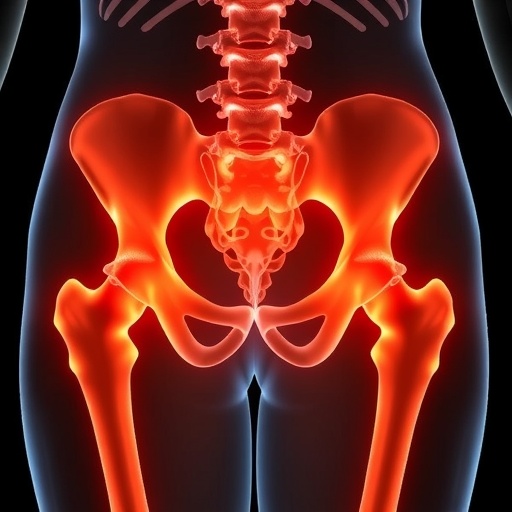
In the evolving landscape of orthopedic surgery, the management of fragility fractures of the pelvis (FFP) presents a significant challenge, particularly within the elderly demographic. Fragility fractures, typically resulting from low-energy impacts, are increasingly prevalent due to the global rise in aging populations and the concurrent prevalence of osteoporosis. These fractures, especially those classified as type III under the Rommens and Hofmann classification, require meticulous consideration due to the complexities in stabilization and the fragile health of the patients affected. The recent retrospective study conducted by Yang et al., published in BMC Geriatrics (2026), offers compelling insights into the use of anterior subcutaneous pelvic internal fixation (INFIX) as a viable surgical intervention for elderly patients grappling with this debilitating condition.
Elderly patients experiencing FFP type III fractures often face considerable morbidity, prolonged immobilization, and a cascade of secondary complications arising from decreased mobility. Traditional open surgical fixation methods, while effective in younger cohorts, carry heightened risks in this group due to comorbidities, poor bone quality, and increased surgical trauma. The INFIX system represents a paradigm shift, offering a minimally invasive operative technique designed to stabilize the anterior pelvic ring without the extensive soft tissue disruption inherent in conventional approaches. The study by Yang and colleagues meticulously documents the clinical outcomes, offering a detailed comparative analysis of functional recovery, complication rates, and radiographic healing in a sizable cohort of elderly patients.
Central to the affirmation of INFIX utility is its biomechanical premise. The fixation apparatus employs subcutaneous pedicle screws connected by a transverse bar, effectively stabilizing the anterior pelvic ring through compressive force distribution. This stabilization enables early mobilization, which is crucial in mitigating the deleterious effects of prolonged bed rest such as deep vein thrombosis, pressure ulcers, and muscle atrophy. The study’s quantitative data underscore significant improvements in patient mobility scores postoperatively, suggesting an expedited rehabilitation trajectory that positively impacts overall quality of life.
Radiological evidence presented within the study correlates well with clinical outcomes, delineating successful fracture union without signs of implant loosening or failure. The investigation highlights the average timeframe to radiographic consolidation and stresses the importance of early weight-bearing protocols made feasible by the robust yet minimally invasive nature of INFIX. Such findings are particularly poignant given the precarious osteoporotic status of the patient population under scrutiny, spotlighting INFIX as a technique tailored to meet the biomechanical demands imposed by compromised bone integrity.
Crucially, Yang et al. have illuminated several perioperative considerations that enhance the safety profile of this intervention. The retrospective analysis delves into intraoperative metrics such as blood loss, operative duration, and anesthesia impacts, all of which showed favorable outcomes compared to traditional fixation methods reported in the literature. This evidence advocates for INFIX’s adaptive suitability to elderly patients, many of whom would otherwise be deemed high-risk candidates for invasive surgical repair due to frailty and comorbid conditions.
Beyond surgical parameters, the study advances our understanding of postoperative complications, noting a comparatively low incidence of infection, neurovascular injury, and implant-related adverse events in patients undergoing INFIX. Such findings challenge previously held concerns regarding subcutaneous hardware’s vulnerability and underscore the meticulous surgical technique required to avoid iatrogenic complications. The study’s protocol for patient monitoring and wound care sets a benchmark for postoperative management in this vulnerable group, reinforcing the holistic nature of efficacious treatment strategies.
Functional outcomes, gauged through standardized scoring systems, reveal a marked decline in pain metrics and a resurgence in daily activity levels. The recovery trajectory charted in the analysis evidences the INFIX system’s role not merely as a mechanical solution but as a facilitator of patient autonomy and enhanced physical independence. Such outcomes are imperative—especially against the backdrop of declining physiological reserves attendant with old age, where preserving functional status is synonymous with preserving dignity and reducing healthcare burdens.
The underpinning rationale for favoring INFIX over other fixation techniques is further bolstered by the minimally invasive approach’s alignment with enhanced recovery protocols. The reduction in soft tissue trauma, coupled with decreased hemodynamic instability during surgery, contributes to shorter hospital stays and faster transitions to rehabilitation. This synergy between surgical innovation and recovery science is particularly impactful in the elderly, where prolonged hospitalization often precipitates further functional decline.
Furthermore, the study parses out nuanced subgroup analyses, indicating that patients with comorbidities such as cardiovascular disease, diabetes, or chronic renal insufficiency still derive meaningful benefit from INFIX stabilization. This finding broadens the clinical applicability of the technique, proposing that the elderly patient’s multimorbid profile need not preclude effective mechanical stabilization of pelvic fractures. Such data illuminate a compassionate, evidence-based approach to orthopedic care in an aging society.
Yang and colleagues also engage with the biomechanical implications of pelvic stability restoration beyond mere fracture fixation. The pelvic ring’s integrity is fundamental to kinetic chain functionality, influencing gait patterns and load distribution through the lower extremities. By reinstating this anatomical and functional harmony, INFIX postoperatively supports not only structural healing but also neuromuscular coordination essential for effective ambulation and fall prevention, which is pivotal in reducing future fragility injury risks.
The authors do not overlook the potential limitations inherent to their study, including its retrospective design, the absence of a randomized control group, and possible selection biases. Nevertheless, the rigor of their data collection, the homogeneity of the patient cohort, and thorough longitudinal follow-up offset these constraints, offering a robust foundation for future prospective trials. Such investigations will hopefully delineate operative indications, refine surgical protocols, and consolidate INFIX’s role within the orthogeriatric armamentarium.
In addressing cost-effectiveness, the study posits that the decreased complication rates, reduced hospital length of stay, and expedited rehabilitation collectively translate into economic benefits for healthcare systems grappling with the escalating demands of an aging population. By potentially alleviating the resource strain imposed by fragility fracture morbidity, INFIX represents not only a clinical innovation but also a strategic public health intervention.
As geriatric orthopedic care continues to advance, the work by Yang et al. marks a significant milestone. Their comprehensive analysis offers a beacon of hope to clinicians endeavoring to balance the complex interplay between surgical efficacy, patient safety, and functional restoration in elderly patients burdened by FFP type III fractures. INFIX emerges not simply as a new device but as a holistic therapeutic approach integrating biomechanical insight, surgical finesse, and postoperative care excellence.
In sum, this retrospective study provides a compelling narrative that anterior subcutaneous pelvic internal fixation is an effective, safe, and patient-centric intervention for managing complex fragility fractures of the pelvis in elderly populations. It underscores the critical need for tailored surgical solutions that accommodate the unique challenges posed by osteoporotic bone, comorbidity profiles, and rehabilitation imperatives intrinsic to older adults. The findings resonate beyond orthopedic surgery, offering valuable perspectives on multidisciplinary care pathways designed to optimize outcomes for one of the most vulnerable patient cohorts in modern healthcare.
Cite Scienmag News
Ophelia Keating. (March 16, 2026). Successful INFIX Results for Pelvic Fragility Fractures. Scienmag. https://scienmag.com/successful-infix-results-for-pelvic-fragility-fractures/
Ophelia Keating. "Successful INFIX Results for Pelvic Fragility Fractures." Scienmag, 16 March 2026, https://scienmag.com/successful-infix-results-for-pelvic-fragility-fractures/. Accessed 4 September 2026.
Ophelia Keating. "Successful INFIX Results for Pelvic Fragility Fractures." Scienmag. March 16, 2026. https://scienmag.com/successful-infix-results-for-pelvic-fragility-fractures/


