


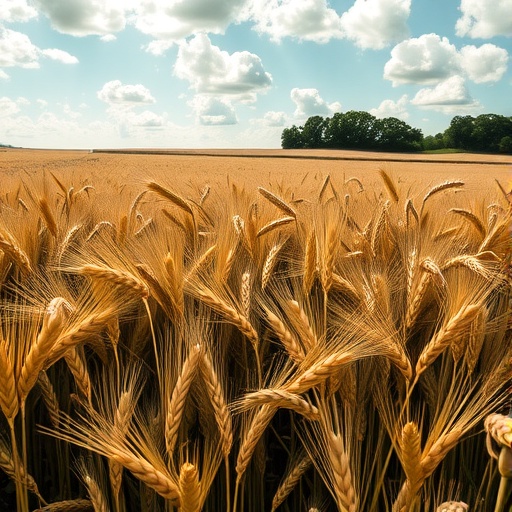
As the planet continues to warm, global agriculture faces an unprecedented challenge: sustaining food production in an environment increasingly hostile to traditional farming practices. Wheat, a staple crop providing sustenance for billions, is at the forefront of this threat. Rising temperatures, altered precipitation patterns, and the growing incidence of extreme weather events jeopardize wheat yields worldwide. However, a groundbreaking study by He, Ren, and Rosa offers a novel solution that could reshape the future of agriculture in a warming world: reclaiming abandoned croplands. Their research, published in Communications Earth & Environment in 2026, sheds light on a promising strategy to adapt wheat production amid climate change.
The planet’s cropland resources have been evolving over decades, influenced by economic shifts, population movements, and agricultural policies. Many fertile lands once cultivated have been left fallow or abandoned due to urbanization, soil degradation, or changing market dynamics. These lands, often neglected and underutilized, represent a vast reservoir of potential cropland. He and colleagues propose that rehabilitating these abandoned fields could offer a feasible path to offset some of the adverse impacts warming poses on wheat cultivation.
In making this case, the researchers conducted comprehensive assessments integrating climate models, land use data, and crop yield projections. They specifically focused on how temperature increases affect wheat development cycles and productivity across various geographic regions. Their models reveal that warming trends do not uniformly decrease wheat yields everywhere, but rather introduce spatial variability. Some current croplands will truly suffer yield penalties, but other areas, especially those currently too cold or marginal for wheat cultivation, might become more suitable. Here, the reclaimed abandoned cropland could play a critical role by expanding wheat-growing zones into climatically favorable areas that remain unused.
The process of reclaiming abandoned croplands is not simple, however. These lands often suffer from degradation issues such as soil nutrient depletion, erosion, or contamination. Remediation involves employing advanced soil restoration techniques including organic amendments, cover cropping, and erosion control, to restore soil health and fertility. Additionally, modern agronomic practices tailored for warming climates — such as drought-resistant wheat varieties and precision irrigation — are necessary to ensure that the reclaimed fields can be productive and resilient under future conditions.
An important aspect emphasized by the study is the temporal dynamic of abandonment and reclamation. Many lands have been abandoned for decades, allowing secondary succession and woody encroachment to occur, which can complicate efforts to return them to cropland. The authors suggest a phased approach, beginning with detailed site evaluations to determine specific remediation needs and potential yield outcomes. Such steps will optimize resource allocation and maximize the efficiency of restoration efforts. Importantly, leveraging remote sensing and machine learning technologies enhances the identification and monitoring of suitable abandoned lands, streamlining decision-making processes on large spatial scales.
The socio-economic dimension of cropland reclamation is equally vital. Changing land ownership and usage patterns present hurdles, yet opportunities exist as rural depopulation leaves some lands idle. Policy frameworks incentivizing reclamation, paired with investments in rural infrastructure, can catalyze the reintegration of these lands into food production systems. Moreover, this strategy aligns with broader sustainability goals: by expanding wheat cultivation without deforestation or conversion of natural habitats, it minimizes biodiversity loss and greenhouse gas emissions associated with agricultural expansion.
Climate change adaptation through cropland reclamation also contributes to food security, especially in vulnerable regions where warming is particularly intense and current croplands face diminishing returns. The research highlights zones in higher latitude countries and some previously marginal temperate regions where wheat production can be enhanced. This geographic redistribution of production may alleviate pressure on overstrained agricultural zones in lower latitudes, promoting global balance in cereal supply.
One striking implication of this study is its potential to redefine global agricultural land use paradigms. Instead of solely focusing on technological improvements within existing farms, it broadens the scope by reintegrating underexploited land resources. This approach affords a complementary pathway alongside conventional adaptation strategies such as genetic improvement and pest management. It encourages policymakers, scientists, and farmers to think expansively about land resource management in the Anthropocene.
The article also carefully addresses potential environmental trade-offs. While reclamation offers new cropland areas, it must avoid negative impacts like freshwater depletion or soil carbon loss, which would undermine climate goals. The authors advocate for integrated land management plans that balance crop production with ecosystem health, leveraging agroecological principles to maintain or even improve biodiversity, soil structure, and carbon sequestration capabilities on restored lands.
Technological innovation facilitates this reclamation vision. Advances in soil microbiome engineering, smart farming technologies, and climate-smart agronomy enable more effective and sustainable cropland recovery. For instance, deploying biofertilizers can accelerate soil restoration, while drones and satellite systems provide real-time data for adaptive management. The synergy between science and technology stands to transform abandoned croplands from liabilities into vital assets for food resilience.
With global food demand projected to rise sharply over the next decades, particularly for staple grains like wheat, timely action is paramount. This research suggests that leveraging abandoned croplands could substantially buffer against yield losses caused by warming alone. It promotes an optimistic scenario in which agricultural landscapes evolve dynamically to meet human needs despite climate adversity, balancing productivity with ecological stewardship.
While challenges remain—from policy coordination to technical implementation—the promise unveiled by He, Ren, and Rosa’s study marks a paradigm shift. It underscores how revisiting and reinvesting in previously forsaken lands can unlock hidden potentials critical to humanity’s food future. As the climate crisis unfolds, such innovative, integrative approaches will become increasingly indispensable.
In sum, reclaiming abandoned croplands emerges as a compelling strategy to adapt wheat production to a warmer world. By restoring degraded soils and realigning agricultural zones with shifting climatic envelopes, it supports sustained yields and global food security. This comprehensive investigation offers not only a blueprint for land restoration but a powerful testament to the resilience and ingenuity underpinning agricultural adaptation strategies in the face of global change.
Cite Scienmag News
Alan Morgan. (March 15, 2026). Reclaiming Abandoned Cropland to Boost Wheat Productivity. Scienmag. https://scienmag.com/reclaiming-abandoned-cropland-to-boost-wheat-productivity/
Alan Morgan. "Reclaiming Abandoned Cropland to Boost Wheat Productivity." Scienmag, 15 March 2026, https://scienmag.com/reclaiming-abandoned-cropland-to-boost-wheat-productivity/. Accessed 4 September 2026.
Alan Morgan. "Reclaiming Abandoned Cropland to Boost Wheat Productivity." Scienmag. March 15, 2026. https://scienmag.com/reclaiming-abandoned-cropland-to-boost-wheat-productivity/


